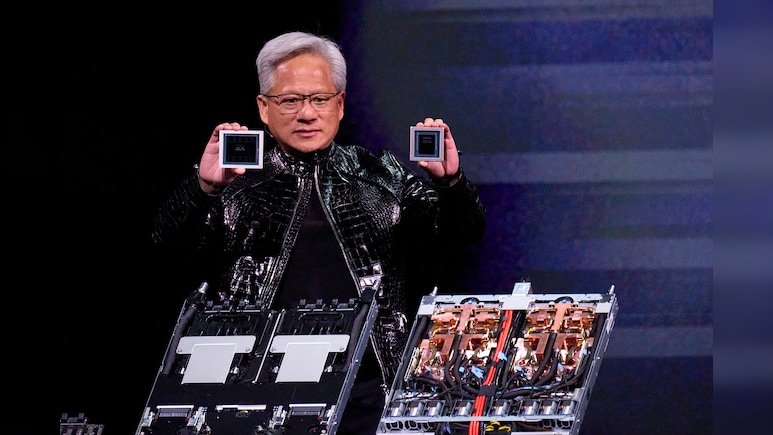
Nvidia Corp. failed to impress investors with its latest forecast, signaling that concerns about an overheated AI economy will continue to dog the company.
Fiscal first-quarter sales will be about $78 billion, the chipmaker said in a statement Wednesday. Though the average Wall Street estimate was $72.8 billion, some analysts had projected numbers approaching $80 billion, according to data compiled by Bloomberg.
After a remarkable run of sales growth, which turned Nvidia into the world's most valuable company, investors have proven harder to satisfy. Nvidia shares fell about 1% after the chipmaker delivered the outlook.
Also Read | Layoffs Are Rising In Tech, But These Skills Are Helping People Unlock Better Pay
The company is still contending with fears that a run-up in artificial intelligence spending isn't sustainable. Chief Executive Officer Jensen Huang has argued that the concerns are misplaced, saying it will take years to replace the world's installed base of older computers with machines that offer a leap forward in productivity.
“Our customers are racing to invest in AI compute — the factories powering the AI industrial revolution and their future growth,” Huang said in the statement.
But even Nvidia acknowledges that China is a big question mark. The company is still waiting for clarity on whether it's going to be able to do business in the country, the largest market for chips. A political standoff between Beijing and Washington has restricted Nvidia's ability to sell its best products to Chinese customers.
Nvidia said Wednesday that it wasn't including any China data-center revenue in its first-quarter sales outlook. The good news: The company indicated in a filing that it was granted a US license this month to ship “small amounts” of its H200 chips to customers in the Asian nation.
The license requires the chips to go through a US inspection before they can be shipped to customers, and they're subject to a 25% tariff when they come into the US, Nvidia said.
“To date, we have not generated any revenue under the H200 licensing program, and do not yet know whether any imports will be allowed into China,” Nvidia said.
ALSO READ: Nvidia Earnings Slam Into Market With No Patience For AI Hiccups
Nvidia is the dominant seller of accelerator chips, processors designed to handle the huge amounts of data needed to create artificial intelligence models. The semiconductors are also used to run the software — a stage known as inference — when it carries out tasks in response to real-world inputs. Nvidia has branched out into general-purpose processors, networking and full computer systems, giving it an even greater hold on customers.
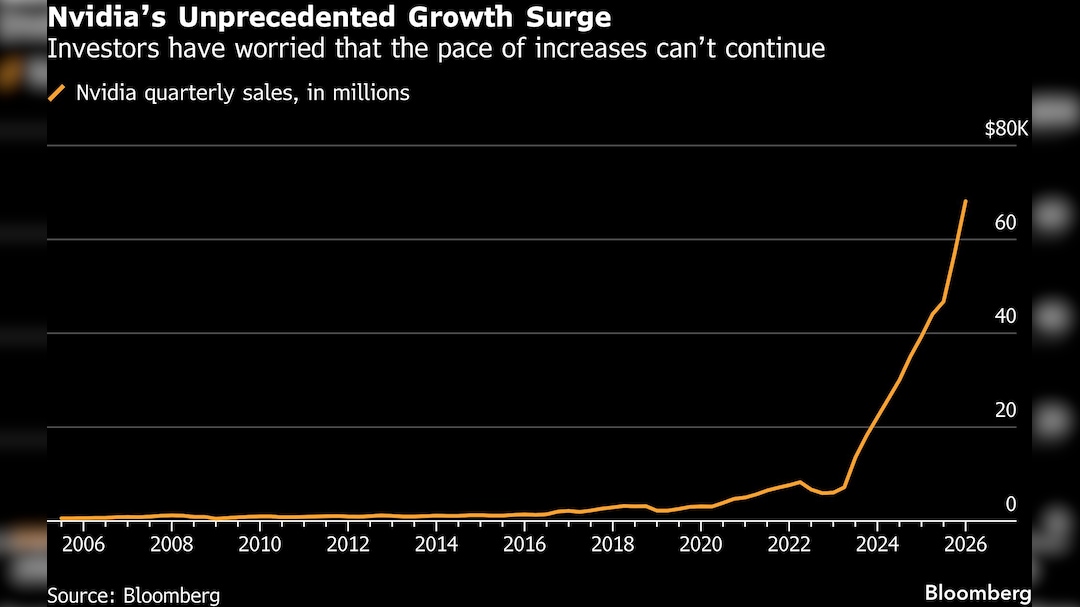
In the fiscal fourth quarter, which ended Jan. 25, revenue gained 73% to $68.1 billion. Profit was $1.62 a share, excluding certain items. Analysts had predicted $65.9 billion in sales and $1.53 a share in earnings.
Adjusted gross margin, the percentage of revenue remaining after deducting costs of production, was 75.2%. That also edged past estimates.
One cloud hanging over the tech industry: a shortage of memory chips. Like much of the electronics industry, Nvidia's products are reliant on a steady supply of these components, which provide short-term storage in everything from smartphones to supercomputers. Supply constraints have sent memory prices soaring and made it harder to ship as many devices this year.
READ MORE: The ePlane Company Partners With NVIDIA To Develop India's First Electric Air Taxi
Santa Clara, California-based Nvidia said the company has enough supplies in general. “We have strategically secured inventory and capacity to meet demand beyond the next several quarters,” it said.
Nvidia's data-center unit, which is responsible for its industry-leading AI accelerator and networking products, had revenue of $62.3 billion in the quarter. That compares with an average analyst estimate of $60.4 billion.
Other areas weren't as strong. Gaming, which offers graphics chips that once provided the majority of Nvidia's revenue, generated $3.73 billion in sales. The average estimate was $4.01 billion. Automotive-related sales were $604 million, with Wall Street predicting $643 million.
Earlier this month, Nvidia announced that Meta Platforms Inc. has agreed to deploy “millions” of Nvidia processors over the next few years, tightening an already close relationship between two of the biggest companies in AI. Nvidia's main rival, Advanced Micro Devices Inc., announced this week a similar long-term deal with Meta. That chipmaker said the transaction would be worth multiple tens of billions of dollars.
READ MORE: Does Crypto Rally Every Ramadan — And What's The Outlook For This One?
A flurry of such megadeals, aimed at locking down long-term commitments for computing capacity, has been offered by the chipmakers as evidence that the AI economy is strong. But the cozy nature of these transactions — with suppliers and customers sometimes taking financial stakes in one another — has drawn criticism about circular deals potentially inflating demand.
Essential Business Intelligence, Sharp Market Insights, Practical Personal Finance Advice, Daily Fuel, Gold and Silver Prices and Latest Stories — On NDTV Profit.