Indian markets are seeing some pressure again in Friday's trade after a brief period of recovery earlier this week, amid renewed geopolitical tensions in the Middle East. As of 2:30 pm, Nifty is trading around 1.77% lower at 23,219 and Sensex is trading 1.67% lower at 74,775.
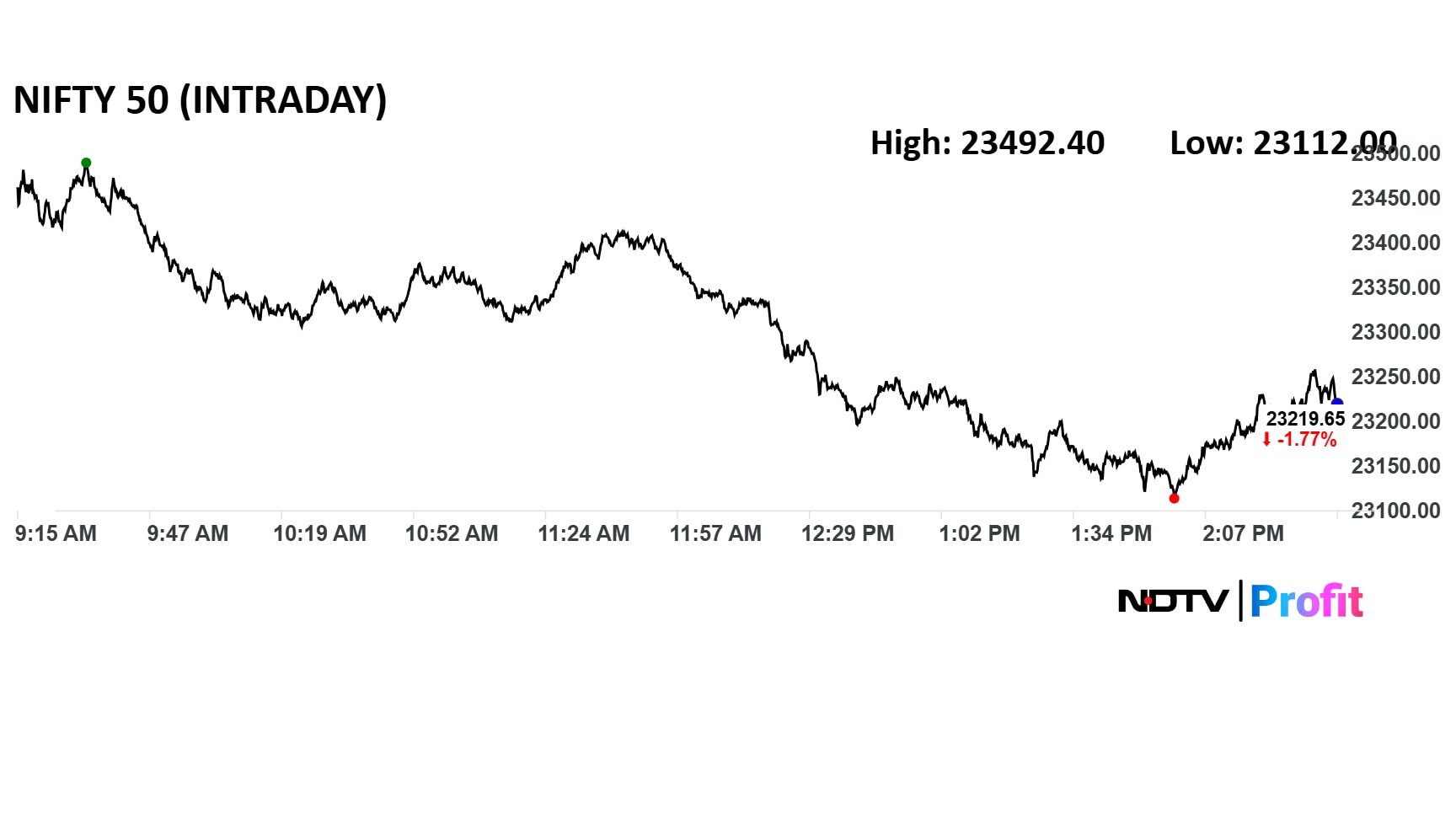
Nifty extended its losing streak for the third straight week, marking a sharp downturn in the markets. The index slipped more than 5% over the week, its steepest weekly decline since April 2025.
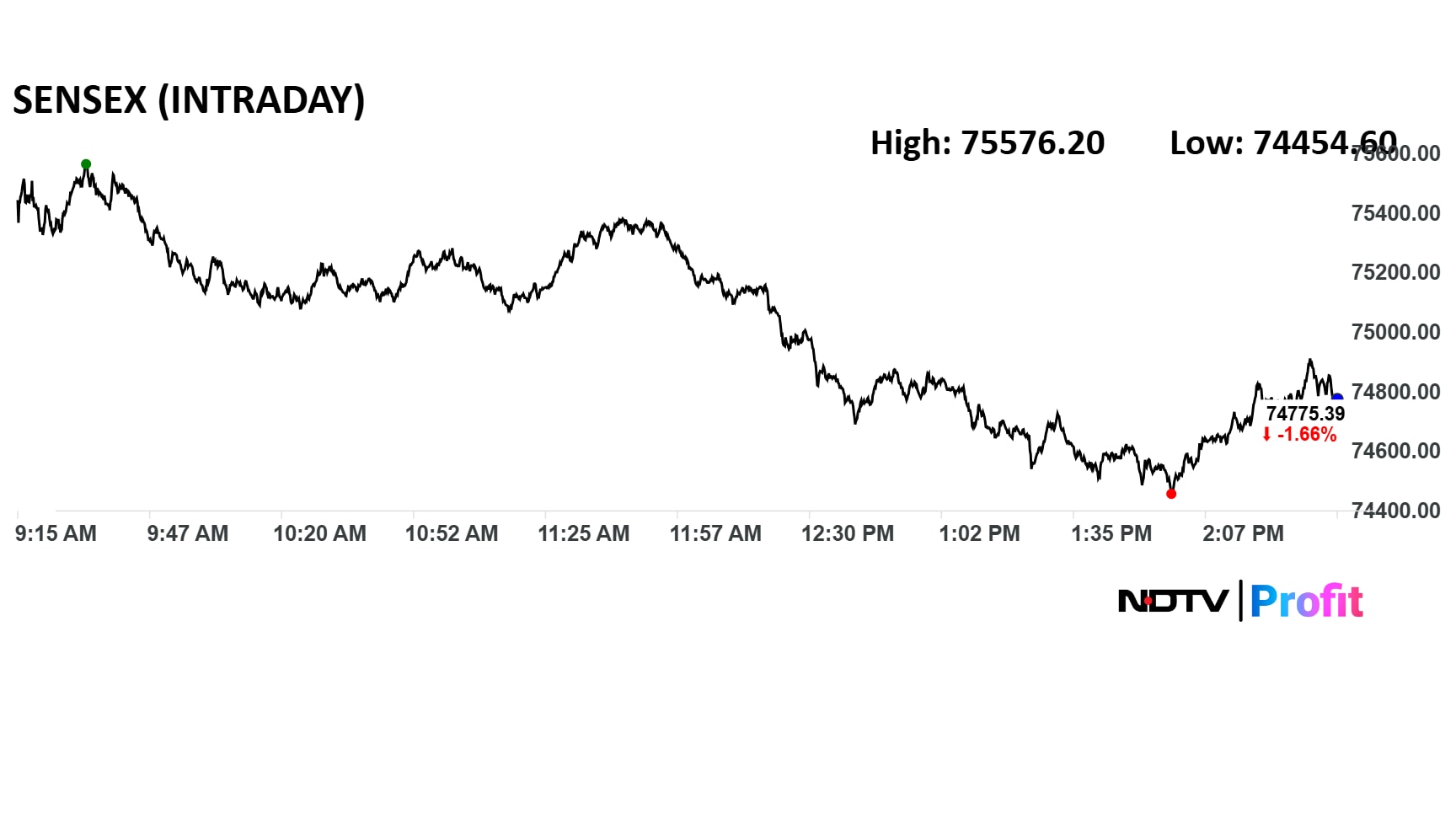
This selloff erased nearly Rs 10 lakh crore in market capitalisation and dragged the index down by over 1,200 points. Market sentiment remained fragile, reflected in the fact that 14 of the Nifty 50 stocks touched new 52‑week lows during the week.
Also Read | Layoffs Are Rising In Tech, But These Skills Are Helping People Unlock Better Pay
All sectors are trading in the red, with Metal leading the losses by nearly 4.5%. All bank stocks part of the Nifty Bank Index are down. Punjab National Bank and IndusInd Bank were the top losers. On the Nifty 50, HDFC Bank and ICICI Bank were the top drags in terms of points.
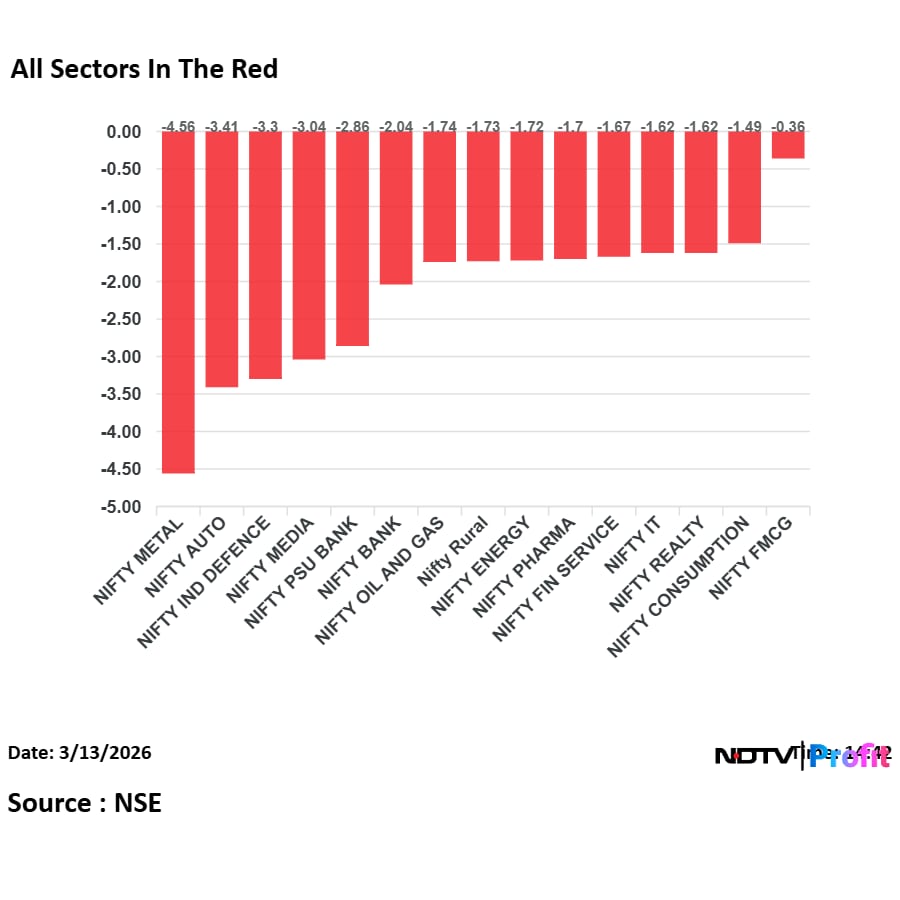
Pain is also witnessed in the broader markets, with Nifty Midcap 150 trading with cuts of 2.45%, and the Smallcap 250 index is trading with cuts of 2.02%.
The blue-chip Nifty 50 index is down 3,000 points from its all-time high of 26,328.55 on Jan 2, marking one of the worst starts to a year for Indian stock markets. As per an NDTV Profit calculation, this has led to an erosion of over Rs 24 lakh crore in market capitalisation. During the same phase, the 30-stock BSE Sensex is down nearly 10,700 points from the high of 85,762 hit on the same day.
Here are three reasons why markets are falling in trade today.
Weak Global Cues
Asia-Pacific markets are trading lower Friday as oil prices soared on renewed fears that a prolonged conflict in the Middle East could further crimp energy supplies, stoking fears of a global economic downturn. A gauge of Asian shares dropped 0.5% in early trading. Japan's Nikkei 225 dropped 2% while the broad-based Topix fell 1.4%. South Korea's blue chip Kospi slumped almost 3%. Hong Kong's Hang Seng index fell 0.7%.
Major stock indexes also notched closing lows for 2026, with the Dow Jones Industrial Average falling nearly 740 points to settle below 47,000 for the first time this year. The S&P 500 shed 1.5% to end the session at 6,672.62, while the Nasdaq Composite lost 1.8% to close at 22,311.98.
Get all the latest market updates here.
Middle East Tensions
Friday marked the 14th day of the US, Israel-Iran conflict and no indication of de-escalation is visible from either ends. The US Treasury Department announced it was taking steps to further ease sanctions on Russian oil as crude prices surge during the Iran war. The agency said that it was granting a license that authorises the delivery and sale of some sanctioned Russia crude oil and petroleum products for the next month.
Iran's secretive new leader issued his first public statements resolving to keep fighting, promising more pain for Gulf Arab states and threatening to open “other fronts” in a war that has already disrupted world energy supplies, the global economy and international travel.
The hard-line stance revealed by Supreme Leader Ayatollah Mojtaba Khamenei came as Israeli Prime Minister Benjamin Netanyahu said his country's attacks were creating conditions for the Iranian population to topple the government.
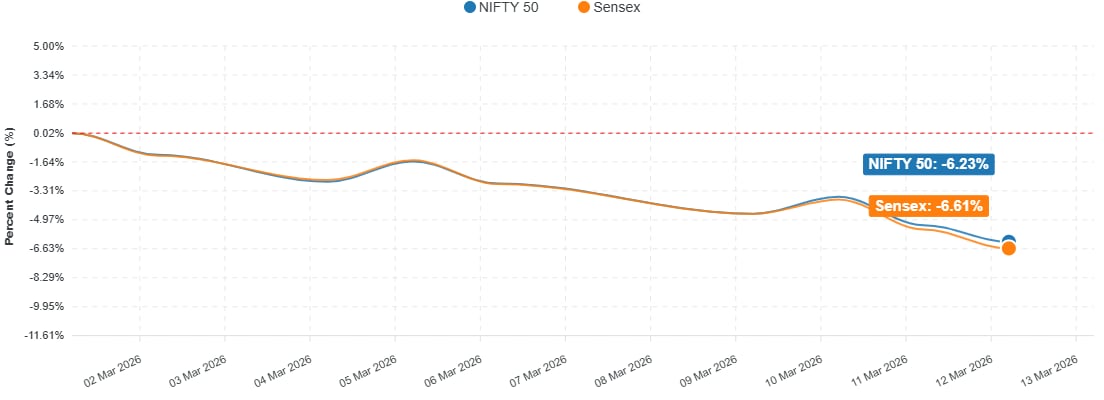
Nifty and Sensex have fallen nearly % since the start of the start of the conflict in the Middle East.
Nifty and Sensex since March 2, 2026.
Get all the latest updates on US, Irsrel-Iran war here.
Crude Prices
Global oil markets remain on edge after one of the most turbulent trading weeks in years, with Brent crude hovering near the $100-per-barrel mark as tensions around the Strait of Hormuz intensify.
The international benchmark eased slightly after surging more than 9% in the previous session, while US crude benchmark West Texas Intermediate traded close to $96. The sharp moves reflect growing concerns about supply disruptions as geopolitical tensions escalate in the Middle East.
"Going ahead, 23,550–23,500 will act as a key support zone for the index. A sustained move below 23,500 could trigger further downside towards the 23,350 level," according to Sudeep Shah, head of technical and derivatives research at SBI Securities. On the upside, 23,800–23,850 remains an immediate resistance zone, while a decisive breakout above 23,850 may lead to pullback rally towards the 23,970–24,000 zone.
Meanwhile, Gaurav Udani, Founder of Thincredblu Securities says, "From a technical standpoint, the 23,200 level could act as an important support zone for Nifty in the near term, while 23,600 is likely to act as immediate resistance on any recovery attempt. Given the uncertain geopolitical backdrop, traders should remain cautious and prioritise risk management, as markets are likely to witness elevated volatility in the coming sessions."
ALSO READ: Brent Crude Near $100 As Hormuz Crisis Deepens, Markets Brace For Supply Shock
Essential Business Intelligence, Sharp Market Insights, Practical Personal Finance Advice, Daily Fuel, Gold and Silver Prices and Latest Stories — On NDTV Profit.