Oil Holds Sharp Drop After US Stockpiles Expand To 10-Month High

(Bloomberg) -- Oil held the bulk of a large drop amid a slew of conflicting signals that ranged from rising stockpiles to tensions in the Middle East and the reimposition of US sanctions on Venezuelan crude.
Global benchmark Brent traded below $88 a barrel after slumping by 3% on Wednesday, while West Texas Intermediate was near $83. US crude inventories rose by 2.7 million barrels last week, hitting the highest level since last June, while gauges of fuel demand declined.
The weak US data overshadowed the impact of geopolitical tensions in the Middle East as traders await Israel's response to Iran's unprecedented recent attack. At present, there's a premium of $5 to $10 a barrel baked in, but without escalation, prices may fall, Goldman Sachs Group Inc. said
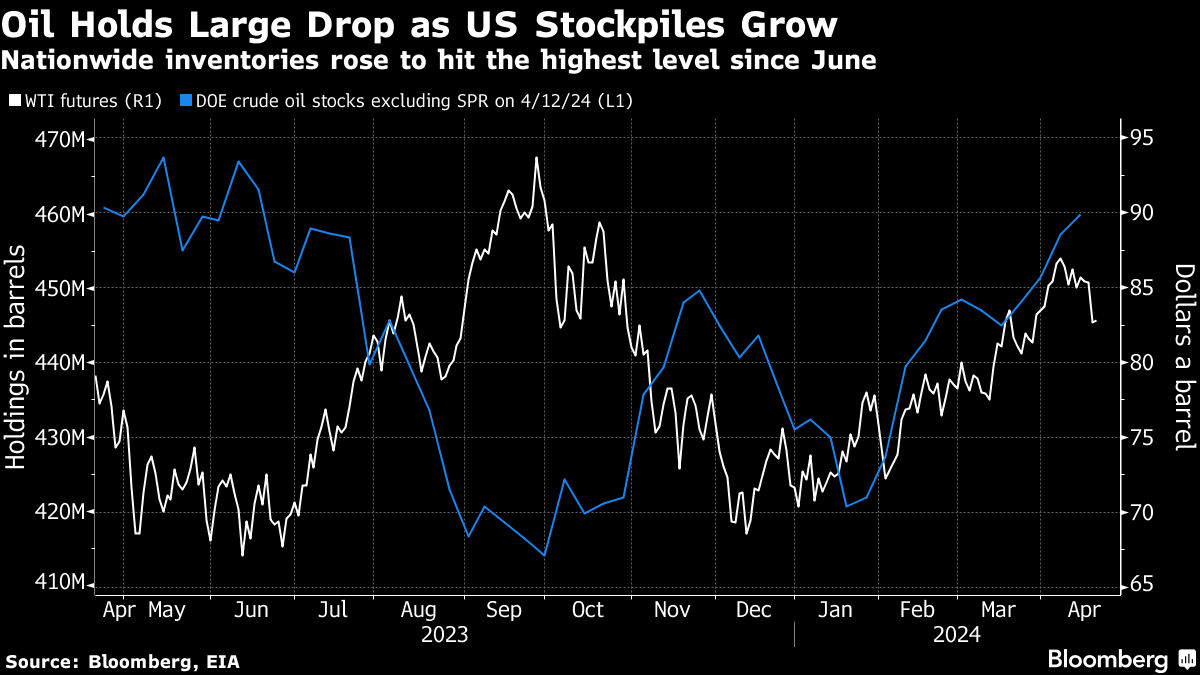
US sanctions were also in focus. President Joe Biden's administration has reimposed restrictions on Venezuelan oil, ending a six-month reprieve in a move that may hamper flows from the South American nation. At the same time, new sanctions on Iranian oil were included as part of a foreign aid package released by House Republicans that is slated for a floor vote later this week.
Oil remains comfortably higher year to date as supply cuts by OPEC+ members and geopolitical risks in the Middle East and Russia have combined to aid prices. The run-up had ignited speculation that crude may regain $100 a barrel, although the ascent has now faltered, with some market metrics including timespreads pointing to slightly less tight conditions.
“The market appears to have discounted the possibility of an Israeli retaliation to Saturday's Iranian attack,” said Vandana Hari, founder of Vanda Insights. The midweek drop suggests “that the latest bout of risk premium from heightened Israel-Iran tensions has eroded,” she said.
More stories like this are available on bloomberg.com
©2024 Bloomberg L.P.

-
Getting To Work Costs Women More | The Reason Why

It is not just about women paying more than men. It is about women paying much more in cities than in villages.
-
AI Bias In Investing Cannot Be Eliminated, But It Can Be Governed
Framing is a particularly important example as identical financial information presented in terms of gains rather than losses can lead an LLM to reach a different assessment.
-
Joining The Dots | Dark Skies, Steady Diya: Why Hope Holds This Diwali
With war, a weak rupee and foreign outflows weighing on sentiment, policymakers at the NDTV World Summit and market veterans at NDTV Profit Ignite: Diwali Edition offered the same advice: stay invested and filter out the noise.
-
The Curious Case of Equitas Small Finance Bank And A CEO Who Quit For Stock
PN Vasudevan believes persistent investor concerns over a perceived conflict of interest had become a governance overhang on Equitas Small Finance Bank's stock, even as the lender improved profitability and asset quality.
-
Talking Points This Week: AI Cash Burn, A Tiger Comeback And An India That Still Finds Its Own Path
India is not immune to higher oil or tighter global liquidity, yet its earnings base is broader, its domestic policy levers are still available.
-
Foreign Investors Own Half Of HDFC Bank and ICICI Bank. An LTCG Cut Could Matter Most Here
Foreign portfolio investors have US$115 billion parked in HDFC Bank, ICICI Bank. If the government cuts long-term capital gains tax, Jefferies says returning foreign money could land here first.
-
'Never Seen This Level Of Negativity': Sandeep Tandon Says The Next Rally May Be Closer Than You Think
Veteran investor Sandeep Tandon says foreign selling is easing, large-caps are due a comeback and mid-caps are crowded, while he turns positive on gold, power and pharma this Diwali.
-
Indians Stay With Family, Not In Hotels | The Reason Why
India still lacks enough clean, reliable and affordable hotels for budget-conscious travellers.
-
The Economic Imperative: Analysing The Material Driving Force Behind India-Canada Strategic Reset
This economic complementarity is further reinforced by deep institutional investment ties and talent mobility, which form the bedrock of the bilateral framework.
-
Medicine Pricing: Where Must Profit Stop?
India must confront excessive margins, hidden incentives and regulatory gaps that threaten the integrity of medicine.










