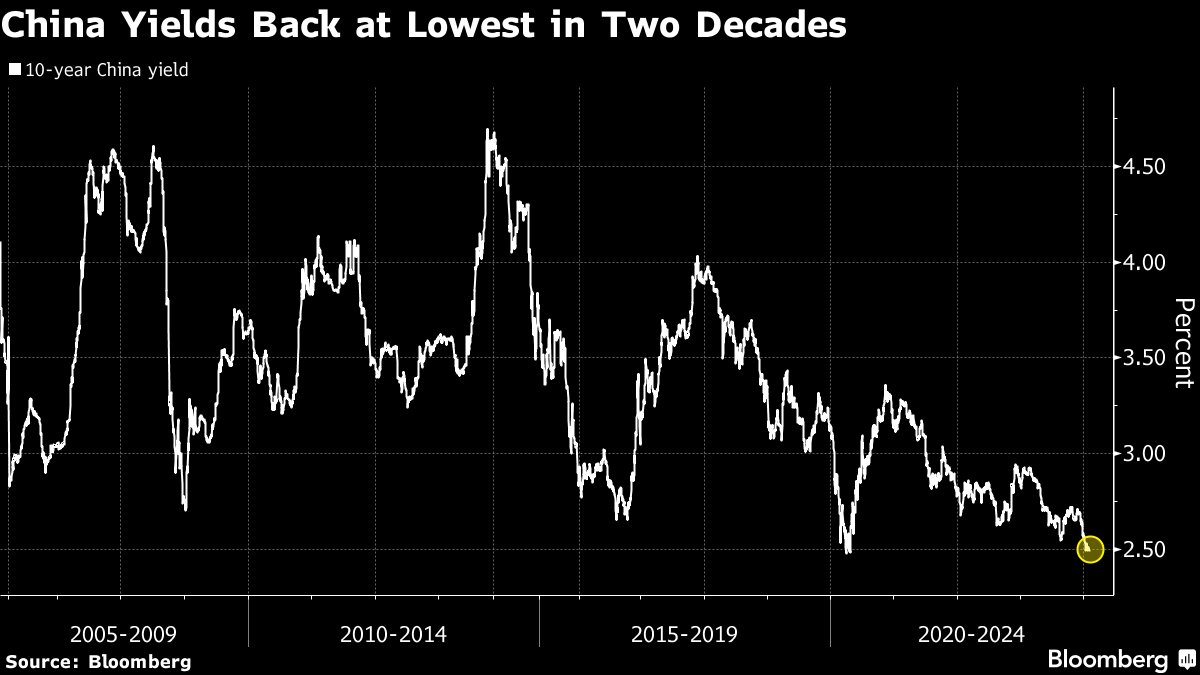
(Bloomberg) -- China's benchmark government bond yield fell to its lowest in nearly 22 years on mounting expectations for further monetary easing amid a fragile economic recovery and stock-market selloff.
The yield on the 10-year sovereign note slipped to 2.47%, a level unseen since 2002. The world's second-largest economy is suffering from an extended housing slump and its stock market is under pressure from weak investor sentiment, leading to calls for policymakers to deploy more monetary stimulus to boost growth.
Demand for haven assets is on the rise amid expectations that the economy will continue to be pressured by weak consumption and the property downturn. Beijing is already starting to loosen its monetary policy in a more aggressive way, as it surprised the market by cutting the mount of cash banks need to set aside as reserves last week.
“The pressure is definitely for yields to go lower” due to expectations for an interest rate cut, said Woei Chen Ho, economist at United Overseas Bank. “For longer term yields, the market is also pricing the expectation that growth in the coming years will settle into a lower range.”
While concerns about currency volatility and uncertainty over when the Federal Reserve would start cutting US interest rates are considered to have limited the PBOC's room for easing, it last week noted signs of an impending pivot stateside.
The narrowing of divergent policies between the world's two largest economies “will expand space for China's monetary policy operations,” the PBOC Governor Pan Gongsheng said, adding that the nation's financial risks are manageable
“Market expectation for a rate cut in February is gaining traction, especially after PBOC's surprising announcement to cut the reserve-requirement ratio,” said Ming Ming, chief economist at Citic Securities.
China's government bonds have outperformed in a global debt selloff with the 10-year yield down 8 basis points since the start of the year. The US Treasury equivalent is up almost 20 basis points.
Bond Buyers
Amid a slew of steps to bolster sentiment, Beijing has also pledged to open up its bond trading toolbox to overseas investors this month, a move which should expand the universe of potential buyers. Officials vowed to expand foreign access to the onshore market in so-called repurchase agreements — a popular instrument for traders to borrow and lend short-term funds using yuan bonds as collateral.
Funds are flowing into bonds at a time investors are souring on stocks. Bond funds raised 13 times the capital garnered by their equity counterparts in December, according to third-party data collated by China analysis firm Z-ben Advisors Ltd.
And while yuan liquidity typically tightens ahead of the Chinese New Year as residents take out cash for gifts and travels, such pressure has remained muted so far thanks to the reserve ratio cut and PBOC's injections of short-term funding. That means commercial lenders — the biggest investors of government bonds — also have more cash available to buy such notes.
“Liquidity remains flush and the prospect of further easing by the People's Bank of China, including policy rate cuts, is becoming a consensus,” said Kiyong Seong, lead Asia macro strategist at Societe Generale SA. However, “the scale and pace of China rates rally will likely remain very moderate.”
--With assistance from Shulun Huang and Qizi Sun.
(Updates with additional context on liquidity.)
More stories like this are available on bloomberg.com
©2024 Bloomberg L.P.
Essential Business Intelligence, Continuous LIVE TV, Sharp Market Insights, Practical Personal Finance Advice and Latest Stories — On NDTV Profit.