Natalia Bertran was ready to spend as much as $90,000 on her son's first year in college. When the time came, most of it went to a gap year instead. Rather than move her older son into a dorm last fall, Bertran saw him off at the airport for an eight-month trip around the world with Baret Scholars. The $94,500 program pitches itself as more than time off from school, when students ages 17 to 22 spend “a year very much on.”
Bertran's son bungee jumped near the Victoria Falls in southern Africa, visited the Brazilian bank Itau Unibanco and coded an app — all before heading to Bocconi University in Milan in August.
“It was of course expensive,” Bertran said. “But it was reasonable based on what they got.” Baret knocked down the tuition price, but altogether with travel costs and spending money, she spent about $80,000.
Also Read | Layoffs Are Rising In Tech, But These Skills Are Helping People Unlock Better Pay
Still, she believes the experience delivered something college could not. “I can guarantee he learned more that year than in a year of university.”
Premium gap years are becoming more appealing as families question whether a college degree alone — or one from anything but a top-tier school — is enough to stand out. Parents are willing to spend sometimes more than a year of tuition to help compensate for what they fear college may not provide. Whether the immediate goal is a stronger college application, a better resume or more direction, parents see this as yet another way to prepare their kids for a cutthroat job market.
What families get for that investment is hard to measure. A 2020 analysis by researchers at Colorado College and the University of North Carolina at Chapel Hill found that students who took gap years earned higher college GPAs, but they were also more likely to come from affluent households and attend more rigorous high schools.
To properly control for those from different backgrounds, studies would have to randomly assign students to programs, said Sandy Baum, a nonresident senior fellow at the Urban Institute who studies access to higher education.
“If what the program does — aside from being incredibly enriching and teaching you to be a better student — is improve your resume and get you into a better college, that in and of itself is going to improve your outcome, regardless of what the program did,” she said.
The lack of hard evidence hasn't stopped families from buying in. Bertran, in fact, is sending her younger son on a Baret program in September, deferring his first year at Purdue University.
Membership in the Gap Year Association, a nonprofit that sets industry standards, has doubled in six years to nearly 90 programs, driven in part by new, high-end offerings. Some providers say they are also seeing stronger demand. EnRoute Consulting hit its capacity — around 50 students — for the first time since 2021, while applications to Baret nearly doubled to about 750 for its upcoming cohort. Tilting Futures, meanwhile, drew more than 18,000 applications to its $21,000-a-semester Take Action Lab, launched in 2023.
When Holly Bull started as a gap-year consultant 40 years ago, it wasn't uncommon for students to spend a year following bands like the Grateful Dead and Phish or working on a ranch. In recent years, she's noticed that students and parents want more structure.
She's long had a sample itinerary that she shares with families: a facilitated group program from September through December, a winter break, a fee-based work placement, internship or volunteer position in the spring and independent travel during the summer.
“Especially right now, there's a lot more tentative energy and the need for a little bit more scaffolding and support,” said Bull, who runs the Center for Interim Programs.
The shift toward more structured, closely supervised programs comes with higher costs. Bull's sample itinerary generally costs between $20,000 and $25,000, excluding some travel and spending money, plus her $2,800 consulting fee.
Some families are prepared to spend much more. At Dynamy Internship Year, a work-focused program in Worcester, Massachusetts, a full year of internships, advising and housing costs $38,650, up 31% since 2020. (Its admissions director attributes the uptick to rising operational costs.) Futures Forge, meanwhile, plans to charge roughly $82,000 for a forthcoming program combining international travel, a 12- to 20-week work placement and a 12-week skills boot camp. Founder Nathaniel Greene said consultants told him he could charge closer to $120,000.
Cheaper options are harder to find. Federal budget cuts slashed funding for the AmeriCorps National Civilian Community Corps service program and the Peace Corps. Higher costs for flights, lodging and insurance have pushed programs that charged $10,000 closer to $20,000, according to the Gap Year Association's interim executive director Jason Sarouhan.
“I do frame it as an investment,” said gap year consultant Julia Rogers, founder of EnRoute. The typical gap year she helps families plan costs between $30,000 and $35,000. That includes a structured program for a semester followed by volunteering, travel or work for the latter half.
“It's such a boutique experience that you're getting for less than college,” she said.
But these programs aren't colleges. They operate outside the academic accreditation system that governs higher education. Programs must meet professional, content and safety standards to be accredited by the Gap Year Association.
With Americans' faith in higher education falling, that might be part of the appeal. Only 38% say they have a great deal or quite a lot of confidence in higher education, down from nearly 60% in 2015, according to a Gallup poll released in July.
Value and workforce preparation are major concerns. Some 22% of Americans say a four-year degree is worth the cost even if attending requires taking out loans, while nearly half say such a degree has become less important for securing a well-paying job, according to a 2024 Pew Research Center survey.
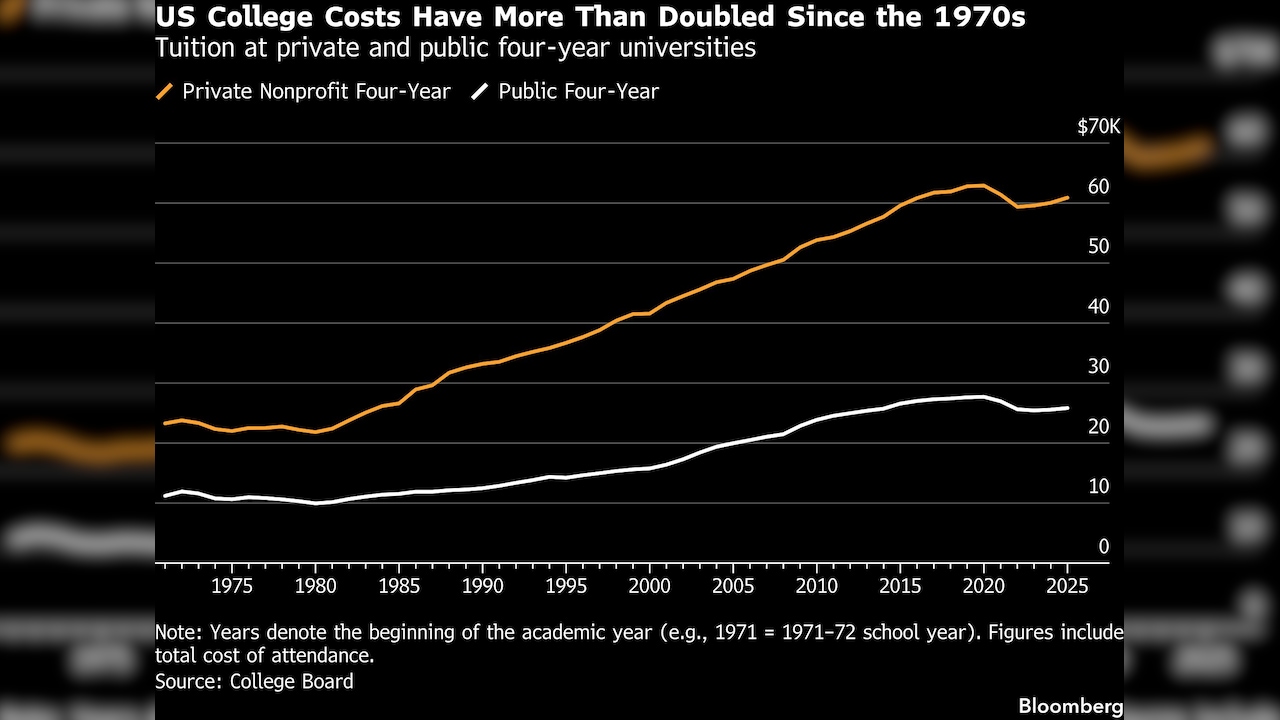
US College Costs Have More Than Doubled Since the 1970s
Photo Credit: (Photo: Bloomberg)
The average tuition for a private four-year university rose to almost $61,000 for the 2025-26 school year, up 13% since 2010, according to the College Board's latest pricing report. At top schools including Duke, Columbia and Brown, the price tag is approaching $100,000 for the upcoming academic year.
Falling faith in college hasn't made families abandon higher education. For some, it has made getting into the “right” college feel even more important. Olivia Centeno hoped a gap year would help her get into a more competitive college. When she got waitlisted by Duke University, she decided to take a gap year with Baret and reapply. She submitted a personal essay about her travels through the Amazon rainforest and, on her second try, got in.
Daniel Sobel, a business analytics major at Boston College, said he had been following a conventional career path without understanding why. Rather than keep spending money on a degree before he knew what he wanted from it, he began to see time away as an investment in figuring that out. While researching MBA programs, he noticed that some students had done gap years.
His parents paid about $15,000 for a semester in Malaysia through Tilting Futures, where he worked in conservation and event planning. Then he took off another semester for an internship. Students can receive college credit through Tilting Futures programs. Sobel still had to push his graduation back a year.
“College is valuable, but it becomes so much more valuable when you actually have experiences to apply to it,” he said. “You need inspiration outside of what's been curated for you.”
(This story has not been edited by NDTV staff and is auto-generated from a syndicated feed.)
Essential Business Intelligence, Sharp Market Insights, Practical Personal Finance Advice, Daily Fuel, Gold and Silver Prices and Latest Stories — On NDTV Profit.