
- 77% of Indian firms see AI changing office needs, but only 19% have acted on it
- Skills shortages (46%) now surpass budget limits (35%) as AI adoption barriers
- 58% of leaders expect workforce growth; 62% say AI enhances human roles
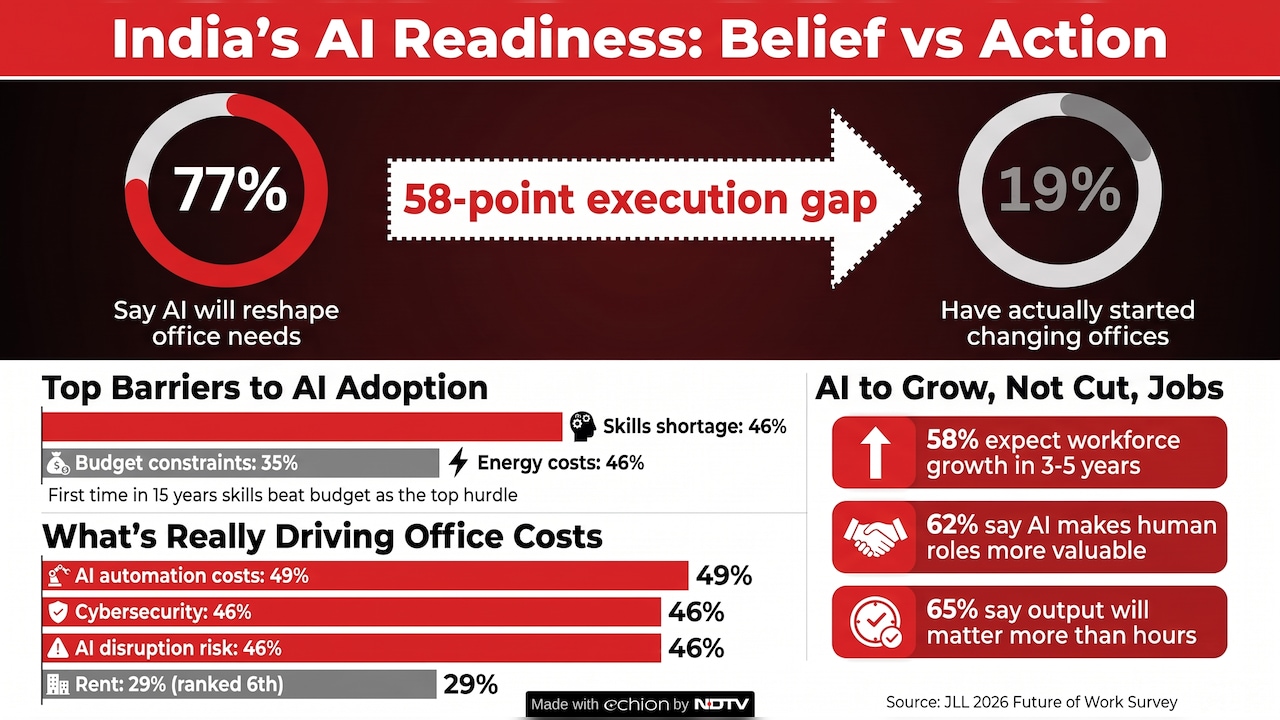
A wide gap has opened up between intent and action on artificial intelligence among Indian companies, with 77% of business leaders saying AI will change what they need from their office space, while only 19% have actually started making those changes, according to JLL's 2026 Future of Work Survey.
India leads the world on all eight AI readiness measures tracked by JLL, the report showed, with Indian firms ahead of the global average on tracking AI trends, studying its impact on real estate teams, staff training and scouting new locations as automation spreads. Nearly one in five Indian companies (19%) said they had reached the most advanced stage of using AI in real estate operations, against 15% globally, and 47% were actively rolling out AI, compared with 42% worldwide.
Skills, not budget, have now emerged as the biggest obstacle to execution. For the first time in JLL's 15-year survey history, capability constraints outweighed cost constraints in India, with 46% of companies citing an AI, technology and data skills shortage as their primary limitation, against 35% citing budget. This gap was more acute in India than the Asia Pacific average of 42% and the global average of 36%.
AI adoption in the real estate space, especially office readiness has a long way to go.
Photo Credit: NDTV Profit
AI To Grow, Not Cut, Jobs
Despite the disruption AI is expected to bring, most Indian business leaders do not see it as a threat to headcount. The survey found that 58% of senior leaders anticipate workforce growth over the next three to five years, while 62% said AI would make human roles more valuable rather than replace them. A further 65% said staff would increasingly be judged on the quality of their work rather than hours logged.
ALSO READ: Bengaluru Home Sales Surge 16% But Hyderabad Slips 3% In H1 2026
Even so, cost pressures are mounting in unexpected places. Energy bills and AI automation costs, both cited by 49% of companies, are expected to be the biggest drivers of rising office expenses over the next three to five years, JLL found. Rent ranked only sixth on that list at 29%, a marked shift from how office costs have traditionally been structured.
"What separates the 19% who have begun implementation from the 77% who recognise the need is not conviction or capital, it is capability," said Ajit Kumar, Managing Director, Work Dynamics Accounts, West Asia, JLL. "The companies that reframe this as a skills development challenge rather than a budget constraint will define India's workplace transformation over the next decade," he said.
Office attendance policies have also held firm, with Indian companies asking staff to come in 3.8 days a week on average, slightly above the global average of 3.7 days, and 62% requiring four to five days in office.
ALSO READ: Shah Rukh Khan's Mannat: How A Rs 18 Crore Dream Home Became A Rs 300 Crore Mumbai Landmark
Essential Business Intelligence, Sharp Market Insights, Practical Personal Finance Advice, Daily Fuel, Gold and Silver Prices and Latest Stories — On NDTV Profit.