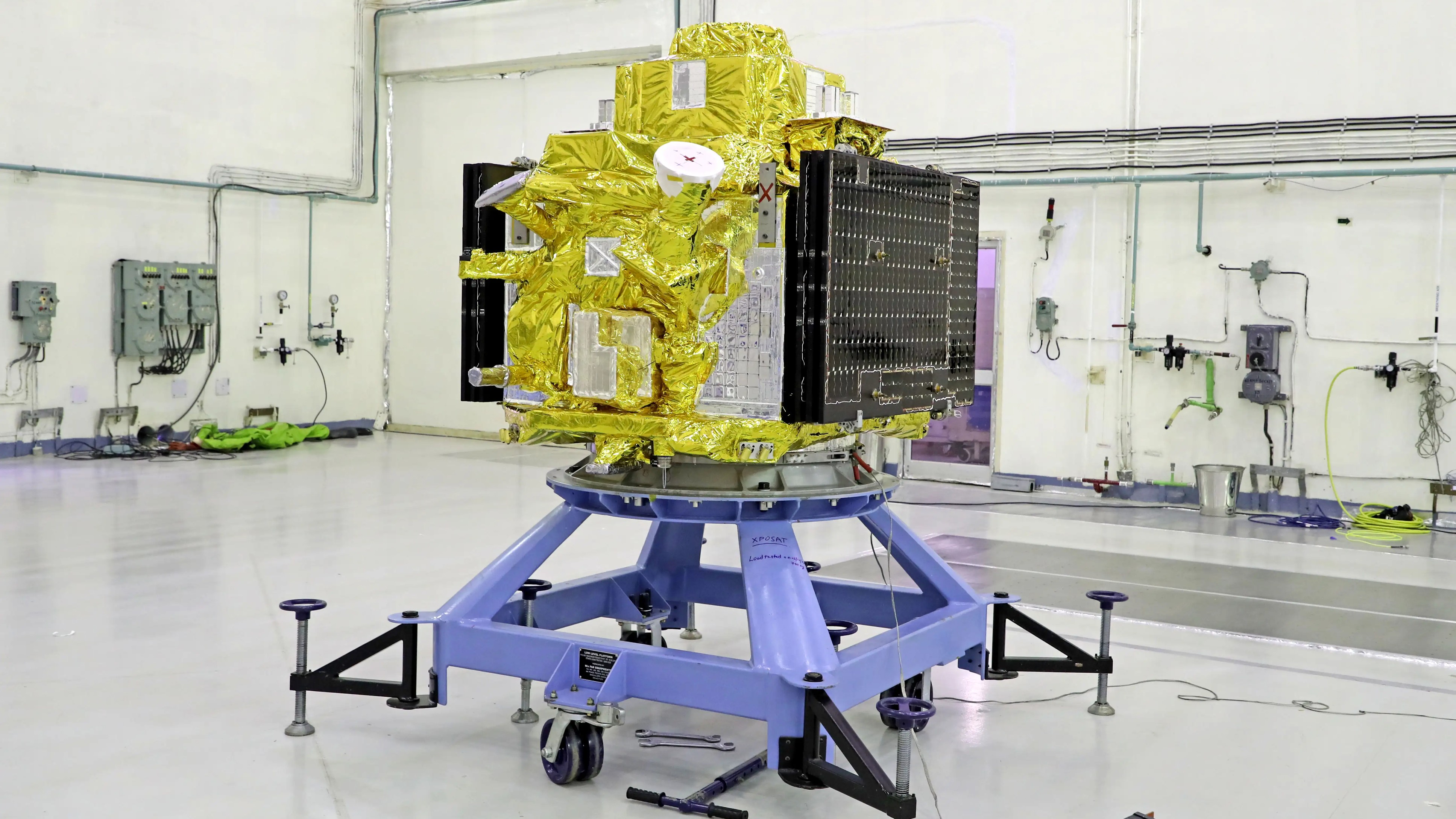
The Indian Space Research Organisation (ISRO) is likely to launch its X-ray Polarimeter Satellite (XPoSat) mission on January 1. According to ISRO, this is India's first dedicated polarimeter mission where the satellite will study different dynamics of bright astronomical X-ray sources under extreme conditions.
As per reports, the XPoSat million will lift off at 9:10 AM using a Polar Satellite Launch Vehicle (PSLV).
The spacecraft will carry two payloads in a low earth orbit. The primary payload POLIX (Polarimeter Instrument in X-rays) will measure the polarimetry parameters (degree and angle of polarization) in medium X-ray energy range. The second payload, XSPECT (X-ray Spectroscopy and Timing), will provide spectroscopic information.
The mission is important as it will provide groundbreaking information to enhance the understanding of the astronomical realm.
The emission mechanism from various astronomical sources such as black holes, neutron stars, active galactic nuclei, pulsar wind nebulae etc. originates from complex physical processes and are challenging to understand. Although current space observatories offer insightful data, it is a struggle to determine the precise nature of emissions from these sources.
India's XPoSat mission will capture the degree and angle of polarisation, adding two significant elements to the process of understanding these phenomena.
"The polarimetric observations, along with spectroscopic measurements, are expected to break the degeneracy of various theoretical models of astronomical emission processes. This would be the major direction of research from XPoSat by the Indian science community," said ISRO about the mission.
XPoSat Mission Objectives
The mission objectives include:
Measurement of X-Ray polarization in the energy band of 8-30 keV emanated from X-Ray sources
Long-term spectral and temporal studies of cosmic X-Ray sources in the energy band of 0.8-15 keV.
The mission life is expected to be approximately five years. The payloads onboard XPoSat will observe the X-ray sources during its transit through the Earth's shadow, i.e., during the eclipse period.
XPoSat Payloads
POLIX: This is an X-ray Polarimeter for astronomical observations in the energy band of 8-30 keV. The payload is being developed by Raman Research Institute (RRI), Bengaluru, in collaboration with U R Rao Satellite Centre (URSC). This is the first payload in the medium X-ray energy band dedicated for polarimetry measurements.
XSPECT: This is an X-ray SPECtroscopy and Timing payload onboard XPoSat, which can provide fast timing and good spectroscopic resolution in soft X-rays.
Essential Business Intelligence, Continuous LIVE TV, Sharp Market Insights, Practical Personal Finance Advice and Latest Stories — On NDTV Profit.