33 Years On, Bhopal Gas Tragedy Survivors Still Await Adequate Payout
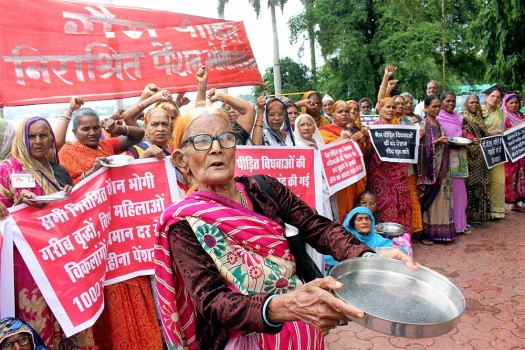
Thirty-three years after the Bhopal gas tragedy, survivors are still fighting for adequate compensation and proper medical treatment for ailments caused by the toxic leak.
Families of the deceased and people who bore the brunt of the industrial disaster are now signing a petition, to be sent to the Supreme Court, requesting it to start hearing a curative petition of the government filed in December 2010 for more compensation.
The U.S. company which then owned the chemical plant in Bhopal, from where the poisonous gas leaked in 1984, has not yet adequately compensated the victims, a Madhya Pradesh minister said.
The victims of the ‘world's worst industrial disaster' had not been paid adequately by U.S.-based Union Carbide Corporation (UCC) now owned by Dow Chemical, Madhya Pradesh's Bhopal Gas Tragedy Relief and Rehabilitation Minister Vishwas Sarang told PTI.
He alleged that the then Central government led by the Congress was more interested in helping the multi-national company rather than bringing it to book.
The Central and the state governments, both led by the Congress, helped the then Union Carbide chairman, Warren Anderson, who had come to Bhopal after the tragedy, to escape to the U.S.Vishwas Sarang, Bhopal Gas Tragedy Relief and Rehabilitation Minister, Madhya Pradesh
He said the curative petition seeks compensation of more than Rs 1,000 crore from Union Carbide (now owned by Dow Chemical) for the welfare of the victims.
Abdul Jabbar, the convenor of the Bhopal Gas Peedith Mahila Udyog Sanghathan, who has been working for the survivors for over three decades, said Union Carbide gave a compensation of $470 million (Rs 715 crore) after the toxic gas leak from the Union Carbide factory on the intervening night of December 2-3, 1984, killed 3,000 people and affected 1.02 lakh others.
“We challenged the meagre compensation in the Supreme Court saying that the number of victims was too high and the compensation given by Union Carbide was too small, in 1989,” Jabbar said.
He added that the signature campaign for more compensation was launched by those whose health had been affected by the gas leak.
“We moved the apex court again in 2005 saying that the number of victims had swelled five-fold,” Jabbar said.
On December 3, 2010, the Centre and the state government filed a curative petition in the apex court seeking more compensation for the victims from UCC, Jabbar said.
“But nothing has happened after that. So now the sufferers are signing the petition, with a request to the Supreme Court to hear the curative petition and decide the matter at the earliest,” he added.
The survivors were suffering from many diseases, including cancer, tumours and lung problems, caused by the inhalation of the poisonous gas three decades ago, he said.
“They are not getting proper medical care as they don't have money,” Jabbar said.
On June 7, 2010, a Bhopal court convicted seven executives of Union Carbide India Limited (UCIL) to two years' imprisonment in connection with the incident.
Anderson was the prime accused in the case but did not appear for the trial. On February 1, 1992, the Bhopal Chief Judicial Magistrate Court declared him an absconder.
The courts in Bhopal had issued non-bailable warrants against Anderson twice -- in 1992 and 2009.

-
Navigating Friction And Energy Realities: An Analysis Of Marco Rubio's October Visit To India

Occurring at a critical juncture marked by stalled trade negotiations and escalating geopolitical pressures over global energy supplies, the visit offers a profound window into modern US-India relations.
-
India Exports Capital. Why Not Export Trusteeship?
The big question, then, is whether India can build an institution that global borrowers, investors, banks, and lawyers can trust, even without an Indian connection.
-
France's Economy & Politics Are In Crisis | The Reason Why
Let's look at how the French economy and politics evolved under Nicolas Sarkozy, Franois Hollande and Emmanuel Macron.
-
You May Inherit The Business. You Must Earn Its Credibility.
Succession tests the founder's ability to share authority as much as it tests the next generation's readiness to assume it.
-
Signing Deals Is One Thing; Making Them Work Is Another | The Week In Whys
Sometimes, things don't turn out as planned. Indian companies have lost some bids to rivals, some projects won't produce until 2030.
-
FOMC Wall, PERM Suspension, Hospital Stocks | Talking Points This Week
A PERM suspension would directly affect green-card sponsorship rather than H-1B visas, so the near-term earnings impact could remain relatively limited. The key question is whether this marks a new phase in US scrutiny of Indian IT.
-
Everything, Everywhere, All At Once: Dalal Street's Week To Forget | Joining The Dots
Visa curbs, a Starlink spat and cancer drug caps: what connects this week's shocks for Indian markets
-
India Is Going Abroad For Critical Minerals. But It May Take Years To Pay Off | The Reason Why
Although India's steps are in the right direction, they remain modest compared with India's growing dependence.
-
When Everyone Has AI, What Gives You An Edge?
India's young workforce is entering an uncertain world of work where powerful AI tools are becoming widely accessible. The advantage will belong to those who combine deep expertise with digital fluency, and the distinctly human capabilities that technology cannot manufacture.
-
Wrong Labels, High Pesticide Residues Holding Back Agri Exports | The Reason Why
India needs stronger domestic food-safety and labelling standards, with best practices becoming part of everyday business for farmers, traders and food companies.










