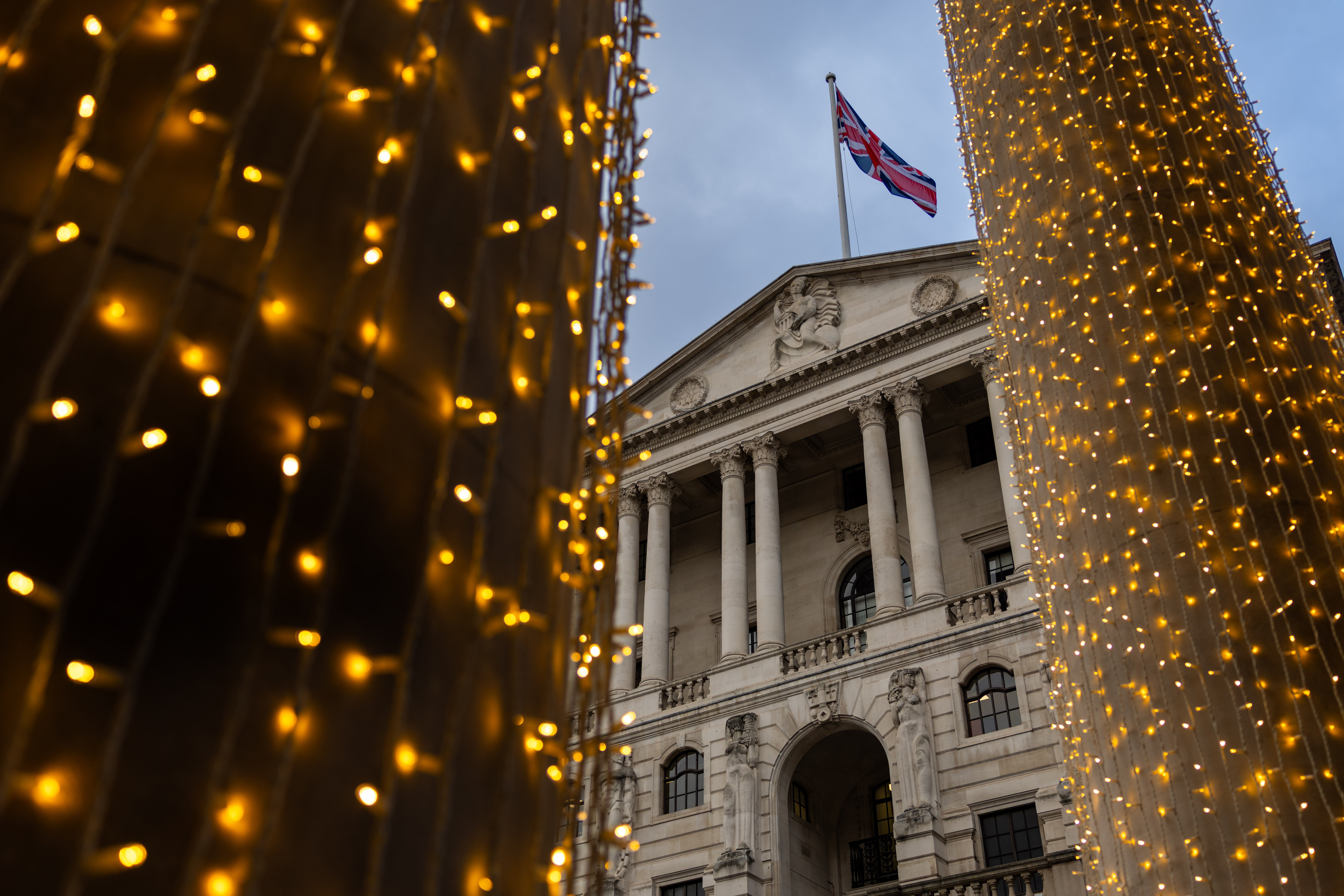
The Bank of England will likely deliver a pre-Christmas interest-rate cut on Thursday as concerns shift away from inflation and toward the UK's struggling economy and jobs market.
Traders and economists expect the central bank to reduce its benchmark rate by a quarter point to 3.75%, the lowest level in almost three years. It will announce the decision at 12 p.m. in London.
The Monetary Policy Committee is predicted to ease policy for the first time since August after skipping a move in September and November. Governor Andrew Bailey had been expected to cast the deciding vote again, but Wednesday's sharp drop in inflation raised the prospect of one of the MPC's four hawks switching sides.
The path has been cleared to a cut by evidence that UK price pressures are in retreat, while last month's budget also sought to reduce inflation in the near term. Still, the BOE is edging closer to the end of its cutting cycle with markets only fully pricing in one more reduction if the central bank follows through with a cut on Thursday.
Vote split
In November, Bailey sided with the MPC's hawkish camp, which includes Deputy Governor Clare Lombardelli and Chief Economist Huw Pill. Bailey said he needed to see more evidence of disinflation before he could back another policy easing with the government's budget also looming.
Since that meeting, data has pointed to a more benign picture. Inflation has cooled to its weakest in eight months after a sharper-than-expected drop in November, private sector wage growth has eased and the economy has suffered back-to-back monthly contractions. That is expected to be enough to persuade Bailey to align with the four doves at the BOE, which include Deputy Governors Dave Ramsden and Sarah Breeden.
The decision should still reflect long-running divides on the MPC, with Bloomberg's survey showing economists expect a 5 to 4 split for a second straight meeting. However, it's worth bearing in mind that the survey was conducted prior to Wednesday's surprisingly low inflation reading.
Either way, markets put the odds of a cut at more than 90% and predict another move by the end of April.
Guidance
There is expected to be little change to the MPC's already cautious guidance on future rate cuts with markets looking for any hints on how much further the BOE will go.
In November, it maintained language predicting a “gradual” easing in rates if there was progress on bringing down inflation. However, it also stressed that policy is becoming less restrictive as bank rate edges toward neutral — the level at which it neither boosts inflation nor drags it down.
Economists will be looking for clues on where rates will settle in the nine members' individual outlooks, which will be published for only the second time.
Budget impact
The central bank may provide more details from its early assessment on how Chancellor of the Exchequer Rachel Reeves' second budget impacts its outlook.
Lombardelli has already revealed that the BOE expects the plans — which included a freeze on rail fares, cuts to household energy bills and relief for drivers on fuel duty — will knock as much as half a percentage point off inflation next spring. She said the budget will provide a small 0.2% boost to gross domestic product in 2027.
The rate-setters may signal their intention to look through this one-off effect on price growth unless it helps to bring down elevated inflation expectations. Most of the backloaded tax rises and spending restraint in Reeves' fiscal plans occur beyond the BOE's three-year horizon.
Growth and inflation
The BOE may pencil in weaker growth for the final quarter of 2025 after a raft of downbeat economic signals since its last meeting.
While in November it predicted GDP growth 0.3% for the final three months of the year, official figures last week showed output contracted for a second straight month in October and surveys pointed to a tepid picture in November ahead of the budget. That has prompted forecasters to warn that the UK economy is at risk of its first quarterly contraction in two years.
It may also highlight that inflation is running below where it was expected it to be. CPI cooled to 3.2% in November, while the BOE projected 3.4% just last month.
UK Firms Cut Jobs At Fastest Pace Since 2021, BOE Survey ShowsEssential Business Intelligence, Continuous LIVE TV, Sharp Market Insights, Practical Personal Finance Advice and Latest Stories — On NDTV Profit.