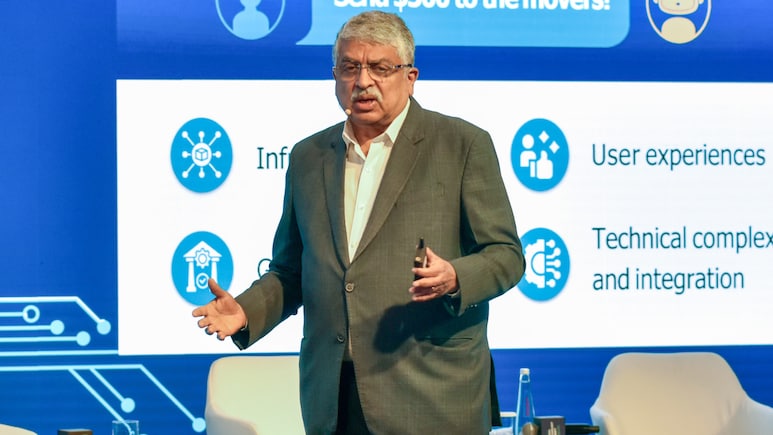
Nandan Nilekani, co-founder of Infosys, said India's digital payments ecosystem cannot rely entirely on a free model, arguing that participants need sustainable revenue streams to continue operating. Speaking at the India Open Finance Summit on Thursday, he cited merchant discount rates (MDR) on Unified Payments Interface transactions as an example of the economic models needed to support the payments ecosystem.
"You can't completely rely on a free system," Nilekani said, adding that participants must have viable economic models to sustain themselves.
His remarks bring the economics of India's digital payments infrastructure into focus as the country seeks to expand its reach and strengthen the businesses that support it. Nilekani also referred to charges for Aadhaar authentication and know-your-customer services as examples of how digital public infrastructure can incorporate revenue models.
Also Read | Layoffs Are Rising In Tech, But These Skills Are Helping People Unlock Better Pay
Which UPI Transactions Will Attract MDR?
The National Payments Corporation of India announced on Oct. 13 that the implementation of revised MDR rates on select UPI transactions would be deferred. The revised framework had been scheduled to take effect on Oct. 15, with the payments body citing the festive season for the postponement.
Under the framework, select merchant categories, including railways, telecom services, insurance and fuel, will attract a flat MDR of Rs 5 on UPI transactions above Rs 2,000.
READ | UPI MDR Rollout Deferred Until After Diwali, NPCI Says
Large merchant payments above Rs 2,000 will attract a charge of 0.4%, capped at Rs 300, under the earlier framework outlined by NPCI.
The changes are expected to cover about 4% of merchant transactions. More than 95% of person-to-merchant transactions will remain outside the framework, while small merchants operating under the person-to-person merchant model will continue to pay zero MDR.
What MDR Means For UPI Users And Businesses
MDR provides a mechanism for generating revenue within the payments ecosystem. Nilekani said participants need economic models that allow them to sustain their operations, rather than depending entirely on free services.
He did not announce any new MDR rates or provide a fresh implementation date. His remarks were about the need for sustainable revenue models across digital public infrastructure.
Under the revised UPI framework, individual users will not face a monthly limit on free transactions. Banks have also been advised to ensure that merchants do not pass MDR costs on to customers. Consumers are therefore not expected to face additional charges under the revised structure.
The framework will allocate 5% of total MDR collections to a dedicated fund to support UPI acceptance among small merchants. The revenue will be shared among participants in the payments ecosystem and is expected to support the expansion of UPI, cybersecurity and innovation.
The revised rates are also expected to remain lower than charges applicable to cards and digital wallets.
READ | UPI MDR Framework Needs Rationalisation To Protect Public Trust: Report
Essential Business Intelligence, Sharp Market Insights, Practical Personal Finance Advice, Daily Fuel, Gold and Silver Prices and Latest Stories — On NDTV Profit.