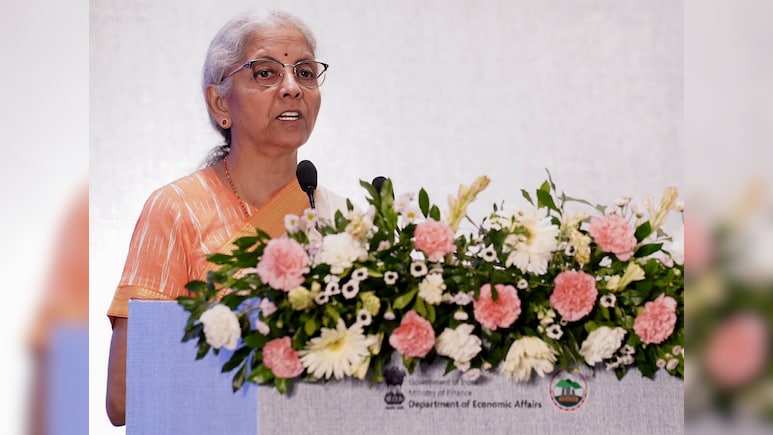
- FM Sitharaman urged viewing externally aided projects as tools for local market growth, not just financing
- Northeast aid rose seven-fold under Modi, from Rs 9,000 crore (2004-14) to Rs 76,000 crore (2014-26)
- Over 10,000 km of roads built in the northeast since 2014, with 5,000 km more under construction
Union Finance Minister Nirmala Sitharaman on Friday said externally aided projects should not be viewed merely as financing mechanisms, but as instruments for local produce to reach global markets, strengthen livelihoods and transform the northeast's geographical challenges into opportunities for economic growth.
Chairing a conference on "Leveraging externally aided projects in the northeastern states" here, she said that assistance under the externally aided projects (EAP) in the northeastern region has seen a seven-fold rise under the Narendra Modi government.
The event was attended by Assam Chief Minister Himanta Biswa Sarma, Meghalaya's Conrad K Sangma, Sikkim's Prem Singh Tamang, Nagaland's Neiphiu Rio, Mizoram's Lalduhoma and Tripura's Manik Saha,
"The scale of support to the northeast had increased from around Rs 9,000 crore during 2004-2014 to nearly Rs 76,000 crore between 2014 and 2026," the Union minister said.
Highlighting that farmers, artisans and the youths in the northeast have historically faced greater challenges in reaching markets, Sitharaman asserted that the Centre has made infrastructure, connectivity and sustained ministerial attention the cornerstones of its development agenda for the region.
"More than 10,000 km of roads have been built in the region since 2014 at a cost of more than Rs 1 lakh crore. Another 5,000 km of highways are currently under construction," she told the conference.
Describing the northeast as "blessed as few places on earth are", the Union finance minister said its breathtaking landscapes, rich cultural resources and hardworking people deserved better market access and visibility.
She said the region possesses enormous natural and human potential, but the key challenge is converting that into prosperity.
The Union minister cited products such as Lakadong turmeric, Khasi mandarin, Arunachal Pradesh's kiwis, Assam's Tezpur litchis, Karbi Anglong ginger, Manipur's black rice, Mizoram's chillies, Nagaland's tree tomatoes and Tripura's pineapples as examples of quality produce with untapped market potential.
Sitharaman said EAPs not only bring financing but also international best practices in project design, procurement, contract management, environmental safeguards and community participation.
"When we speak of EAPs, we are not speaking of loans or project costs but of a development model that combines central support, state execution and global expertise, all for local communities," she said.
"They bring innovative technologies and tested models because institutions like the World Bank and IFAD work in difficult geographies and bring their experience for our benefit," she said.
Noting that Prime Minister Narendra Modi visited the region over 75 times since 2014 and Union ministers more than 700 times, Sitharaman said no northeastern state should have to go to Delhi seeking support.
Development should be driven by outreach rather than requests, she stressed, adding that the Modi government has placed connectivity, infrastructure and sustained political engagement at the heart of the northeast's development.
"The northeast is no longer seen as peripheral to India's development story but regarded as central to India's growth, connectivity and future prosperity," she said.
Sitharamn, however, cautioned about implementation challenges, and called for stronger project management, improved last-mile connectivity, greater private sector participation and better coordination among agencies to maximise the impact of the investments.
Referring to her visit to an organic spice processing plant in Meghalaya's Ri-Bhoi earlier in the day, she said, "I saw the kind of intervention that the Northeast needs more of -- local produce being processed locally, farmers getting better value and traditional strengths being connected to modern markets."
"Can there be anything better tailored than local products going global with external aid?" she posed.
The Union finance minister also laid the foundation stone for a host of externally aided projects worth Rs 1,246 crore in Meghalaya.
These include the Rs 957-crore Meghalaya Logistics and Connectivity Improvement Project, the Rs 52-crore Supporting Human Capital Development Project for improving school infrastructure, the Rs 138-crore Integrated Eco-Tourism and Sustainable Agri-based Livelihood Development Project, and the Rs 91-crore Meghalaya Eco-Tourism Infrastructure Development Project.
She said these projects reflect the Centre's approach of converting the state's natural assets into jobs, enterprises and sustainable economic opportunities.
Meghalaya Chief Minister Sangma hailed the organic spice processing plant as a major boost to farmer-led value addition, and said that targeted interventions over the past eight years have helped create sustainable income opportunities for thousands of farming families across the state.
He described the facility as a "game-changing initiative" for farmers in the area and said the government's focus since 2018 has been on strengthening infrastructure, market access, training and processing capabilities to enhance the value of agricultural produce.
The chief minister said that with over Rs 12,000 crore worth of EAPs under implementation, the state was accelerating growth and creating opportunities across sectors.
"Our state may be small, but our aspirations are limitless," he said.
(This story has not been edited by NDTV staff and is auto-generated from a syndicated feed.)
Essential Business Intelligence, Sharp Market Insights, Practical Personal Finance Advice, Daily Fuel, Gold and Silver Prices and Latest Stories — On NDTV Profit.