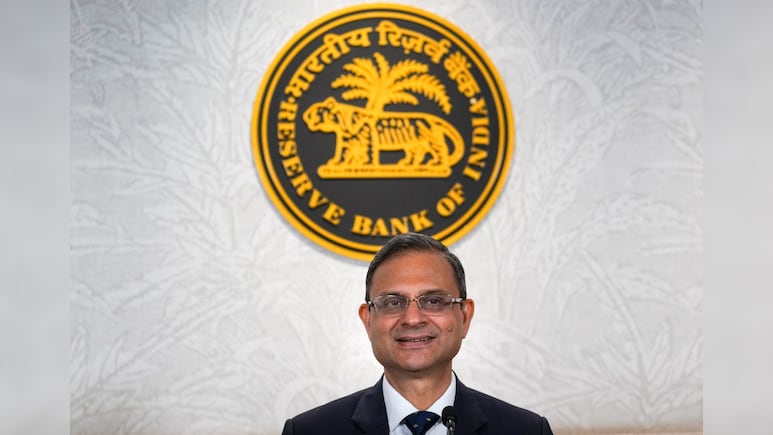
- The Reserve Bank is likely to keep the policy rate steady at 5.25% in June's MPC meeting
- Experts expect RBI to revise inflation forecast upward and lower GDP growth estimate
- RBI will closely monitor supply-driven inflation and geopolitical risks amid West Asia turmoil
The Reserve Bank is expected to leave the key policy rate unchanged at 5.25% this week and adopt a cautious stance that factors in the possible headwinds to inflation and growth trajectory amid the West Asia turmoil, experts opined.
With surging energy prices, continuing supply chain woes and a depreciating rupee, primarily driven by external challenges, some experts are of the view that the RBI may raise its inflation forecast and lower its GDP growth estimate at its bi-monthly monetary policy meet from June 3 to 5.
After three days of deliberations, the six-member Monetary Policy Committee (MPC), headed by RBI Governor Sanjay Malhotra, will announce its decision on June 5.
Also Read | Layoffs Are Rising In Tech, But These Skills Are Helping People Unlock Better Pay
In April, the Reserve Bank had kept its key policy rate unchanged, adopting a cautious wait-and-watch stance as policymakers assessed the fallout from the West Asia conflict on energy supplies, inflation and growth.
A research report from the SBI's economic research department expects the RBI to maintain status quo in June policy against volatile backdrop.
Going by the growth-inflation spiral, the report expects the consumer price index (CPI) trajectory (as of now) may indicate more than 5% inflation for the next three quarters (current quarter at 4 to 4.1%).
It also expects Q4 FY26 real GDP growth closer to 7.2% and FY26 GDP growth at 7.5%.
"Our nowcasted full year FY2027 GDP growth rate of 6.6%, however, with the continued geopolitical uncertainties, the numbers will be revised as more data comes in.
"Our call is along 'hold the rates' with a data-driven future dependency. However, an inflation targeting central bank can always use interest rate tools like Operation Twist that address market microstructure," the report said.
ALSO READ: The Week Ahead: US-Iran Tensions, Monsoon, RBI MPC Decision, IPOs
It also emphasised that the MPC needs to debate the role of exchange rate as a policy anchor beyond its mandate of pure inflation targeting.
Madan Sabnavis, Chief Economist at Bank of Baroda, also does not expect any change in the repo rate or stance next week.
"However, the tone will be cautious, leaning towards being hawkish. We can expect RBI to increase their inflation forecast towards 5 per cent and lower that on GDP more towards 6.5 per cent from 6.9 per cent," he said.
Sabnavis also does not expect any specific foreign exchange measures, though there will be an explanation of developments.
In its annual report released on Friday, the RBI said it will be reviewing and improving GDP growth and inflation forecasting during the current financial year.
RBI said that the outlook for the Indian economy in 2026-27 remains positive, supported by strong macroeconomic fundamentals, although a prolonged West Asia conflict may pose downside risk.
According to the report, inflation in 2026-27 is likely to remain aligned with the target on the back of adequate foodgrain stocks, sufficient reservoir levels and stable agricultural prospects despite possible El Nino conditions and above-normal summer temperatures.
However, the evolving upside risks to inflation may emanate from multiple other factors such as a spike in global fuel and commodity prices amid geopolitical tensions, it added.
The government has set the consumer price index (CPI) based headline inflation target at 4 per cent with the upper tolerance level of 6 per cent and the lower tolerance level of 2% for the central bank.
On expectations from the MPC, Dipti Deshpande, Principal Economist, Crisil said the RBI is likely to maintain the policy repo rate and retain a neutral policy stance.
"Inflationary pressures at present are largely supply-driven, stemming from elevated fuel and input costs, along with a weaker rupee. As such, the MPC may choose to look through these supply-side pressures in its policy assessment," she said.
Deshpande further said the prolonged disruption around the Strait of Hormuz had heightened upside risks to the inflation outlook, and the MPC is therefore expected to closely monitor the magnitude and pace of pass-through from higher global energy prices to domestic headline inflation.
"The MPC is also likely to closely assess the impact of the evolving El Nino conditions on the upcoming monsoon season and the consequent implications for food inflation dynamics," she added.
ALSO READ: India's Forex Reserves Fall $7.5 Billion To $681 Billion Amid RBI Intervention
Aditi Nayar, Chief Economist, ICRA, opined that with the India Meteorological Department (IMD) striking a sombre note on the monsoon and El Nino, along with continuing uncertainty around the longevity of the ceasefire in West Asia, "we expect the MPC to remain cautious and maintain rates and stance unchanged...".
According to the IMD, the southwest monsoon seasonal (June-September) rainfall over India is expected to be below normal. It also stated that rainfall is likely to be 90 per cent of the long-period average with a model error of 4 per cent.
Vinay Pai, MD and Head of Fixed Income, Equirus Capital, said that market expectations currently price in a potential 25-50 basis point rate hike, though recent RBI actions suggest a preference for liquidity management and currency stabilisation over immediate tightening.
"For the upcoming June policy, the RBI is expected to maintain rates, while possibly adopting a more hawkish forward guidance stance, though the official policy stance is likely to remain unchanged in the near term. A rate hike remains contingent on sustained macro stress," he said.
If crude prices remain above $100 per barrel for an extended period, inflationary pressures could force the central bank to consider a cumulative 50 bps hike by August, although this is not the base case at present, Pai opined.
The Reserve Bank had reduced the policy rate cumulatively by 100 bps in 2025-26.
India's CPI or retail inflation rose slightly to 3.48% in April, mainly due to higher prices of gold and silver jewellery as well as some kitchen items.
(This story has not been edited by NDTV staff and is auto-generated from a syndicated feed.)
Essential Business Intelligence, Sharp Market Insights, Practical Personal Finance Advice, Daily Fuel, Gold and Silver Prices and Latest Stories — On NDTV Profit.