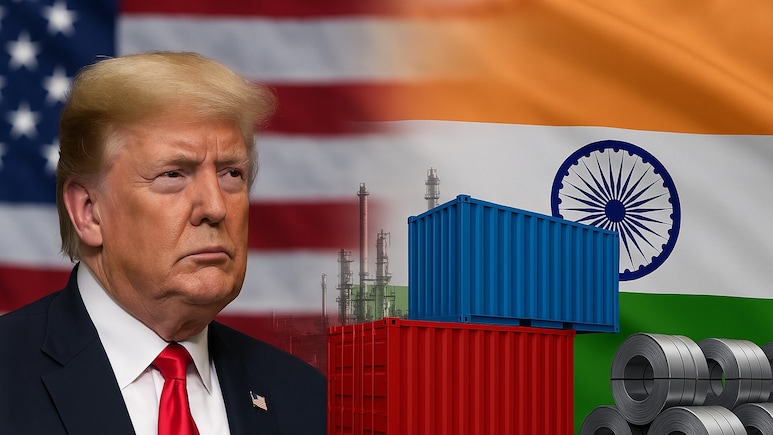
Donald Trump, once a reality TV star, has brought a reality TV show approach to his presidency. This time it is "Deal or No Deal", with countries as contestants. The original show was adapted across countries, including in India, which I never thought was a particularly great show. But the real stakes this time have made it more adventurous, for sure.
India's Mystery Box
On the show, contestants start with a closed box, which could contain a big prize or very little. The game goes on with more closed boxes. Contestants either pick one, move on, or end up with the box they got at the start. As more boxes are opened, the range of possible outcomes narrows.
That setup looks uncomfortably familiar with all the trade negotiations. Countries began with a tariff box they didn't want. Some took early deals out of caution or confidence. Others, like India, chose to wait, hoping the next box would be a better offer. Unfortunately, we had a few penalties on the way, but we have finally wrapped up a deal. But since they haven't shared the details yet, everyone's wondering what's in the box India chose.
Also Read | Layoffs Are Rising In Tech, But These Skills Are Helping People Unlock Better Pay
Why Should We Worry What's At Stake?
Early in the negotiations, the government said it would not compromise on Indian farmers or the dairy sector. That reassurance made political sense. Even on Tuesday, Commerce Minister Piyush Goyal repeated that stance — something many would have welcomed.
But the experience of other countries shows that the biggest concessions in these deals rarely show up in headline tariff numbers. They are buried in the fine print; in investment control, regulation, data, energy choices, taxation, trading with others, and geopolitics.
Japan: Best Case of Asymmetry
Japan's deal shows an imbalance. Japan committed $550 billion in investments, while the US controls project selection and keeps 90% of the profits. A St. Louis Fed analysis suggests Japan could lose $127-191 billion in present value, equivalent to 3-5% of its GDP, making this look less like an investment and more like a risky loan to the US.
South Korea: A Deal Signed Under Pressure?
South Korea will invest $350 billion. It has removed limits on US auto imports and opened its digital services market, too. The deal has already run into trouble. Although South Korea signed, it still faced US tariff threats due to delayed legislative approval. Signing was only the first step; getting all leaders to agree on it is more complex.
Cambodia: No Room To Change
Cambodia eliminated tariffs on all US goods. Beyond tariffs, Cambodia accepted US standards on vehicles and food. It even agreed to mirror US trade actions against third countries. Also, if it signs a deal with a "US foe" — read it as China — a 49% punitive tariff is back.
Malaysia: Deep Regulatory Control
Malaysia's agreement locks in US export controls and sanctions, mandates data sharing, limits future digital trade policy, restricts telecom and nuclear choices, and opens its rare earth and critical minerals sector to US firms. If Malaysia signs deals considered contrary to US interests, tariffs can return to 24%. The country also pledged $70 billion in US investment.
Indonesia: Near-Total Market Opening
Indonesia agreed to remove tariffs on most US products, waive local content rules for US firms, accept US standards, and allow unrestricted exports of critical minerals to the US. The deal is framed as supply-chain cooperation, but it narrows Indonesia's industrial policy space.
Final Take
There's a clear pattern to these deals. Countries are asked to invest in the US, while Washington decides what kind of investments it wants. At the same time, the US gains influence over who others trade with, which standards they follow, and how much freedom they retain in making laws. Signing the deal isn't the end — it's the start of living with these constraints.
Just as some deals came with China-decoupling clauses, India's agreement is clearly moving toward Russian decoupling. Trump himself tweeted that India will stop buying Russian oil. Until now, India had held its ground, even in the face of international criticism. Getting this deal meant India had to budge.
So, if energy policy is already part of the bargain, what other surprises might be hidden in the details? Maybe India landed at a better tariff rate than its neighbours, but we won't know for sure until we see the full agreement. For now, it's best not to get too excited or worried — let's wait and see.
Disclaimer: The views expressed in this article are solely those of the author and do not necessarily reflect the opinion of NDTV Profit or its affiliates. Readers are advised to conduct their own research or consult a qualified professional before making any investment or business decisions. NDTV Profit does not guarantee the accuracy, completeness, or reliability of the information presented in this article.
ALSO READ: Budget Itself Not Catalyst For Corporate Bond Issuances | The Reason Why
Essential Business Intelligence, Sharp Market Insights, Practical Personal Finance Advice, Daily Fuel, Gold and Silver Prices and Latest Stories — On NDTV Profit.