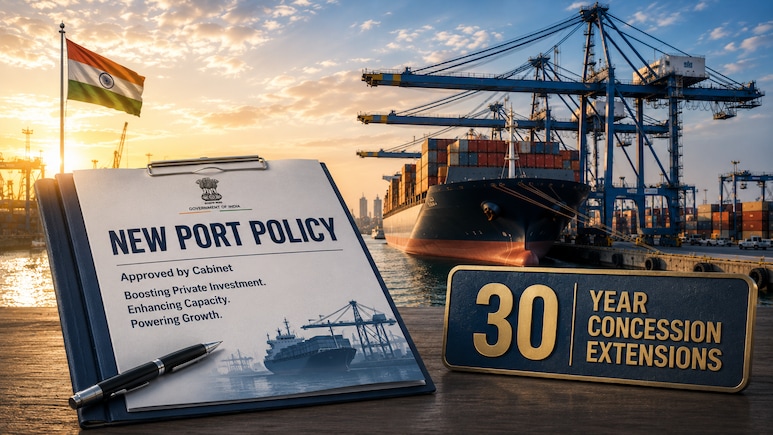
- Union Cabinet approves revised policy for Port Dependent Industries to boost investment and capacity
- Existing operators can expand facilities with Right of First Refusal under competitive bidding process
- Concession agreements can be extended up to 30 years at market or indexed revenue rates
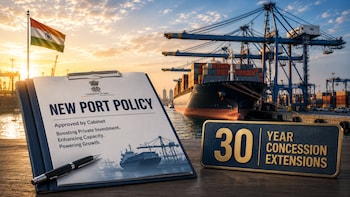
The Union Cabinet on Friday approved a revised policy governing the allocation of waterfront and associated land to Port Dependent Industries (PDIs), introducing major reforms aimed at encouraging private investment, expanding cargo-handling capacity and improving operational flexibility at India's major ports.
The updated policy replaces the 2016 Captive Policy and is expected to support the government's broader push to modernise port infrastructure under the Public-Private Partnership (PPP) model.
According to the Ministry of Ports, Shipping and Waterways, the changes are designed to provide greater certainty to investors while improving the ease of doing business without any additional financial burden on the government.
Existing Operators Get Expansion Opportunity
A key feature of the revised framework allows existing captive port operators to build additional berths, jetties, terminals or Single Buoy Moorings (SBMs) to meet growing cargo requirements. To ensure transparency, major port authorities will determine pricing through competitive bidding.
However, existing concessionaires will receive the Right of First Refusal (RoFR), allowing them to match the highest bid and retain the expansion project.
The concession period for any newly developed facility will remain aligned with the tenure of the existing concession, preventing operators from using expansion projects solely to extend their contracts.
Concession Agreements Can Be Extended
The policy also allows major port authorities to renew or extend concession agreements of existing Port Dependent Industries for up to 30 years without conducting a fresh tender.
The extension will be granted at either the prevailing market rate or the indexed revenue payable under the current agreement, whichever is higher.
The government believes this provision will provide long-term certainty for investors while safeguarding revenue earned by ports.
Also Read: Adani Ports Delivers 19% EBITDA Growth In Q1 FY2
Government Entities to Get Direct Waterfront Access
For the first time, eligible government organisations will be able to obtain waterfront land directly without participating in competitive bidding. This benefit will be available to Central and State government departments, statutory bodies, autonomous organisations, Central and State public sector undertakings, and government-controlled joint ventures operating in sectors such as petroleum, fertilisers, coal, steel, food and other notified industries.
These allocations will be made at the notified floor price, subject to land availability and other safeguards.
More Flexibility for Businesses
Recognising that trade patterns and regulations change over time, the revised policy introduces provisions covering changes in law and unforeseen events. Businesses will be allowed to revise cargo profiles or business plans if regulatory developments or exceptional circumstances affect project viability.
The policy also permits captive operators to change their cargo profile after the prescribed lock-in period or immediately if required because of a change in law, providing greater operational flexibility.
Focus on Port-Led Growth
Union Minister for Ports, Shipping and Waterways Sarbananda Sonowal said the revised policy would create a more transparent and predictable framework for investment while strengthening India's position as a global trade and logistics hub.
The government expects the reforms to attract fresh investments in port infrastructure, improve utilisation of waterfront assets, increase cargo throughput, strengthen supply chains and create new employment opportunities. The revised policy will be implemented across all major ports in the country.
Also Read: Cabinet Greenlights Rs 3.15-Lakh-Crore Outlay To Continue PM-KISAN Until 2031
Essential Business Intelligence, Sharp Market Insights, Practical Personal Finance Advice, Daily Fuel, Gold and Silver Prices and Latest Stories — On NDTV Profit.