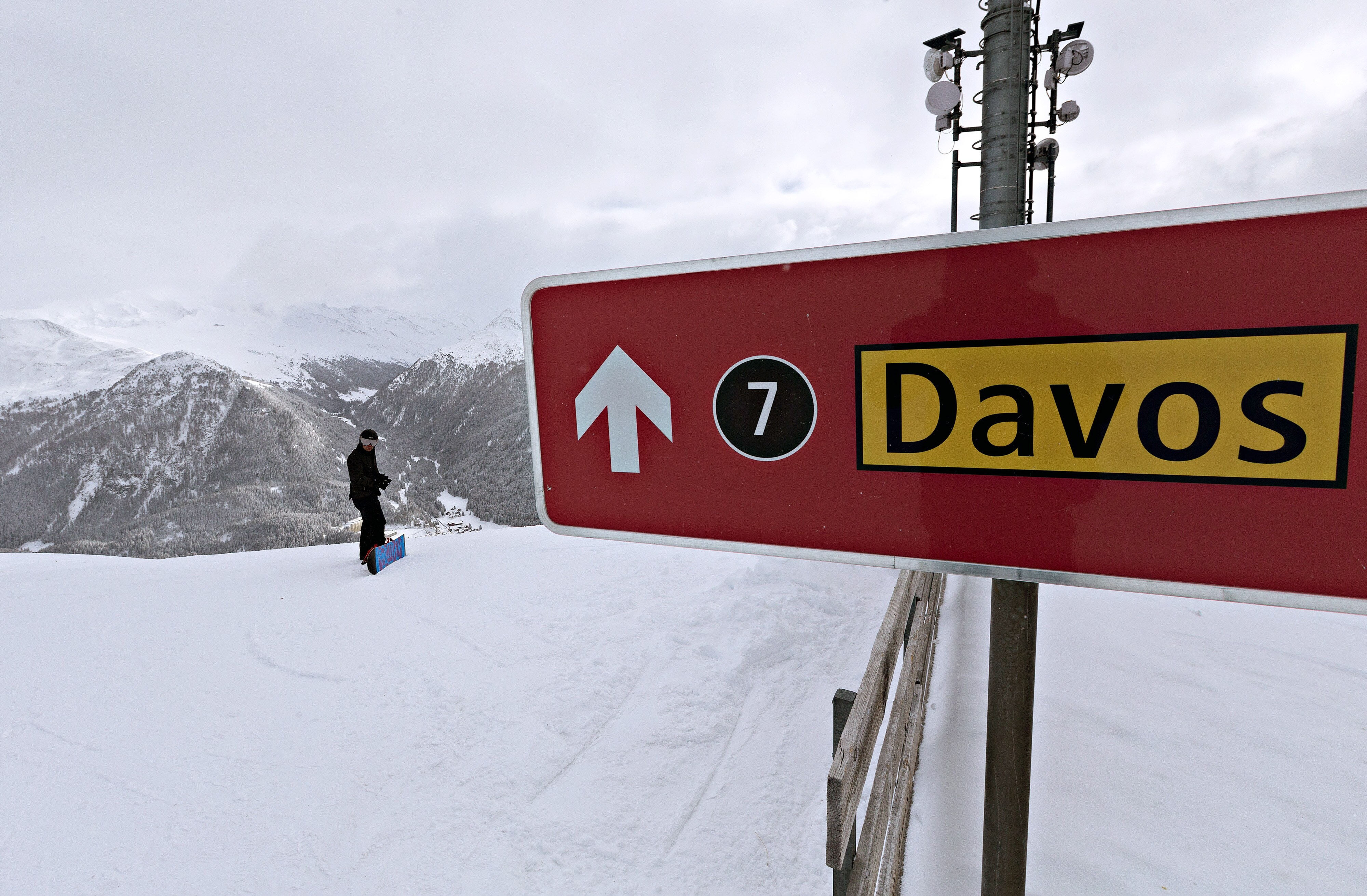
The annual World Economic Forum gathering in the snow-laden Swiss resort town of Davos-Klosters concluded on Friday after four days of discussions and deliberations on what the year 2017 may bring. That the year will bring change, in some cases dramatic change, seemed clear from the mood at Davos.
BloombergQuint's Menaka Doshi spoke to global and domestic leaders on a number of issues over the course of the week to get a sense of how the global economy will shape-up, its implications for India and the issues that corporate executives are focused on in their individual businesses this year.

-
 India's Market Leaders To Decode The New Samvat At NDTV Profit Ignite In Mumbai On Oct 28
 -
 NDTV Profit IGNITE Diwali 2026: Top Market Veterans Decode Wealth Creation
 -
 The Week Ahead: Earnings Season, Fed Policy Verdict And Crude Oil In Focus
 -
 Silver Is Now Down From Rs 4.2 Lakh To Rs 1.9 Lakh: Where It Goes From Here
 -
 NDTV Ignite, The Trillion-Dollar Trajectory: India's Road to 2030
Shifting Sands Of The Global Economy
This year, the annual gathering coincided with a political transition in the world's largest economy - the United States. As the Davos gathering wound down, Donald Trump took oath as the 45th US President. Economists and business leaders told BloombergQuint that they will be closely watching Trump's policies to see whether fears of increased protectionism play out. That the fear is real was evident from comments made by the Chinese President Xi Jinping who made a pitch for globalisation.
Also Read | Layoffs Are Rising In Tech, But These Skills Are Helping People Unlock Better Pay
Economists at Davos highlighted the Trump factor as the single biggest risk of 2017.
The “overhang of a very inexperienced and somewhat erratic U.S. president” and China will be the biggest economic risks of 2017, Kenneth Rogoff, professor of economics at Harvard University, told BloombergQuint.
While Trump's policies are essentially pro-business and pro-growth, “if protectionism and trade wars start to become the order of the day, then that will be a different issue altogether”, said Paul Sheard, chief global economist of S&P Global Ratings in a separate interview to BloombergQuint.
Uday Kotak, vice chairman and managing director of Kotak Mahindra Bank struck a watchful note in his conversation with BloombergQuint and said that the world needs to give President Trump atleast 90 days before judging his administration's policies.
The biggest economy in the world is going through a big political transition and of a kind that I don't think a lot of the U.S. was prepared for. So we have to give it time. We should give the Trump administration 90 days to figure out what its true colours. My experience has been that when a year starts easy, it gets tough by the end of the year. When it starts by looking tough, it gets better through the year.Uday Kotak, Vice Chairman and Managing Director, Kotak Mahindra Bank
Monetary Policy And Markets In 2017
The year also promises to be one of transition for global monetary policy and markets. US Federal Reserve chair Janet Yellen has expressed confidence in the state of the US economy, which in turn will mean more interest rate hikes from the Fed in 2017. Expansionary fiscal policies, if pursued by the Trump government, could speed up the pace of rate hikes.
Tighter monetary policy in the US, and the resultant strength in the US Dollar could mean some pressure on fund flows into emerging market economies, which could also see their currencies depreciate as a result.
Dixit Joshi, managing director and head of fixed income at Deutsche Bank AG told BloombergQuint that he expects two rate hikes from the Fed this year but a third is not ruled out. Tighter monetary policy globally will be a theme this year, although countries like India still have room to ease, said Joshi.
The global theme would be some pullback from the easy monetary policy and a move towards more fiscal-oriented reforms.Dixit Joshi, MD and Head-Fixed Income, Deutsche Bank
In the midst of this, “macro India” is the best place to be, said Kotak.
As always the one risk for India remains higher commodity prices.
Crude oil prices are expected to be volatile in 2017 as the U.S. produces more shale oil, executive director of International Energy Agency, Fatih Birol, told BloombergQuint. Prices have doubled from $28 per barrel last year to around $55, prompting U.S. shale oil producers to increase output, said Birol.
He expects oil prices to hover around the $50-55 per barrel at least in the short term.
We see U.S. oil production increasing and bringing a lot of oil in the market in the next few months, which will again put downward pressure on prices.Fatih Birol, Executive Director, International Energy Agency
India's Shock And Awe Demonetisation
Amidst debates around the global economy, India's shock decision to withdraw 86 percent of its currency in November also drew attention.
S&P's Sheard and Rogoff both said that while India's demonetisation may have been well-intentioned, its implementation has left a lot to be desired.
The approach of trying to do a shock therapy is something that I argue against in my book. It should take 5-7 years to do something like this. They haven't printed the new notes... it didn't even occur to me to say that in the book but that's created a lot of problems.Kenneth Rogoff, Professor of Economics, Harvard University
Taking stock of the situation, Arundhati Bhattacharya, chairman of State Bank of India told BloombergQuint that she expects the cash shortage to normalise over the next couple of months. She expects most withdrawal restrictions to be lifted by March.
Still, there will be some collateral damage from the demonetisation that will continue to haunt banks. This may come in the form of higher bad loans in the small and medium enterprises segment.
People have come to us seeking an extension in their working capital loans, because liquidity has dried up. We have already made that available wherever possible. We are hoping that it will have an impact, but we need to be watchful before we can assess the situation.Arundhati Bhattacharya, Chairman, State Bank of India
The one segment that benefited most from the government's move to demonetise were digital wallet companies. Paytm, which has among the most popular digital wallets, added 20 million new customers since November 9, said founder Vijay Shekhar Sharma in this interview with BloombergQuint.
The push for a cashless economy boosted Paytm's reach into the least penetrated parts of the country. Revenue contribution from towns with a population of less than 1 lakh people has jumped to just under 20 percent so far from 2 percent in the last two months, Sharma said.
Telecom Wars
Against the backdrop of the World Economic Forum, Sunil Mittal, chairman of Bharti Enterprises spoke out about the battle for market share in the telecom sector with the entry of Reliance Jio.
Mittal told BloombergQuint that the entry of a new player was bound to cause some degree of disruption, especially given the scale of investment and size of Reliance Jio's parent. Mittal commented that he had expected promotional offers to last 30-60 days, but not seven months.
We expected voice to be thrown in for free since it was being talked about for a long period of time. You can sample it for 30-60 days, but to do it free for seven months. Clearly they haven't got the attention they wanted and they haven't been able to stabilise their network.Sunil Bharti Mittal, Chairman, Bharti Enterprises
Mittal said that Airtel, by its own estimates, has held up better against competitors Vodafone India Ltd. and Idea Cellular Ltd. Airtel.
The good news is that among the players in the market other than Reliance Jio, our revenue market share is at a lifetime high of 33.2 percent. We are gaining market share. The smaller or value players, they are not investing, networks are in a bad shape. Most of them are struggling. We believe that we will do better in holding up as compared to Vodafone or Idea.Sunil Bharti Mittal, Chairman, Bharti Enterprises
As the battle in the telecom sector plays out, Mittal said that the regulator needs to be cautious of supporting the new players while ensuring that the industry does not suffer at large.
JSW's Acquisition Spree
Sajjan Jindal, chairman of the JSW Group, who also attended the World Economic Forum, said that almost all the group's divisions are on the prowl to acquire stressed assets which make strategic sense for the individual companies.
He believes the private investment cycle is finally turning around in India and argues that it's only when Indian industry starts investing that foreign players come into the country. “I see green shoots now, with Indians starting to look at investments”, said Jindal to BloombergQuint
We are investing in our companies. We had made large investments in our capacities, and now it's being absorbed into the Indian system. We are starting to look at investments and if we are ramping up investments, am sure others are too.Sajjan Jindal, Chairman, JSW Group
Essar Steel Restructuring
At the Essar Group, the focus is more on consolidating businesses.
The Essar Group-Rosneft PJSC deal was the biggest foreign direct investment (FDI) deal in 2016, with the Russian petrochemical giant and two other foreign players agreeing to buy 98 percent in Essar Oil Ltd. for around $13 billion. This sudden gush of funds gave the debt-laden Essar Group a massive breather.
Chief Executive Officer Prashant Ruia told BloombergQuint's that this will go a long way in helping the group to bring down its debt from Rs 88,000 crore to Rs 50,000 crore. The focus for the group, now, is on restructuring debt on the books of its steel unit. Negotiations are underway and could be completely shortly, said Ruia.
I don't want to specifically get into the restructuring scheme as its not finalised yet. I do believe its going to happen over the next few weeks and the moment we at a point where we are ready to share the details, I will be more than happy to share it.Prashant Ruia, Chief Executive Officer, Essar Group
Budget 2017 Wishlist
As India's top corporate leaders head back home, the next big trigger they are watching is the upcoming budget. BloombergQuint quizzed them on what they would like to hear from Finance Minister Arun Jaitley.
Jindal hopes that the will deviate from the path of fiscal consolidation just for one year and ramp up public investment, thus paving the way for the economy to grow at 8-9 percent again.
I am most in favour of a budget, which has a significant fillip to employment and jobs. The Budget will be thinking about how do you address creation of new jobs in the country. I think globally jobs is a big challenge as the digital world has some impact on creation of jobs especially with new skills.Uday Kotak, Vice Chairman & Managing Director, Kotak Mahindra Bank
The government is looking very seriously at basically kick starting the economy and interest rates in my opinion are very important piece of that and certainly their own investment in through their public sector and through their own schemes. If we can get some stimulus, I think it will help.Prashant Ruia, Chief Executive Officer, Essar Group
Essential Business Intelligence, Sharp Market Insights, Practical Personal Finance Advice, Daily Fuel, Gold and Silver Prices and Latest Stories — On NDTV Profit.