SBI Chief Says Mergers Can Reduce PSU Banks' Need For Government Capital
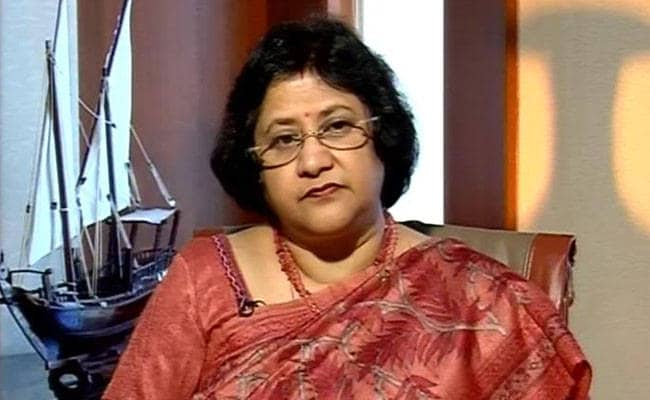
Mumbai: State Bank of India chairperson Arundhati Bhattacharya on Tuesday called for more consolidation among the public sector banks, saying this could reduce their dependence on government for capital. The statement comes after SBI merged all its five subsidiaries and Bharatiya Mahila Bank, which resulted in a massive spike in its provisions and bad loans ratio that touched double digits in the first consolidated results announced earlier this month, though this led to the creation of the 45th largest bank in the world.
The merger of the state-run banks should open up more capital generation avenues, both internally and from market, for the merged entity, she said.
"From a government point of view, besides an increased stream of dividends, which forms a part of their non-tax revenue, mergers of state-run banks can also reduce dependence of the merged bank on government for the future capital infusion," Ms Bhattacharya said while delivering the 14th Nani A
Palkhivala memorial lecture here this evening.
Merger of public sector banks must increase the role of internal and market resources and thus reduce government's dependency, she explained.
Stating that the banking sector is at critical juncture and is faced with challenges like capital constraints due to their government ownership, Ms Bhattacharya said, "These issues call further consolidation."
From an institutional and investors point of view, the available market float of a merged bank's shares must appreciate, she said, adding that these considerations have at least guided the merger decision of SBI.
Ms Bhattacharya said after the merger, SBI has moved to a return on equity (RoE) based budgeting, along with risk based budgeting in managing its portfolio.
She said that consolidation in the banking sector will lead to greater concentration of payment and settlement flows as there are fewer parties in the financial sector.
"Now, is this also a hindrance or is this going to be beneficial, but given the cyber security risks that we currently run, probably this could also be beneficial," Ms Bhattacharya said.
However, she warned that operational risks could rise post-merger, as the size of operations enlarge and since the distance between management and operational personnel is greater, the administrative systems become more complex.
"There is a view that exercise of market power by larger merged banks can also alter the monetary transmission operating through bank lending or borrowers without direct access to financial sector," she said, adding, "So mergers may increase systemic risks and mergers guided only by pure capital adequacy considerations are ill-advised."

-
We May Need Another Tukaram Mundhe To Fight Air Pollution | The Reason Why

Developers may install basic measures such as sprinklers and green nets, resume work, and continue violating rules when this equipment stops working.
-
Extracting Value From Battery Scrap Could Be Challenging For India | The Reason Why
A discarded lithium-ion battery still contains valuable materials such as lithium, nickel and cobalt. These can be recovered and reused. When such batteries are crushed and shredded, they produce a dark powder called black mass.
-
One El Nino, India Can Handle. Two Could Break The Granary
India's grain stocks can absorb one bad year, but a second El Nino could drain the buffer in two to three years, economists say.
-
India's Troika Of Good Luck | Joining The Dots
As Jensen Huang's exit drags Nvidia down, a cooling AI trade and resilient earnings have revived investor interest in India. A likely RBI rate hike looms.
-
Talking Points This Week: Leadership Shock At Nvidia, Earnings Strength, And The Fog Over Hormuz
The Anthropic IPO pricing and first trading day, Nvidia's upcoming earnings, and any fresh signals from Iran will set the tone for the following week.
-
Signature Play: The Classic Cocktail Is Dead. Or Is It?
Classic cocktails are disappearing from India's cocktail menus. But they're still being ordered, taught to bartenders and borrowed from. So, who's really having the last drink?
-
A New Samvat Wishlist: Inclusive Prosperity And Human Development
India has strengthened its economic foundations through infrastructure, digital access and enterprise. Its next growth chapter must deepen productivity, create better livelihoods and widen participation in prosperity.
-
Love, Sex Aur Dhokha: The Audacious Plot To Spy On Jensen Huang
A Taipei dinner, a Singapore chip buyer and a suspected Chinese asset: inside the alleged spy operation that got close to NVIDIA's Jensen Huang.
-
Ten Things I Learnt This Samvat
Patience can be a trap. Cheap stocks can stay cheap. Leverage can wipe you out. What did Samvat 2082 teach us? Niraj Shah writes on 10 lessons from the year gone by.
-
Talking Points This Week: Tech Nerves, FII Buying, And A Faraway Banking Shock
The global markets are not shining this Diwali. The exception in the large markets is, India.









