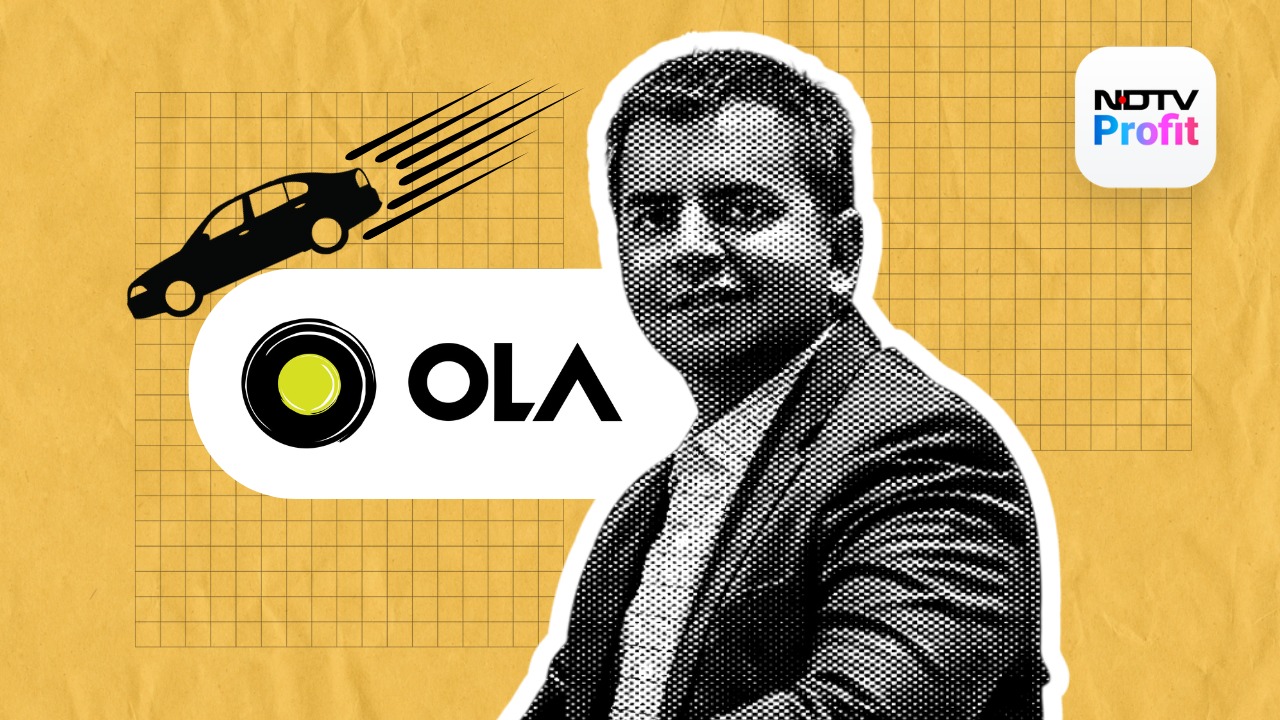
- Bhavish Aggarwal leads three unicorns including Ola Electric and Krutrim AI valued over $1 billion
- Ola Electric shares fell 15% amid promoter selling and concerns over stretched management bandwidth
- Several top executives quit Ola Electric and Ola Cabs within months, raising governance worries
Few can boast of being at the helm of three unicorns — Bhavish Aggarwal achieved that last year, after Krutrim AI achieved a $1-billion valuation. He also managed to list Ola Electric successfully, with shares hitting an upper circuit on the listing day. Apps (Ola Cabs), EVs and AI — he was a part of every past, present and future success story of the startup world.
As of this year, little of those good tidings survived. Most recently, he pledged shares in his listed entity; sold stake in quick succession — raising eyebrows. His ride hailing business Ola Cabs is burning cash, while Krutrim also needs heavy research and development investments.
The listed entity's share sale has spooked the markets as the stock fell 15% this month. The company says that the promoter share sale is personal and his stake stands at 34% after the transaction; which has no impact on Ola Electric's operations, governance or strategic direction.
Also Read | Layoffs Are Rising In Tech, But These Skills Are Helping People Unlock Better Pay
Shriram Subramanian, managing director of proxy advisory firm InGovern, believes that selling stake in the listed entity to fund other ventures is not a major concern in itself. "The larger issue is the promoter's stretched management bandwidth across multiple businesses."
Subramanian argues that continuing as CMD of the listed entity while simultaneously building other ventures raises governance and execution risks. "The promoter should move to a non-executive role and appoint a full-time CEO for Ola Electric," he adds.
Robin Banerjee — corporate governance expert and author of Corporate Frauds: Bigger, Broader, Bolder who held senior executive positions at ArcelorMittal, Thomas Cook, Caprihans, etc — too says that selling an asset to repay debt is a positive move.
"He has sold a 3% stake and that shouldn't dilute his commitment to the company. But he may also have stretched himself too thin. Like many young entrepreneurs, he seems to have underestimated the propensity of startups to suck out time and money," Banerjee adds.
Legal experts believe that it could be a unique case. "This is where the regulator must come in. If there is a certain level of market apprehension or stigma around a company, SEBI can oversee a company's activities. I am not saying that the promoter must be removed etc, but when governance challenges arise it can give direction like RBI does for banks," says Anuroop Omkar, the founding partner at AK & Partners.
Exodus Of Top Execs
According to Subramanian, the situation is compounded by the exit of several senior executives from the company. Ola Electric's chief technology officer, Suvonil Chatterjee, chief marketing officer Anshul Khandelwal; as well as CHRO Balachander N quit in a matter of few months.
The listed business also lost Mahesh Alanthat, the vice president and head of sales ahead of these top-level exits. Ola Cabs CFO Kartik Gupta, Krutrim business head Ravi Jain make up the long list of top executives that the group was unable to retain. Moreover, Ola Cabs' CEO Hemant Bakshi quit within four months of his appointment.
As per Banerjee, there could be other reasons for the inability of Aggarwal to employ CEOs for his businesses. “It costs a lot to employ an experienced CEO and is a difficult decision to make when one is already having a cash crisis. Many promoters double up as CEOs to save costs,” he adds.
Ola Electric Uses Proceeds Of One-Time Stake Monetisation For Repayment Of DebtRiding A Rough Market
Whether it's a coincidence with losing top people or not one never knows; but Ola's consumer businesses have been leaking market share at a spectacular pace. Its ride-hailing business competitor Uber's CEO Dara Khosrowshahi summed up the state of affairs by saying that "Ola is no longer a serious competition".
Ola and Uber maintained an almost duopoly at one point in time, but Rapido's lightning-fast growth made Ola concede its market share; which is down to 30%. "The company's current market share in the four-wheeler segment in India has dwindled to 20-25%, compared with more than 50% two years ago. Consequently, we expect its revenue to decrease 25-27% year-over-year in fiscal 2026," says an S&P rating report on the business, as it downgraded it by two notches in December.
As per a Motilal Oswal report, The Rise of Rapido, Ola's is struggling and its trips have decreased. “Much of this decline stems from a lack of focus. Ola's founder has prioritized projects like Ola Electric, leaving core cab business neglected. Additionally, Ola's hesitation to fully adopt the subscription model in the car segment has hurt its competitiveness,” the report adds.
As per Motilal Oswal, Ola Cabs' valuation too fell from $7.3 billion in 2021 to $2 billion in 2024. If that valuation still holds true, the ride-hailing is worth less than the total funds it has raised. As per a Hurun unicorn report, Ola Cabs is the most-funded unicorn startup — and has raised $3.8 billion, the last being a Series J round.
As per S&P, the business has limited ability to withstand cash burn without additional capital. “Larger peers such as Uber have stronger balance sheets and can remain competitive with incentives and discounts for drivers and consumers, respectively, to grow and maintain their strong market share,” it says. Uber's cash and equivalents stood at more than Rs 53,000 crore, while that of Ola Cabs is a sliver of Uber's at — Rs 690 crore.
Adding insult to injury, one of its vendors filed an insolvency plea against the business in March 2025 over non-payment of dues. But that matter was settled amicably within the same month. “As one sees from a distance, his businesses are in trouble,” says Banerjee.
Eyeing Santa Rally? Jupiter Wagon, Ola Electric, NBCC Likely Gainers Among Small Cap StarsEVs Fall From Grace
The listed electric vehicle business mirrors its ride-hailing business — its market share is shrinking in spite of once being a market leader.
Many analysts predicted that Ola would lose market leadership as legacy two-wheeler players like TVS and Bajaj enter the market. Along with that, Ola has also lost share to another EV startup like itself Ather, which has been reporting growth in sales.
As of end of second quarter, Ola Electric has cut revenue guidance and now expected FY26 volume sales at 2,20,000 units as opposed to 3,25,000-3,75,000 guided earlier. A report by Bank of America says that the reset doesn't "come as a surprise, given the given market share performance has been underwhelming of late".
"FY26 is the year of getting the house in order for Ola and it is still early to call out that warranty shocks are in the rear view," the report added. The company attributed soft volume pick up to slower EV adoption and focus on cost consolidation, improving product reliability and customer experience. It has been trying to improve after-sales service after social media erupted over lack of servicing.
"Customers are unhappy with servicing, and investors are unhappy as the share price continues to fall," he notes. On the listing day in August 2024, Ola Electric's stock price closed at over Rs 90, now it's worth a third of that — at Rs 34 per share.
Most experts attribute this fall to too many businesses under one wing. It's not uncommon for startup founders to continuously ideate new businesses but like in the case of Eternal, most of it lies within the listed entity. In Ola's case, it's not true.
Drawing a parallel with Paytm, Subramanian points out that the company faced similar challenges in the past but course-corrected by focusing sharply on the listed entity while de-emphasising other businesses. Whether Ola can do it or not, is yet to be seen.
Ola Electric Hits Record Lows As Promoter Selling Weighs — Here's How Mutual Funds Are PositionedEssential Business Intelligence, Sharp Market Insights, Practical Personal Finance Advice, Daily Fuel, Gold and Silver Prices and Latest Stories — On NDTV Profit.