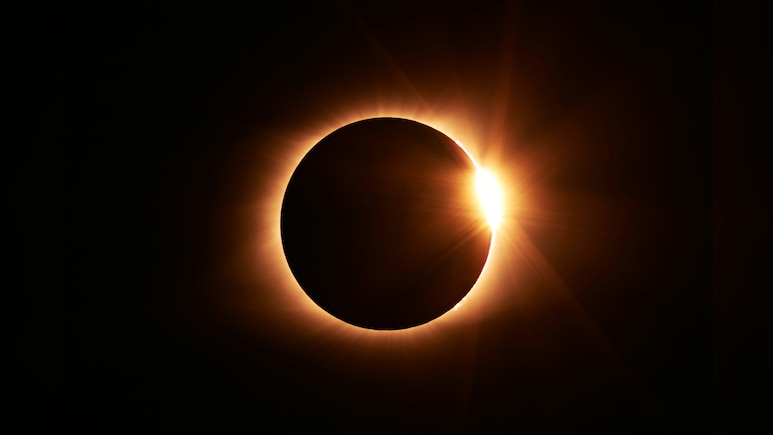
A solar eclipse, or Surya Grahan, is set to take place today (Feb. 17) drawing widespread attention in India as people look for details on visibility and traditional observances. The astronomical event will be an annular solar eclipse, a phenomenon popularly known as the “ring of fire”, where the Moon does not fully cover the Sun.
Despite the interest it has generated, the eclipse will not be visible from any part of India.
The annular solar eclipse will be visible in Antarctica, and a partial eclipse will be visible in Antarctica, Africa, South America, the Pacific Ocean, the Atlantic Ocean and the Indian Ocean, according to NASA.
Also Read | Layoffs Are Rising In Tech, But These Skills Are Helping People Unlock Better Pay
Solar Eclipse Today: Check Timings
According to a Space.com report, the eclipse is expected to first appear over Antarctica's landmass and conclude its journey over the Davis Sea along the Southern Ocean. The Moon's antumbral shadow, responsible for the “ring of fire” effect, will traverse the Earth for just under an hour, between 11:42 and 12:41 UTC (5:12 p.m. to 6:11 p.m. IST).
Visibility of the phenomenon will be limited strictly to Antarctica and the surrounding southern waters.
The peak phase of the eclipse, known as annularity, is expected to begin at 7:12 a.m. Eastern Standard Time (EST) (5:42 p.m. IST) and will last for just under two minutes, the Space.com report added. During this brief window, the Moon will not obscure the Sun fully, leaving a luminous ring before gradually moving away from the solar surface.
This annular solar eclipse will be visible only from a remote stretch of the Antarctic region, where the “ring of fire” will appear for up to 2 minutes and 20 seconds as the Moon covers roughly 96% of the Sun's central area.
ALSO READ: Surya Grahan 2026 Sutak Time, Riituals And More
As the solar eclipse will not be visible from India, the traditional 'sutak kaal' will not apply. As per Indian traditions, 'sutak kaal' restrictions are typically followed only in regions where an eclipse is visible. As a result, there will be no changes to temple rituals, daily activities or food-related practices anywhere in the country.
In the regions where the solar eclipse will be visible, skywatchers are required to exercise caution as looking directly at the Sun without protection can cause serious eye damage. Experts advise the use of certified eclipse glasses or approved solar filters to observe the astronomical event.
Essential Business Intelligence, Sharp Market Insights, Practical Personal Finance Advice, Daily Fuel, Gold and Silver Prices and Latest Stories — On NDTV Profit.