- Net leasing of office space fell 24% to 11.51 million sq ft in Q1 2026 in top eight cities
- New office space supply dropped 18% year-on-year to 8.8 million sq ft due to project delays
- Gross leasing rose 13% to 21.89 million sq ft, reflecting strong overall market activity
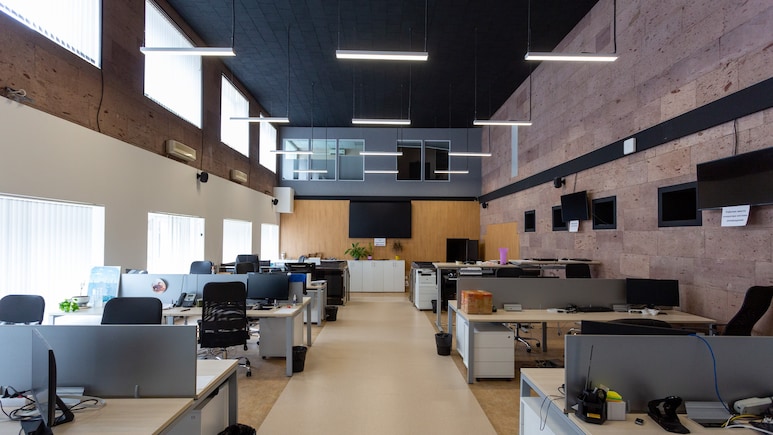
Net leasing of office space declined 24 per cent in January-March across top eight cities at 11.51 million sq ft on lower demand and a 18 per cent fall in fresh supply of workspaces, according to Cushman & Wakefield.
The net leasing stood at 15.08 million sq ft in the year-ago period.
Net leasing or absorption is a key indicator of real estate demand, representing the net change in occupied office space.
ALSO READ | Why FPIs Are Exiting India? Answer Lies In SIP, Says Shankar Sharma
The eight cities are Delhi-NCR, Mumbai, Bengaluru, Hyderabad, Chennai, Pune, Kolkata and Ahmedabad.
Real estate consultant Cushman & Wakefield pointed out that the corporates might go slow in their business expansion because of the West Asia conflict but India's medium to long term demand outlook remains bullish.
The consultant attributed the fall in net leasing or absorption of office spaces in the first quarter of this calendar year to softer fresh leasing after a strong end to 2025.
The delay in completion of office complexes limited the physical realisation of pre-committed demand, it pointed out.
New supply of office spaces across top-eight cities stood at 8.8 million sq ft in January-March 2026, a decline of 18 per cent year-on-year (YoY), largely due to delays in project completions.
However, Cushman & Wakefield highlighted that the gross leasing of office space across the eight major cities rose 13 per cent to 21.89 million sq ft in January-March from 19.3 million sq ft in the year-ago period.
The gross leasing means all leasing activity in the market, including fresh take-up, open market renewals by occupiers as well as pre-leasing. It is an indication of overall market activity.
Anshul Jain, Chief Executive, India, SEA, MEA & APAC Office and Retail, Cushman & Wakefield, said India's office market has carried forward the momentum of 2025 into the first quarter of this year.
Global capability centres, accounting for around 40 per cent of leasing, remained a key driver, he added.
"This continued demand is now translating into tighter market conditions, with vacancy levels declining steadily, reflecting a persistent demand-supply imbalance across key markets, particularly in high-quality assets," Jain said.
Looking ahead, he said around 61 million square feet of new supply would come into the market.
"As much of it will be premium Grade A+, we could see some easing in vacancy levels," Jain said.
ALSO READ | HDB Financial Q4 Results: Profit Surges Over 40%; Dividend Declared
However, he noted that strong absorption and pre-commitment trends are likely to keep overall vacancy broadly stable, even as rental momentum remains firm.
"Amid the global uncertainties, recently accentuated due to the West Asia crisis, we are closely assessing how occupiers factor these into their decision-making. And while the pace of expansion may be impacted in the near term, underlying demand in India continues to remain resilient," Jain said.
Veera Babu, Executive Managing Director, Tenant Representation - India, Cushman & Wakefield, said the office market has entered 2026 with a clear supply demand imbalance, with sustained occupier interest continuing to outpace the availability of quality office space across key markets.
"Net absorption moderated during the quarter as transaction activity remained constrained by the slower pace of project completions. As incremental supply begins to enter the market over the coming quarters, absorption is expected to improve in line with sustained occupier demand," said Veera Babu.
He observed that corporates are increasingly prioritising asset quality, location efficiency and readiness. They have a clear preference for buildings that can support evolving workplace, technology and sustainability requirements, Babu said.
(This story has not been edited by NDTV staff and is auto-generated from a syndicated feed.)
Essential Business Intelligence, Continuous LIVE TV, Sharp Market Insights, Practical Personal Finance Advice and Latest Stories — On NDTV Profit.