Oil Falls As Fading War Premium Revives Angst Over Rates, Growth

(Bloomberg) -- Oil plunged to the lowest in two months amid signs that the Israel-Hamas conflict will remain contained, bringing angst about interest rates and a slowing global economy back to the fore.
West Texas Intermediate fell 1.6% to near $81 a barrel after Hamas told mediators it will release foreign hostages in the next few days, further damping concerns of the war spreading and impairing crude flows in the Middle East. Oil has now declined below its pre-war levels, reaching the lowest settlement price since Aug. 28.
Oil's downward trajectory over the past few days “continues to point to market expectations of a localized conflict,” said Dan Ghali, a commodity strategist at TD Securities. A bank analysis of geopolitical risk events shows that the premium from a war “tends to fade as soon as one month following the onset of the conflict.”
Crude has had a turbulent October, with prices swinging in a roughly $11 range. Oil started the month with a steep plunge on fears of a longer period of hawkish monetary policy, with selling accelerated by algorithmic trading. Then Hamas's attack in Israel on Oct. 7 sent prices surging on the potential for disruptions in the region that accounts for a third of global flows.
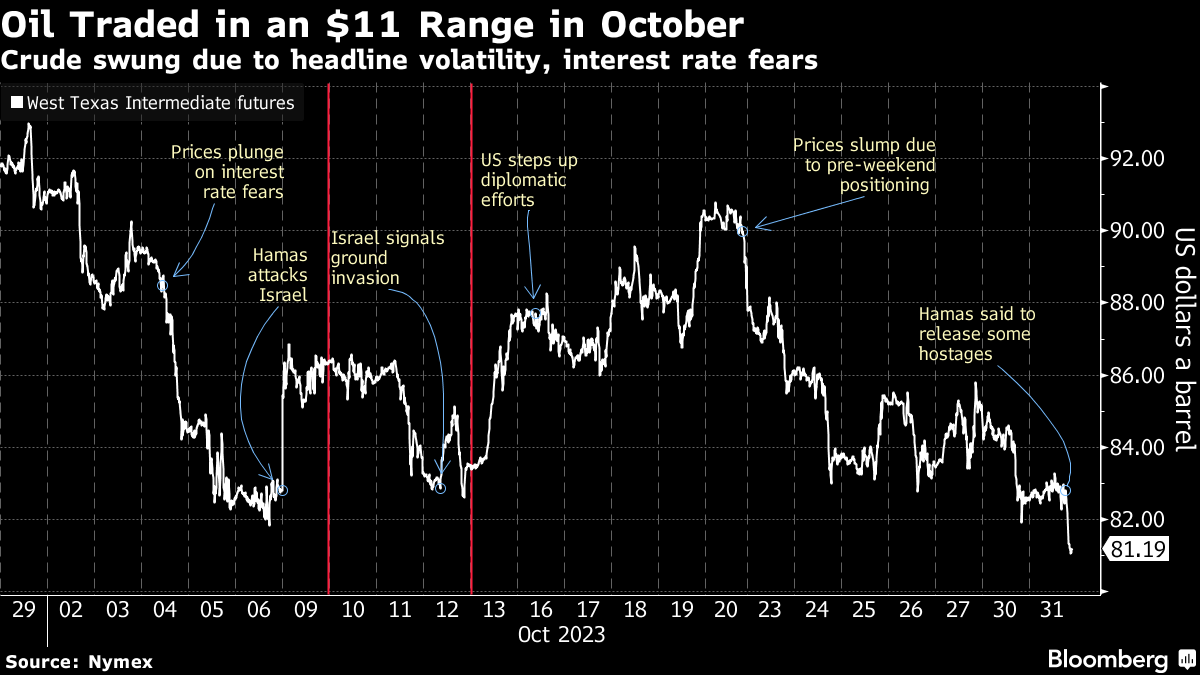
But with the war's contagion fears subsiding, the economic concerns are again taking center stage, sending Brent and WTI to their first monthly declines since May.
While Israeli Prime Minister Benjamin Netanyahu has so far rejected calls for a cease-fire to facilitate the release of captives, the Israeli military is employing a gradual strategy aimed at limiting its own casualties and heeding increasing concerns over the humanitarian crisis in Gaza.
Signs of lackluster demand have arisen in recent days, with manufacturing in China falling back into contraction this month and BP Plc saying gasoline and diesel markets are oversupplied.
A narrowing in WTI's prompt spread — the difference between its two nearest contracts — suggests that near-term conditions are becoming less tight. The widely watched differential has narrowed back to 50 cents a barrel in backwardation, down from about $2 a barrel at the end of September.
--With assistance from Mia Gindis.
More stories like this are available on bloomberg.com
©2023 Bloomberg L.P.

-
Talking Points This Week: Leadership Shock At Nvidia, Earnings Strength, And The Fog Over Hormuz

The Anthropic IPO pricing and first trading day, Nvidia's upcoming earnings, and any fresh signals from Iran will set the tone for the following week.
-
Signature Play: The Classic Cocktail Is Dead. Or Is It?
Classic cocktails are disappearing from India's cocktail menus. But they're still being ordered, taught to bartenders and borrowed from. So, who's really having the last drink?
-
A New Samvat Wishlist: Inclusive Prosperity And Human Development
India has strengthened its economic foundations through infrastructure, digital access and enterprise. Its next growth chapter must deepen productivity, create better livelihoods and widen participation in prosperity.
-
Love, Sex Aur Dhokha: The Audacious Plot To Spy On Jensen Huang
A Taipei dinner, a Singapore chip buyer and a suspected Chinese asset: inside the alleged spy operation that got close to NVIDIA's Jensen Huang.
-
Ten Things I Learnt This Samvat
Patience can be a trap. Cheap stocks can stay cheap. Leverage can wipe you out. What did Samvat 2082 teach us? Niraj Shah writes on 10 lessons from the year gone by.
-
Talking Points This Week: Tech Nerves, FII Buying, And A Faraway Banking Shock
The global markets are not shining this Diwali. The exception in the large markets is, India.
-
Midterm Rally Lasted A Day. The Hard Reality Of A Divided US May Last Two Years | Opinion
Between a contested AI boom, a debt ceiling that arrives in 2027 and a president with every incentive to act alone, the next two years may prove more volatile than the first day's rally suggests.
-
Blue Wave Will Derail the AI Trade but Won't Dismantle the AI Era | Unhedged Position
The Democrats' sweep of the US Congress will see politics collide with economic forces both over the long and short term.
-
It's Time To Take The GST Council's Bet On Trust Global
Payment records can prove India's services exports, and clear, proportionate rules can bring foreign digital sellers into the tax net.
-
Opinion | India at 38: From Innovation Overperformer to Innovation Powerhouse
India now has 453 VC-backed deep science startups, 18 of them late-stage, after 117 percent growth since 2020. Laurus Labs, at USD 9.3 billion, is the most valuable deep science company in any middle-income economy outside China.









