India's Consumption Theme Is Raring To Come Back | Open Interest

India's consumption story has been dragging for a while now. Its been more than 18 months since the start of 2024, that a slowdown in discretionary spending has hurt the fast-moving consumer goods (FMCG) companies. However, a revival may be around the corner.
While rural consumption started turning a leaf after mid 2024, urban spending remained subdued. This imbalance led to muted volume growth for many FMCG companies and this started reflecting in their earnings since June last year.
The Nifty Consumption Index gained 3.6% in 2024, with most of the gains occurring in the last three months, courtesy rural demand as reflected in the Nifty Rural Index.
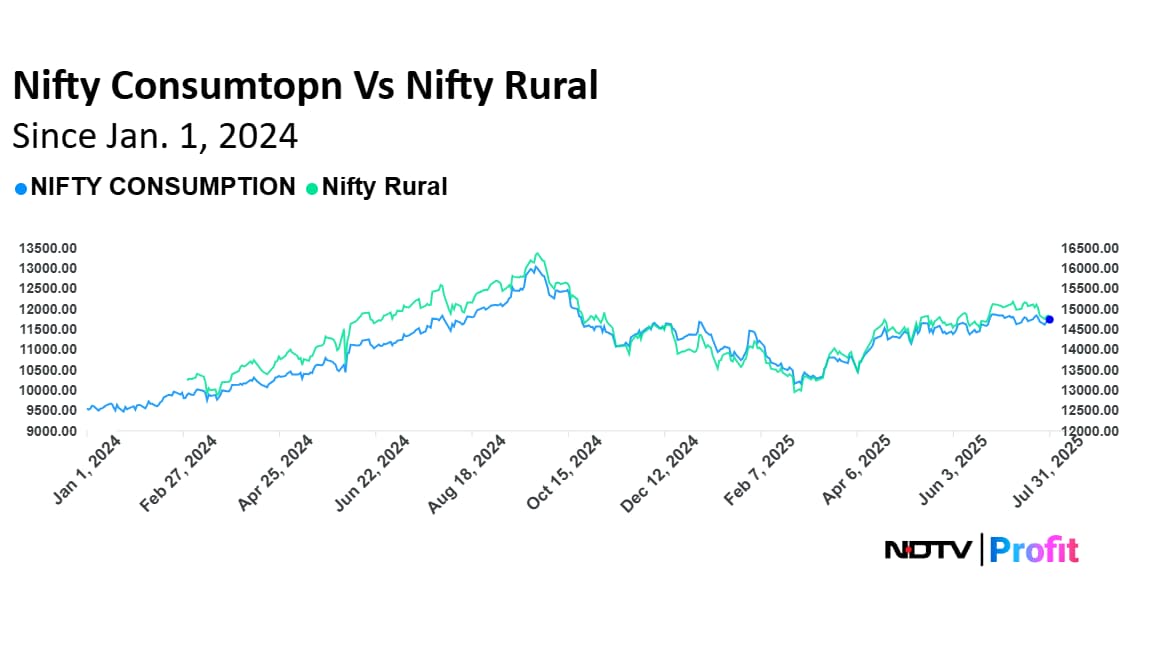
In comparison, the Nifty Rural Index has been outperforming the Nifty FMCG Index significantly. Since January 1, 2024, the FMCG Index has declined by 1.27%, whereas the Rural Index has risen by nearly 12% over the same period.
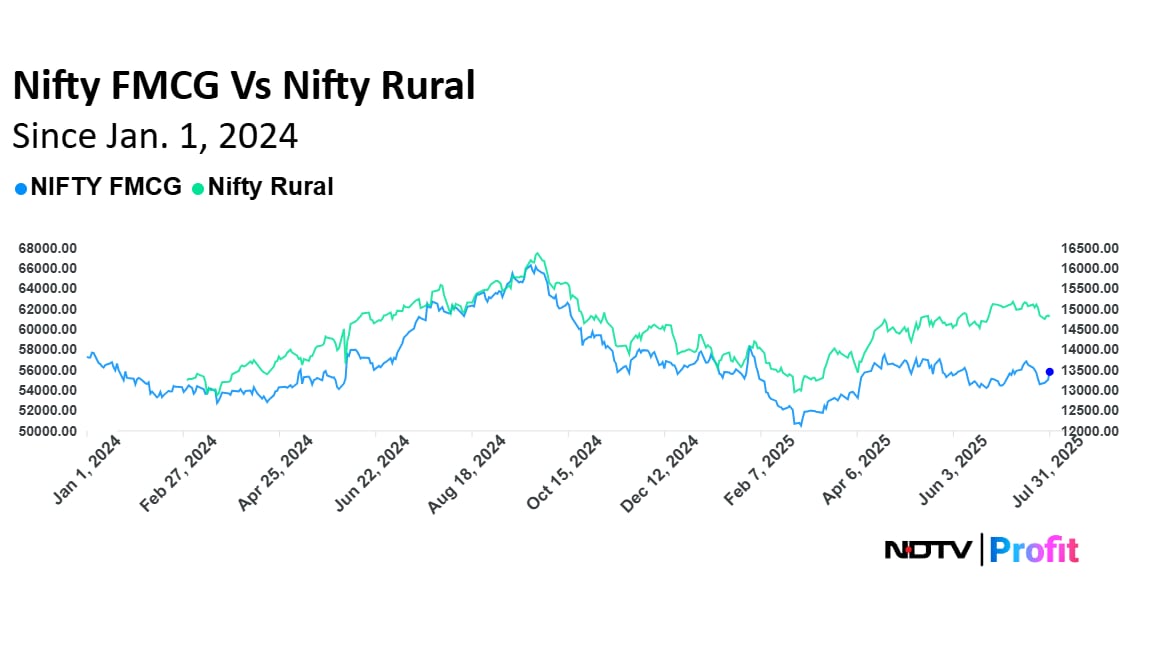
Several macroeconomic factors are contributing to this turnaround in consumption demand.
Tax cuts have added approximately Rs 1 lakh crore to household incomes, while the Reserve Bank of India's front-loaded rate cuts have boosted disposable income and lowered EMIs. These developments are gradually lifting urban consumption.
Furthermore, an expected rationalisation of GST rates could provide an additional boost to domestic consumption at a time when global trade remains uncertain due to U.S. tariffs and ongoing geopolitical tensions.
Consumption Turaround Coming
In a recent earnings call post declaring its first-quarter performance, Rohit Jawa, the outgoing CEO and Managing Director of Hindustan Unilever, observed a sustained and gradual recovery in rural demand. He noted that while urban consumption is improving, it still lags behind rural growth—a trend seen before last year's demand compression. According to Jawa, the growth momentum is coming from smaller towns and digital platforms, particularly e-commerce and quick commerce.
The recovery across most categories is volume-driven, although the food segment continues to be price-sensitive. Jawa added that the improvements are largely reflective of better conditions in both the urban and rural informal economies. These have been supported by a stronger agricultural sector, favourable monsoons, low food inflation, and positive fiscal and monetary policy impulses.
Additional tailwinds include an above-normal monsoon this year, an early sowing season, higher-than-average water reservoir levels, and strong projected agricultural output.
These conditions have contributed to a steady consumption uptick over the last three months across general trade, modern trade, and emerging platforms like e-commerce and quick commerce.
FMCG Sector: Road Ahead
Companies like HUL expect stronger recovery and improved performance in the April–September 2025 period compared to the festive-heavy October–March 2024–25 cycle, driven by accelerating urban demand.
Dabur also echoes this as it is quite optimistic of a sequential recovery in demand on back of softening food inflation, favorable monsoon, sustained momentum in rural, and some green shoots which are visible in the urban demand.
A key positive is the moderation in commodity inflation, which is expected to support low single-digit price growth in non-food categories, further aiding volume-led recovery.
August will be the decider for the FMCG sector as the market readies for the festival period — Raksha Bandhan, Independence Day, Onam and Ganesh Chaturthi.
By the way, some macro watchers are expecting inflation for the month of July to come in as low as 1.1%!

-
Opinion | India at 38: From Innovation Overperformer to Innovation Powerhouse

India now has 453 VC-backed deep science startups, 18 of them late-stage, after 117 percent growth since 2020. Laurus Labs, at USD 9.3 billion, is the most valuable deep science company in any middle-income economy outside China.
-
Navigating Energy Crossroads: S Jaishankar's Call For Diversified Supply Chains At G20 Ministerial Meeting
As geopolitical fault lines continue to test maritime trade routes and commodity flows, Jaishankar's message remains pertinent: true economic resilience requires open markets, protected transit lines, and a genuine commitment to multilateral cooperation rather than coercion.
-
Indians Are Travelling, But Not Every Journey Is A Holiday | The Week In Whys
Pilgrims, patients and working women are the real travellers, and the system hasn't quite caught up with them.
-
Getting To Work Costs Women More | The Reason Why
It is not just about women paying more than men. It is about women paying much more in cities than in villages.
-
AI Bias In Investing Cannot Be Eliminated, But It Can Be Governed
Framing is a particularly important example as identical financial information presented in terms of gains rather than losses can lead an LLM to reach a different assessment.
-
Joining The Dots | Dark Skies, Steady Diya: Why Hope Holds This Diwali
With war, a weak rupee and foreign outflows weighing on sentiment, policymakers at the NDTV World Summit and market veterans at NDTV Profit Ignite: Diwali Edition offered the same advice: stay invested and filter out the noise.
-
The Curious Case of Equitas Small Finance Bank And A CEO Who Quit For Stock
PN Vasudevan believes persistent investor concerns over a perceived conflict of interest had become a governance overhang on Equitas Small Finance Bank's stock, even as the lender improved profitability and asset quality.
-
Talking Points This Week: AI Cash Burn, A Tiger Comeback And An India That Still Finds Its Own Path
India is not immune to higher oil or tighter global liquidity, yet its earnings base is broader, its domestic policy levers are still available.
-
Foreign Investors Own Half Of HDFC Bank and ICICI Bank. An LTCG Cut Could Matter Most Here
Foreign portfolio investors have US$115 billion parked in HDFC Bank, ICICI Bank. If the government cuts long-term capital gains tax, Jefferies says returning foreign money could land here first.










