
Flush with funds after demonetisation, banks are slashing their deposit rates to levels not seen in years. Still, bankers say that depositors continue to get positive real returns if they chose to park their funds in bank deposits, as inflation remains lows.
On Saturday, State Bank of India (SBI) cut the rate it offers on retail fixed deposits of tenors between two and 10 years by 25-50 basis points. For three-year deposits, SBI now offers 6.25 percent - a rate which was last offered by the bank in June 2006, according to data available on Bloomberg. A basis point is one hundredth of a percentage point.
The bank decided to keep its rate on one-year deposits unchanged at 6.90 percent, but that too is at a near seven-year low, Bloomberg data showed.
On Wednesday, another public sector bank, IDBI Bank reduced the interest rate offered on its term deposits with maturities between one and two years to 6.25 percent from 6.40 percent. It, however, raised the rate on deposits of 271 days up to a year to 6.40 percent from 6.25 percent earlier.
Harshvardhan Roongta, chartered accountant and SEBI registered investment advisor, attributes the drop in deposit rates to the flood of low-cost deposits that banks received as a consequence of the demonetisation of Rs 500 and Rs 1,000 notes.
In November, the government banned Rs 500 and Rs 1,000 notes and asked citizens to deposit these notes in banks before the end of December. This led to a surge in deposits. Deposit growth for the fortnight ended April 14 stood at 11 percent over the previous year, according to the latest data released by the Reserve Bank of India (RBI). This continues to be well above the 5 percent growth in credit seen across banks, leaving banks with surplus funds.
Banks had initially anticipated that a large part of these deposits would find their way out of the system once withdrawal curbs were lifted in March. This, however, has not happened, and banks are now adjusting to what some are calling a new normal.
“According to some of the numbers doing the rounds, around Rs 4 lakh crore of deposits that came in during demonetisation is still with the banking system. We're not expecting this money to get withdrawn. The new normal is what we're seeing today,” said Adhil Shetty, chief executive officer at bank data aggregator Bankbazaar.com.
With system liquidity comfortable and credit growth sluggish, it is unlikely that banks will revise deposit rates upwards any time soon, unless there is a tightening in monetary policy rates, he said.
Rajiv Anand, head of retail banking at Axis Bank, points out that while nominal rates are falling, real rates remain positive.
I think what you're looking at is the nominal rates. In 2010, if I remember right, inflation was at double digits.Rajiv Anand, Executive Director, Axis Bank
If one were to look at the one-year fixed deposit, which Anand points out is the most popular tenor, the highest rate offered by SBI between 2010 and now was 9.25 percent in April 2012. At this time, the consumer price inflation was at 9.76 percent.
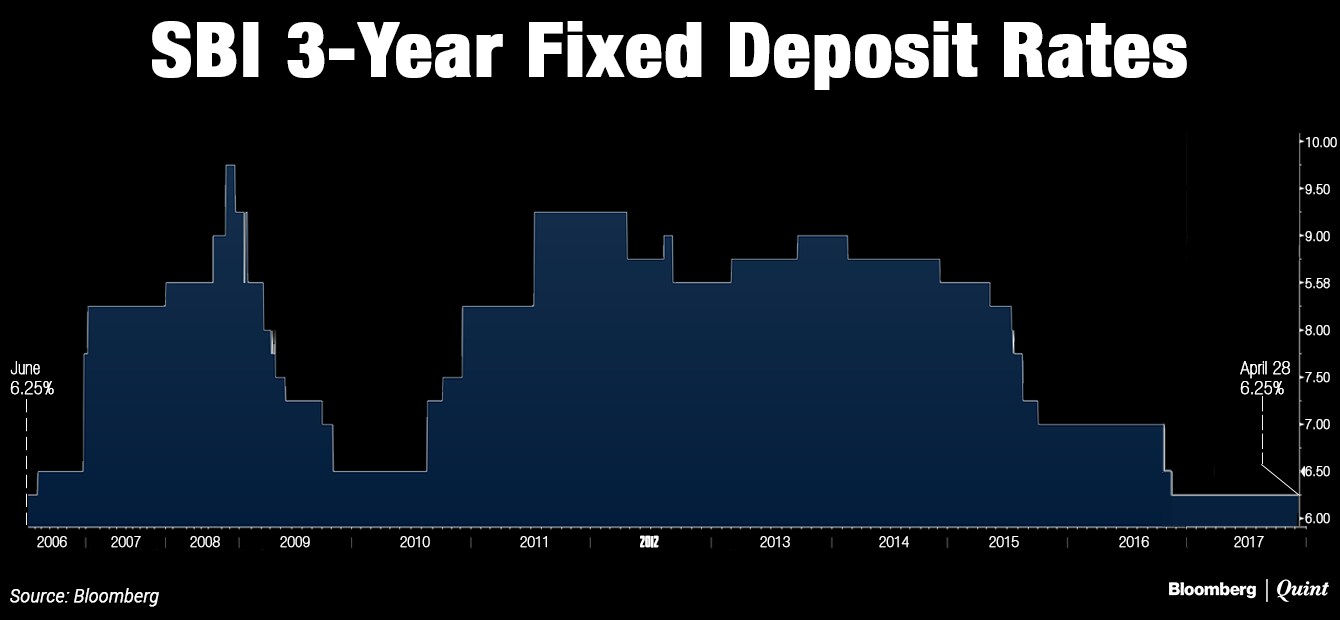
As a result, fixed deposits at the time were actually giving a negative real return.
“Here, you have an environment where inflation is lower than 5 percent and the one- year (fixed deposit) is close to 7 percent,” said Anand.
Vishwavir Ahuja, managing director and chief executive officer at RBL Bank said he does not expect rates to fall further.
“In terms of the rate environment, I think it has played out. The market leader has squeezed out the last bit of juice that was available,” he said.
Mutual Funds More Attractive?
Roongta anticipates that individuals will increasingly look to mutual funds if rates fall any further. Already, mutual funds have seen a sizable inflow of funds over the last financial year.
According to data available on the website of the Association of Mutual Funds in India, the assets under management of mutual funds increased 42.2 percent over the course of financial year 2016-17 to Rs 17.54 lakh crore.
“I think people will look at other options like debt mutual funds,” said Shetty. “Even a relatively conservative mutual fund product like a liquid debt fund, which invests in a combination of government securities and overnight debt, will currently give you a return of 7.5 percent.”
Additionally, if the mutual fund scheme is held for a period of three years, it provides the advantage of a benefit on long-term capital gains tax.
Essential Business Intelligence, Sharp Market Insights, Practical Personal Finance Advice, Daily Fuel, Gold and Silver Prices and Latest Stories — On NDTV Profit.