Consumer Goods Makers See Healthy Growth Post Demonetisation

Consumer goods companies grew at a healthy pace in the quarter ended March, helped by promotions to clear the inventory stuck due to demonetisation in the previous three months.
The fast-moving consumer goods industry clocked a value growth of 12 percent in January-March quarter, largely driven by a 7.5 percent growth in volumes, Sameer Shukla, executive director at Nielsen, told BloombergQuint. Price hikes and preference for bigger packs aided growth, he said, adding that a shift towards premiumisation also helped.
The government's decision to invalidate old high-value currency notes on November 8 had hurt consumption, affecting primarily the home and personal care categories. The cash crunch triggered by the note ban also changed consumption patterns, with consumers purchasing smaller packs instead of buying in bulk.
Shortage of cash also meant consumers shopped at organised retail stores that accepted digital payments. Every second consumer chose to shop for their household purchases like food essentials through modern trade, Nielsen had said in its report released on December 24.
However, modern trade, or sales of consumer goods through supermarkets, grew in a low single digit in the last one year, barring the spike post demonetisation, Shukla said. “Modern trade is not among the fastest growing channels in the country, chemists have been doing better in terms of growth,” said Shukla.
In the fourth quarter, the food category grew the fastest while the personal care category remained under pressure.
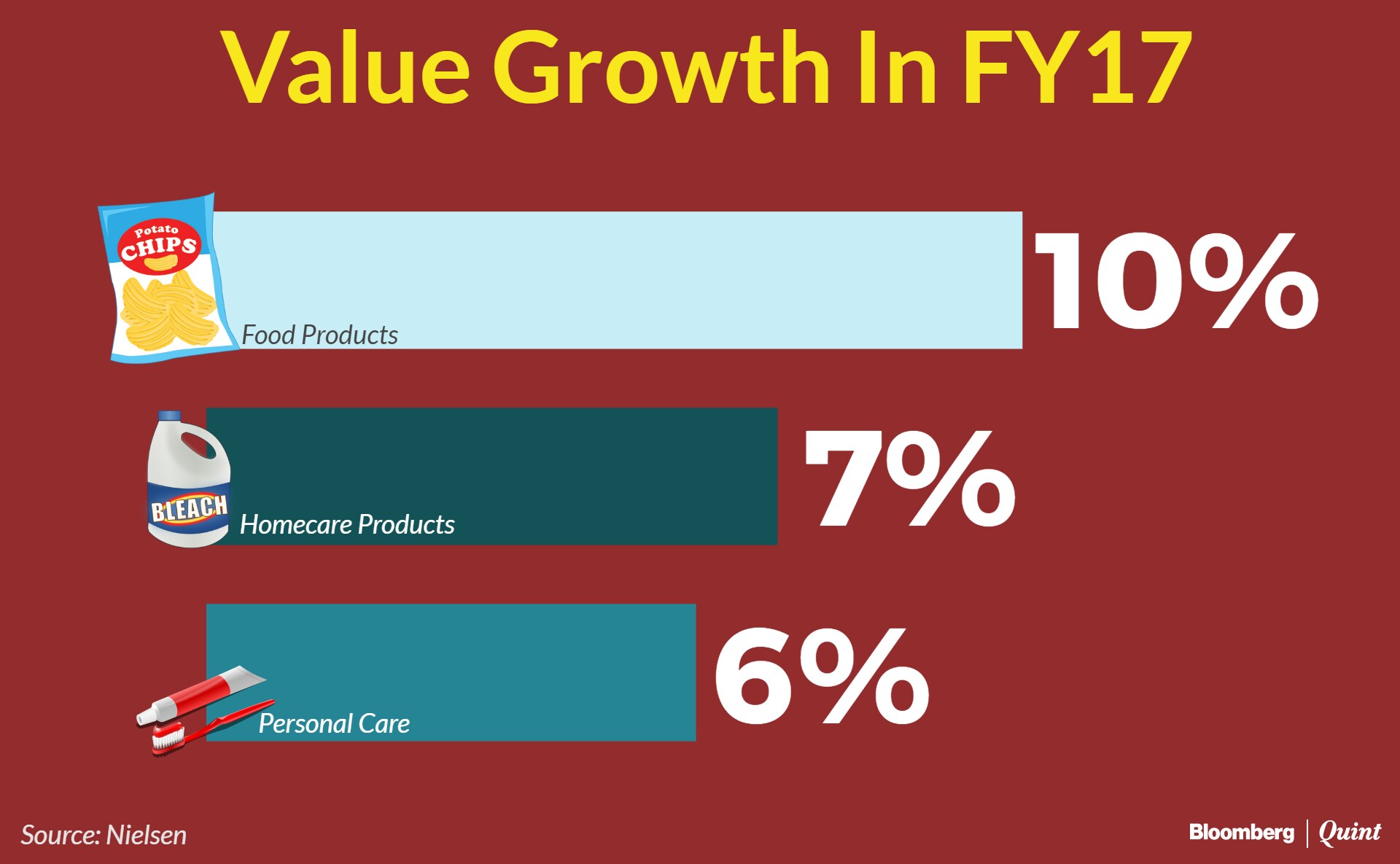
The food segment, the primary driver of growth in the sector, grew 10 percent in value in the quarter while the personal care category grew the slowest pace at 6 percent. The homecare segment witnessed a rise of 6-7 percent.
The cost of raw materials has been on the rise, but Nielsen does not expect the consumer goods companies to push for price hikes. They will choose to ride on the growth momentum rather than resort to steep price hikes, Shukla said.
Consumer companies have also fought back with products in the ayurveda and herbal space to counter Patanjali Ayurved Ltd. The took advantage of the strong growth in the foods category by launching salty snacks, packaged tea and edible oil.
Hindustan Unilever Ltd. launched three herbal shampoos under its Clinic Plus and Tresemme brand, while India's largest consumer goods maker also revived its Lever Ayush range of ayurvedic products.
Marico Ltd. launched Saffola Aura, a premium edible oil. Emami Agrotech, the edible oil arm of Emami Ltd., also launched its edible oil brand nationally – expanding outside West Bengal and Karnataka.

-
Medicine Pricing: Where Must Profit Stop?

India must confront excessive margins, hidden incentives and regulatory gaps that threaten the integrity of medicine.
-
Why Amazon And Flipkart Are Struggling To Beat Meesho In India's Smaller Cities
With 274 million users and lowest-cost logistics, Meesho is defending its value commerce crown against giants like Amazon and Flipkart.
-
High US Salaries, No Green Card Certainty: The Financial Calculation Facing Indian H-1B Families
The suspension of PERM processing at eight technology employers does not cancel existing H-1B visas. What it does is force a question many Indian families have been avoiding: is the US salary worth tying your career and family plans to one employer?
-
Swiggy vs Eternal: Food Delivery's Two Rivals Are No Longer In The Same Race
Eternal is building a private AI assistant, dark.ai. Swiggy is still working out how to make Instamart pay, with an operating loss of Rs 895 crore in the July-September quarter while Blinkit stayed profitable.
-
Where You Live Shapes How You Get To Work | The Reason Why
Two-wheelers are the most popular way to get to work in India, accounting for nearly 43% of workplace commutes.
-
Unhedged Position: Can India See An Indonesia-Style Time Correction?
The Nifty is trading below levels it first clocked in 2024. Is there, then, as I have suggested in the headline, potential that the current time correction drags on painfully for the next three-five, even ten years?
-
Navigating Friction And Energy Realities: An Analysis Of Marco Rubio's October Visit To India
Occurring at a critical juncture marked by stalled trade negotiations and escalating geopolitical pressures over global energy supplies, the visit offers a profound window into modern US-India relations.
-
India Exports Capital. Why Not Export Trusteeship?
The big question, then, is whether India can build an institution that global borrowers, investors, banks, and lawyers can trust, even without an Indian connection.
-
France's Economy & Politics Are In Crisis | The Reason Why
Let's look at how the French economy and politics evolved under Nicolas Sarkozy, Franois Hollande and Emmanuel Macron.
-
You May Inherit The Business. You Must Earn Its Credibility.
Succession tests the founder's ability to share authority as much as it tests the next generation's readiness to assume it.










