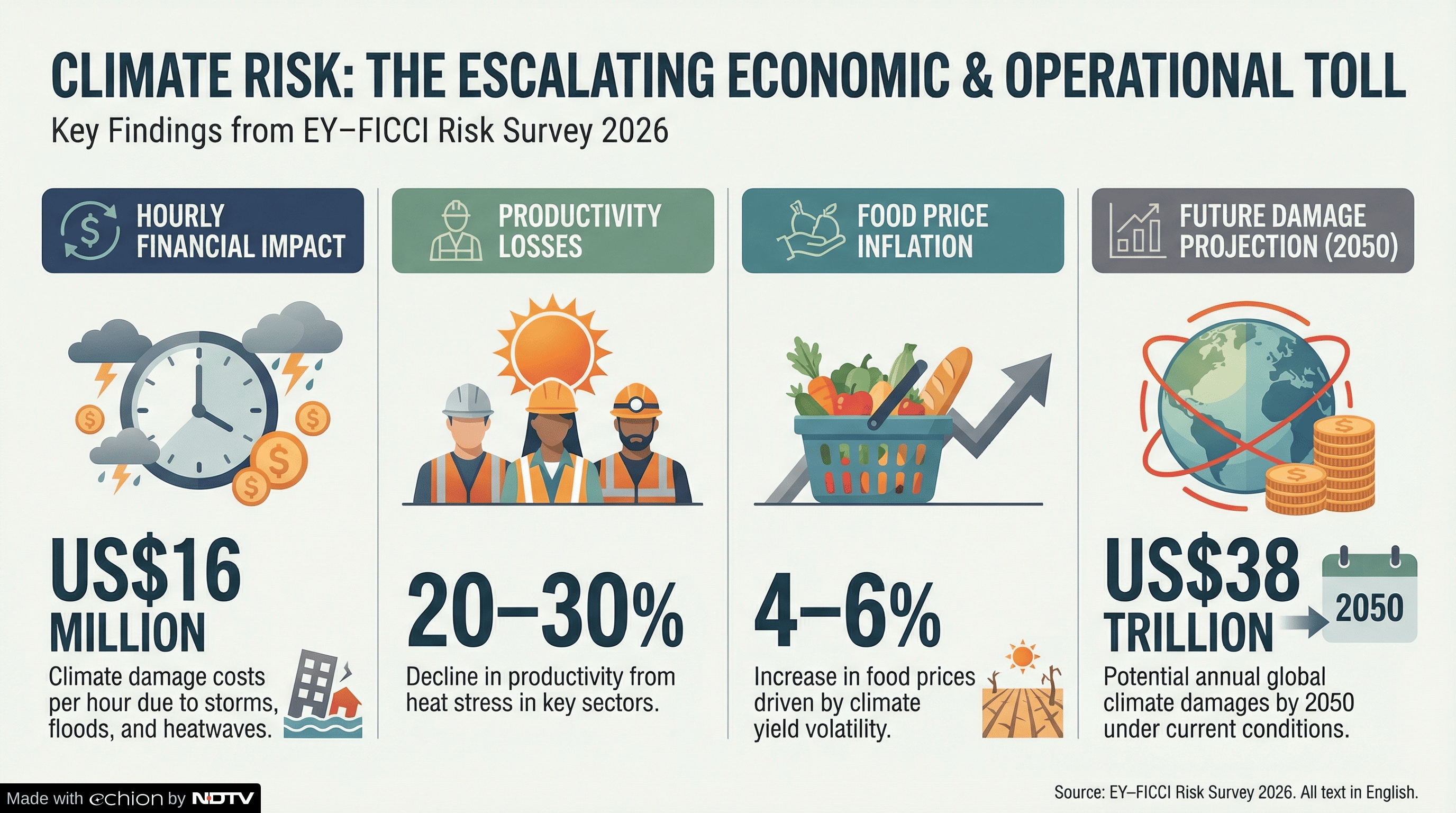
Every minute the world debates climate action, the global economy quietly loses over $250,000 to climate damage. By the hour, that bill swells to $16 million. What was once dismissed as a long-term environmental concern has become an immediate economic shock, disrupting supply chains, food systems and labour productivity.
The FICCI-EY Risk Survey 2026 makes it clear that climate change is no longer a future risk — it is a present-day financial drain. And for India, the exposure is deeper, broader and more urgent than many boardrooms still acknowledge.
The report warns that under current conditions, annual global climate damages could rise to $38 trillion by 2050, driven by storms, floods, heatwaves and ecosystem degradation. What was once considered a “long-horizon risk” is now disrupting economies, supply chains and livelihoods in real time.
Also Read | Layoffs Are Rising In Tech, But These Skills Are Helping People Unlock Better Pay
Why India Is Especially Exposed
For India, the economic risks are sharper. The survey highlights water scarcity as a growing structural threat, with per-capita water availability estimated at 1,341 cubic metres, already below the stress threshold. States such as Punjab, Haryana, Rajasthan and Karnataka — key hubs for agriculture, textiles, chemicals and power — face severe groundwater depletion, directly threatening water-intensive industries.
Extreme heat is also translating into tangible productivity losses. Record temperatures are cutting output by 20–30% in sectors such as construction, logistics and mining, while rising cooling demand has pushed power costs up by about 15%, squeezing margins for businesses and households alike.
Climate Shocks Are Hitting Balance Sheets
The report notes that repeated climate shocks — urban flooding, desertification and prolonged heatwaves—have damaged infrastructure and agriculture, pushing cumulative global losses since 2000 into the trillions. In India, urban flooding has disrupted transport, power supply and essential services, while desertification is hurting agricultural output and rural demand.
Food systems are also under stress. Climate-driven yield volatility has already lifted food prices by 4-6%, and the report flags the risk of a 16% output decline by 2030 if current trends persist. These pressures feed directly into inflation, credit risk — especially in agriculture and MSMEs — and higher insurance claims across crop, health and property lines.
Boards And Businesses Are Waking Up — Slowly
Despite the scale of the threat, preparedness remains uneven. The survey shows 45% of respondents believe climate-related financial impacts pose a critical risk to their operations in India, while a similar share flags non-compliance with ESG disclosure requirements as a material business risk. Alarmingly, over 40% also point to gaps in board-level oversight of ESG and climate issues.
The message from the report is clear: climate risk is no longer just about sustainability reporting. It is reshaping capital allocation, asset strategy, supply-chain design and long-term growth decisions.
As climate change bleeds billions from the global economy each year, India faces a narrowing window to adapt. The survey argues that businesses which integrate climate risk into strategy—rather than treating it as a compliance exercise — will be better positioned to protect value, manage volatility and sustain growth in an increasingly hostile environment.
ALSO READ: India's Obesity Crisis Enters Budget Debate; Survey Says 75% Know Someone Affected
Essential Business Intelligence, Sharp Market Insights, Practical Personal Finance Advice, Daily Fuel, Gold and Silver Prices and Latest Stories — On NDTV Profit.