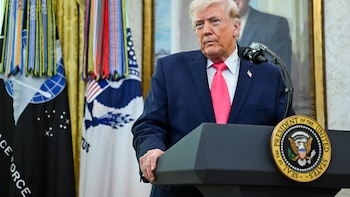
With US President Donald Trump's threat of steep tariffs on China, Brazil, India, Canada, Mexico and other countries, fears of global trade wars and rising protectionism have resurfaced.
The Economic Survey 2024–25, prepared by Chief Economic Adviser V Anantha Nageswaran and presented in Parliament by Finance Minister Nirmala Sitharaman, offered insights into how India could strengthen domestic manufacturing in an era of tariffs.
The survey suggested that while offering incentives to industries is essential, punitive measures must also be in place — an approach it terms "carrots and longer sticks."
"Industrial policy refers to measures that target the transformation of an industry in pursuit of a public goal," the survey stated, addressing the impact of modern tariff wars. "Tariffs are a standard tool of industrial policy and are often seen as a way to support fledgling industries before they gain traction."
"However, using tariffs requires a calibrated approach, which balances the sector's needs with the costs imposed on the rest of the economy. Tariffs can also be viewed as a lever within a system of tools that can further the goals of industrialisation."
Recognising the global shift towards modern industrial policies, the survey notes that many countries combine tariff-based protection with credit grants and export subsidies to boost their industries.
Drawing from global examples, the survey emphasised "longer sticks"—stricter penalties for underperforming industries.
"The recipe for a successful industrial policy lies in the simultaneous use of carrots and sticks, with the sticks often being longer than the carrots. Taking a comprehensive look at the industrial policies of Northeast Asia, Joe Studwell wrote in 'How Asia Works' that the region succeeded with its industrial policy because it punished non-performers more than it rewarded performers," the survey explained. "As Studwell notes, the emphasis on infant industry protection in Northeast Asian economies went hand in hand with external benchmarking through export performance."
There were special privileges for local businesses, but there was accountability for export performance. That is how scale, productivity, efficiency and rapid economic growth were achieved. Studwell repeatedly notes that Korean industrial policy punished its non-performers more than helped performers, it added.
Essential Business Intelligence, Continuous LIVE TV, Sharp Market Insights, Practical Personal Finance Advice and Latest Stories — On NDTV Profit.