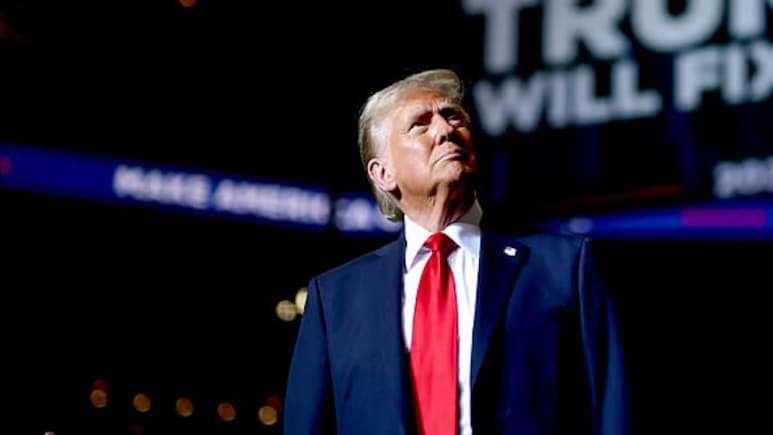
The United States Supreme Court has struck down US President Donald Trump's sweeping global tariffs imposed under a national emergency law. The 6-3 decision marks a significant setback for Trump, who had made tariffs a central pillar of his economic and foreign policy during his second term.
Court Says President Exceeded Authority
The ruling, authored by Chief Justice John Roberts, upheld a lower court's finding that Trump exceeded his authority by using the 1977 International Emergency Economic Powers Act (IEEPA) to impose tariffs without congressional approval.
Also Read | Layoffs Are Rising In Tech, But These Skills Are Helping People Unlock Better Pay
Roberts wrote that the president must “point to clear congressional authorization” to justify such an extraordinary use of power. “He cannot,” Roberts added.
The majority said the US Constitution clearly gives Congress — not the president — the power to impose taxes, including tariffs. “The Framers did not vest any part of the taxing power in the Executive Branch,” Roberts wrote.
Justices Samuel Alito, Clarence Thomas and Brett Kavanaugh dissented. Kavanaugh argued that the tariffs were lawful.
“The tariffs at issue here may or may not be wise policy. But as a matter of text, history, and precedent, they are clearly lawful,” he wrote.
First Major Test Of Trump's Second-Term Agenda
The case was brought by businesses affected by the tariffs, along with 12 US states — most led by Democratic governors.
It is the first major element of Trump's second-term agenda to be reviewed by the Supreme Court, which includes three conservative justices he appointed during his first term.
Trump had relied on IEEPA to impose tariffs on nearly every major US trading partner without seeking approval from Congress — the first US president to do so.
The tariffs triggered a global trade war, strained relations with key allies and added volatility to financial markets.
ALSO READ | Big Setback To Donald Trump, US Supreme Court Strikes Down Global Tariffs
What Happens To Collected Tariffs?
The court did not decide whether companies would be refunded the billions of dollars already paid under the tariffs. Many firms, including retail giant Costco, have already filed legal claims seeking refunds. Kavanaugh warned the repayment process could become complicated.
“The Court says nothing today about whether, and if so how, the government should go about returning the billions of dollars that it has collected from importers. But that process is likely to be a ‘mess,'” he wrote.
Economists at the Penn-Wharton Budget Model estimated that more than $175 billion had been collected under the IEEPA-based tariffs. That amount could potentially have to be refunded.
Other Tariffs Remain In Place
Trump had argued that the tariffs were essential for US economic security. He repeatedly claimed that without them, the country would be “defenseless and ruined.”
In November, he told reporters that without tariffs, “the rest of the world would laugh at us.”
While the Supreme Court ruling invalidates tariffs imposed under IEEPA, Trump has also imposed additional tariffs under other laws. Those measures, which are not affected by this decision, account for roughly one-third of tariff revenue collected during the period.
Administration officials, including Treasury Secretary Scott Bessent, have said the US could rely on other legal provisions to maintain tariffs. These include laws allowing tariffs on imports that threaten national security or on countries accused of unfair trade practices.
However, analysts say these alternatives do not provide the same broad authority or speed that IEEPA offered.
The ruling is expected to reshape US trade policy and reinforce Congress's constitutional role in taxation, even as debates continue over executive power and economic strategy.
ALSO READ | Trump's First Reaction As Supreme Court Strikes Down Sweeping Tariffs — 'Disgrace'
Essential Business Intelligence, Sharp Market Insights, Practical Personal Finance Advice, Daily Fuel, Gold and Silver Prices and Latest Stories — On NDTV Profit.