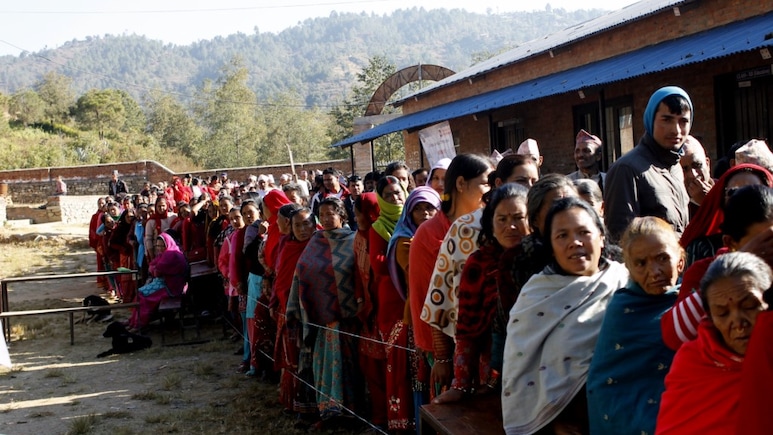
Nepal went on polls on Thursday, less than six months after the deadly Gen-Z-led protests rocked the Himalayan nation and toppled the government.
The country has since been run by an interim government under the former chief justice of the country, Sushila Karki. The interim government had promised to hold fresh elections within six months of the September 2025 uprising.
While the country votes, here is everything we need to know about the polls.
There are a million first-time voters in the election, wherein a total of around 19 million people will cast their ballots. The voting will start at 7:00 a.m local time and will continue till 5:00 p.m.
The voters will exercise their right to elect 275 parliament members. The election is not a simple one; it is held in two ‘phases'. 165 members of the parliament will be chosen through first-past-the-post voting, which essentially means that the candidate with a higher number of votes will win.
The remaining 110 MPs will be selected via PR (proportional representation), taking into account the proportion of votes cast for a particular political party.
This system makes it difficult for any party to get an outright majority, and there is almost always a coalition government in place.
The Election Commission of Nepal has maintained that there were 6541 candidates in total, of which 3406 are contesting in the directly elected seats, and more than 100 others are contesting under the PR system, the BBC has reported.
The key players, the contests to look out for:
The most interesting and the most closely watched contest will be between the former Prime Minister of Nepal, 74-year-old KP Sharma Oli, and the former mayor of Kathmandu, Balendra Shah, who is only 35 years of age.
The contest will be held in Jhapa-5 constituency, a traditional Oli stronghold. However, it was Oli's government that was hooted out by the young protestors last year, on charges of corruption.
Shah's party, the Rastriya Swatantra Party (RSP), had stood fourth in the tally in the last general elections of 2022. The observers, however, expect the party to perform better than the last time. The party has projected Shah as their Prime Ministerial candidate.
The Nepali Congress is a strong contender as well, with the largest membership and a fine track record of winning elections. The party is presently being led by four-time parliamentarian, Gagan Thapa.
Oli's party, the Communist Party of Nepal UML, and the Communist Party of Nepal (Maoist) are the other contenders in the elections.
Also Read: Nepal Goes To Polls In First General Election Since Govt-Toppling Gen Z Protests Last Year
What will the voters consider?
Corruption is going to be the number one issue this elections, given the fact that 77 people lost their lives during last year's anti-corruption protests led by the youth of the country.
It is quite evident that the million new voters, and the young voters among the rest, feel strongly about the corruption in their country and will vote keeping the issue at the forefront. Unemployment and economic stagnation are the other key issues that were the driving force for last year's unrest and are expected to be among the key factors in the ongoing polls.
The fact that most of the political parties have better governance, fighting corruption, and reducing unemployment in their manifestos is proof enough that these are the major issues that will drive the voters in this election.
Besides, China and India will be closely watching the elections in Nepal for their own geopolitical interests. The last PM, Oli, has been closer to China and had a fractious relationship with India. China, with major influence in the mountainous region, will be hoping for a friendly government to take centre stage and be supportive towards its interests, including the Belt and Road Initiative (BRI).
When to expect the results?
The election commission has promised to reveal the results of the ‘first phase', the directly contested 165 seats, within 24 hours of the start of voting. However, given the fact that the ballot boxes need at least 24-hours to be delivered at the counting centres in the mountainous region might be an impediment. If the election commission delivers within this time frame, it will be a huge departure from what the results in earlier elections had looked like.
“For the PR vote, it will be another two to three days before the results are tallied,” BBC quoted the election commission officials as saying.
Ram Prasad Bhandari, the chief election commissioner, says he is committed to finish counting by 9 March. During the 2022 election, though, the result was declared after about two weeks.
Also Read: Nepal Election On March 5: What Triggered Fresh Polls? From Key Players To Issues — All You Need To Know
Essential Business Intelligence, Sharp Market Insights, Practical Personal Finance Advice, Daily Fuel, Gold and Silver Prices and Latest Stories — On NDTV Profit.