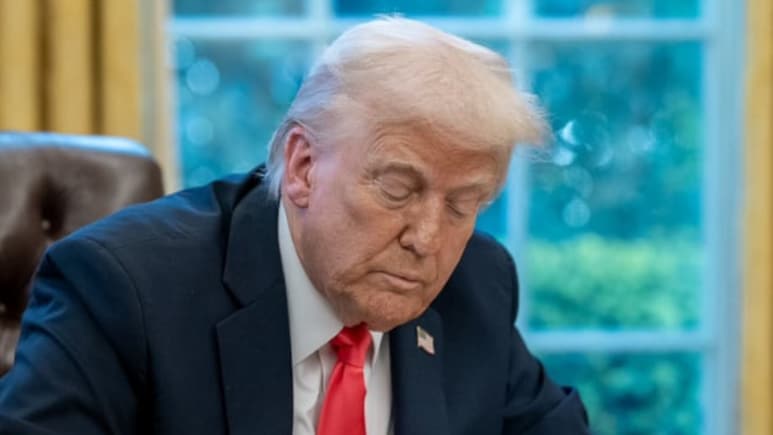
- The White House claimed Iran halted 800 scheduled executions after US warnings
- Iran's crackdown has killed over 2,600 protesters, according to human rights groups
- US imposed sanctions on five Iranian officials linked to protest violence
The White House on Thursday projected a message of forceful diplomacy on two very different global fronts — Iran's violent crackdown on protesters and President Donald Trump's push to acquire Greenland — underscoring what officials described as a no-compromise approach to US national security and human rights.
On Iran, the administration said pressure from Washington had led Tehran to halt plans for mass executions linked to nationwide anti-government protests. White House Press Secretary Karoline Leavitt told reporters that Iran had stopped 800 executions that were scheduled to take place this week after direct warnings from Trump and his team.
"The president understands today that 800 executions that were scheduled and supposed to take place yesterday were halted," Leavitt said, adding that the administration had warned Tehran of 'grave consequences' if killings continued. She stressed that "all options remain on the table," including military action.
According to human rights groups, Iran's crackdown on protests has killed more than 2,600 people in recent weeks. The White House confirmation came shortly after the US imposed fresh sanctions on five Iranian officials accused of orchestrating the violence and began steps to track overseas financial transfers linked to Iranian leaders, according to Reuters.
Trump himself later said he had been told that executions and protest-related killings had stopped. "The executions have stopped and not going to have an execution, which a lot of people were talking about for the last couple of days," he said in Washington. His remarks followed international concern over detained protester Erfan Soltani, whose family said his execution had been postponed.
At the same briefing, Leavitt also made clear that Trump's ambitions regarding Greenland remain unchanged, despite signs of European resistance. She said a developing European military mission in the Arctic would not deter the president's goal of acquiring the mineral-rich territory.
"The president has made his priority quite clear. He wants the United States to acquire Greenland," Leavitt said, calling it a matter of national security. She confirmed that US, Danish and Greenlandic officials have agreed to form a working group to hold technical talks every two to three weeks on the issue.
Denmark's Foreign Minister Lars Lokke Rasmussen later said Copenhagen shared Washington's goal of strengthening Arctic security but rejected the idea of territorial acquisition. "This is 2026 — you can trade with people, but you don't trade people," he said.
Taken together, the twin developments reflect a White House eager to apply pressure abroad — whether through sanctions, threats, or negotiations.
Essential Business Intelligence, Sharp Market Insights, Practical Personal Finance Advice, Daily Fuel, Gold and Silver Prices and Latest Stories — On NDTV Profit.