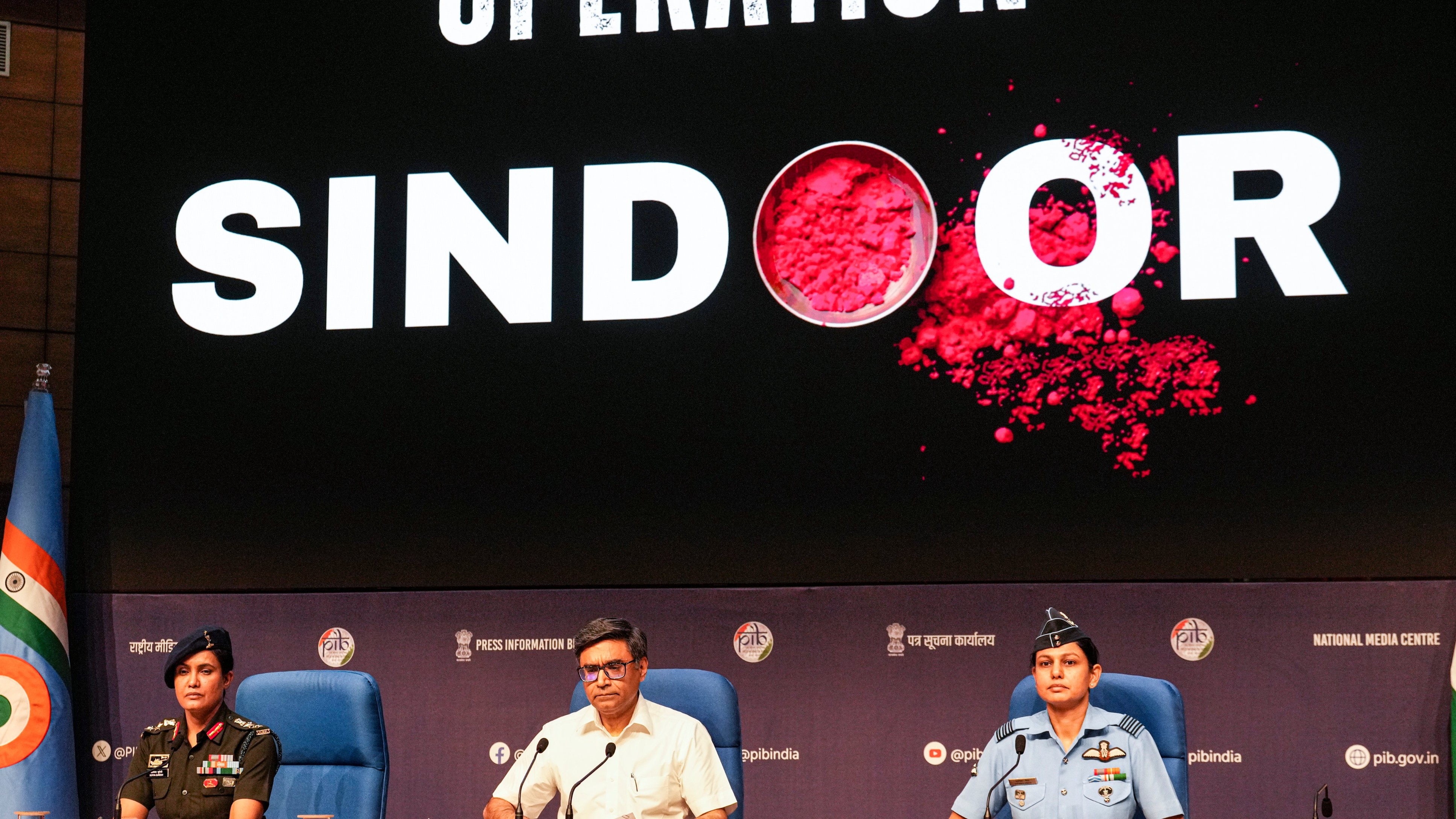
India launched a series of 24 missile strikes on terror camps across Pakistan and Pakistan-occupied Kashmir in the early hours of Wednesday, two weeks after 26 people were killed by terrorists in Pahalgam.
The coordinated military action, codenamed 'Operation Sindoor', targeted nine sites linked to Jaish-e-Mohammed and Lashkar-e-Taiba, killing at least 70 terrorists.
This is not the first time that tensions between India and Pakistan, two nuclear-armed nations born out of the violent partition of British India in 1947, have boiled over into military conflict.
Here is a look at some key flashpoints that have shaped the long, bitter history between the two countries:
1947–48: First India-Pakistan War
The Partition led to massive violence, killing thousands and forcing nearly 15 million people to leave their homes.
At the time, princely states could choose to join either country. The ruler of Jammu and Kashmir, Maharaja Hari Singh, wanted to stay independent. But after Pakistan-backed tribal fighters and its army attacked Kashmir, he asked India for help and signed the Instrument of Accession to join India.
This led to the first India-Pakistan war. After months of fighting, the United Nations stepped in and helped arrange a ceasefire in 1949.
1965: Second Indo-Pak War
Fighting broke out in April 1965 in the Rann of Kutch and escalated into a full-scale war by August after Pakistan launched Operation Gibraltar, aimed at inciting rebellion in Kashmir.
India pushed back with force, capturing territory deep inside Pakistan. The war ended in a stalemate, with both sides agreeing to a return to pre-war positions under the Tashkent Agreement brokered by the Soviet Union.
1971: Third Indo-Pak War; Formation Of Bangladesh
The most decisive conflict came in 1971 when India intervened in East Pakistan (now Bangladesh) to support the independence movement against West Pakistan's military crackdown. India stepped in to support the local fighters, forming the Mitro Bahini to stop the violence.
The war lasted nine months and led to the creation of Bangladesh. An estimated three million people were killed in the conflict.
1972: Creation Of LoC
The Line of Control was established after the 1972 Simla Agreement between India and Pakistan. It is a de facto military boundary, not an official international border.
The LoC separates Pakistan-Occupied Kashmir from India's Jammu and Kashmir and Ladakh.
1999: Kargil Conflict
In 1999, Pakistani soldiers and militants crossed into Indian territory and occupied key positions in the Kargil district of Ladakh. This led to the Kargil War.
The intruders, backed by Pakistan, took control of Indian military posts high in the icy mountain peaks. In response, India launched a full military operation to drive them out. Fierce fighting continued from May to July 1999.
With strong resistance from Indian forces and international pressure, Pakistan was forced to withdraw. India regained the occupied territory. Both sides suffered heavy casualties during the conflict.
2016: Uri Attack
On Sept. 18, 2016, a terrorist attack took place in the town of Uri, located in the Jammu and Kashmir region. Four heavily armed militants from Pakistan-based terror group Jaish-e-Mohammed stormed an Indian Army brigade headquarters.
The attackers set off explosives and opened fire on soldiers, killing 19 Indian Army personnel and injuring several others. The terror attack led to a six-hour gun battle in which all four terrorists were killed.
In response, India launched a military operation. On Sept. 29, Indian forces conducted surgical strikes across the LoC, targeting terrorist launchpads and training camps in PoK.
2019: Pulwama Attack
On Feb. 14, 2019, a suicide bombing targeted a Central Reserve Police Force convoy in Pulwama, Kashmir, killing 40 Indian soldiers. The attack was claimed by the Pakistan-based Jaish-e-Mohammed terror group.
Thirteen days later, on Feb. 26, India carried out a retaliatory airstrike. Indian Air Force Mirage 2000 fighter jets crossed the LoC and targeted Jaish-e-Mohammed camps in Balakot, located in Khyber Pakhtunkhwa province.
The operation lasted less than 20 minutes. The Spice 2000 guided bombs hit six buildings at the terror camp. According to reports, 35 bodies were seen being evacuated from the site.
Watch
Essential Business Intelligence, Continuous LIVE TV, Sharp Market Insights, Practical Personal Finance Advice and Latest Stories — On NDTV Profit.