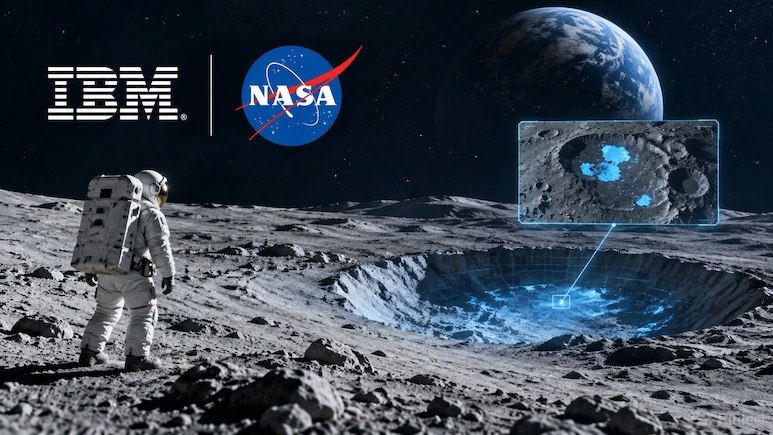
IBM and NASA have unveiled the NASA-IBM Lunar Foundation Model, an open-source artificial intelligence tool designed to analyse decades of lunar observation data and help scientists study the Moon's surface.
The AI model, launched on September 10, 2026, is designed to support lunar research and preparations for a long-term human presence under NASA's Artemis program, according to a report by Reuters.
ALSO READ | 'Robots Are First Line Of Defence, But...': Sunita Williams Explains Human-AI Symbiosis In Space
Also Read | Layoffs Are Rising In Tech, But These Skills Are Helping People Unlock Better Pay
The NASA-IBM Lunar Foundation Model is a publicly accessible AI tool for studying the Moon. More than 30 layers of data gathered by nine instruments across four NASA missions, including the Lunar Reconnaissance Orbiter, were used to train the model.
The model is part of the Prithvi family of open foundation models developed by IBM and NASA, which covers geospatial, meteorological and other applications.
It can assist scientists in mapping craters to identify potential landing locations, identifying possible ice deposits in the Moon's permanently shadowed regions and studying volcanic features. These tasks have traditionally relied on manual analysis of maps and images or lower-resolution machine-learning tools.
According to NASA and IBM, the model recognised important lunar surface features up to 23% more accurately than commonly used methods in benchmark tests.
ALSO READ | NASA, SpaceX Delay ISS Mission Launch Over Dragon Spacecraft Leak
Space agencies are particularly interested in lunar ice because it could provide access to water and other resources that may be important for establishing a future Moon base and producing rocket fuel for missions to Mars.
NASA's Artemis program plans to send astronauts back to the Moon in 2028 as part of efforts to test technologies and establish the foundations for sustained lunar exploration and future Mars missions.
Essential Business Intelligence, Sharp Market Insights, Practical Personal Finance Advice, Daily Fuel, Gold and Silver Prices and Latest Stories — On NDTV Profit.