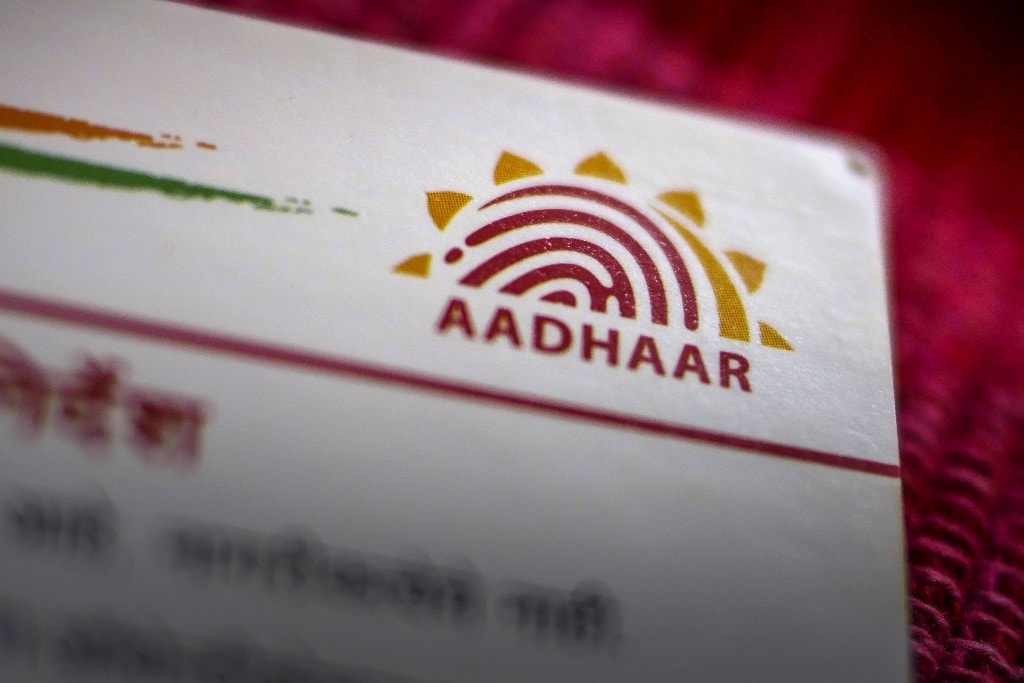
An Aadhaar biometric identity card, issued by the Unique Identification Authority of India (UIDAI), is arranged for a photograph in Mumbai, India (Photographer: Dhiraj Singh/Bloomberg)
9 years ago
Apr 11, 2017
Aadhaar debate: Upper House of Parliament discusses savings, privacy and more...
He argued that with Aadhar the misuse of subsidies can be addressed. Prasad claimed that these benefits of people in rural areas were claimed by village heads, and Aadhar solves the problem.
Prasad proclaimed that Aadhaar, and its data is completely safe. He distinguished between core biometrics and demographic information which are defined in the act. He added that no religion, income, medical history, ethnicity or education is being profiled, hence making Aadhaar foolproof.
Only minimum information from the Aadhaar system will be utilised for verification, Prasad clarified.
The government has been blacklisting operators that share data from the Aadhaar system. It has blacklisted 34,000 operators, and has taken action against 1,000 of them, the minister stated.
Prasad set addressing infrastructure issues as the first priority with Aadhaar. He also said that the UIDAI will be accountable to the parliament.
Uttar Pradesh parliamentarian Pratap Shukla cited a World Bank report, saying that it had called it more secure than the social security system of U.S.
Loopholes exist in all systems, but those loopholes are used to make it better, he said. He added that the government will ensure everyone's privacy, and that more subsidies should be linked to Aadhaar.
Only 27 percent of villages have banking facilities within 5 kilometers, hence the government should address infrastructure issues before proceeding with Aadhaar, said V. Vijaysai Reddy of YSR Congress Party from Andhra Pradesh.
The average state preparedness for Aadhaar is 12 percent, while for some it is still zero, he said adding that the biometrics based systems suffer from infrastructure issues.
Reddy questioned why the act prevents the aggrieved from going to court.
He praised some aspects of Aadhaar, such as the its linking with the Permanent Account Number (PAN) card. This, he said, was justified to mitigate the generation of black money and duplicate PAN cards.
Raja, who does not have an Aadhaar card, said that it cannot be thought of as a universal wand for all problems. He argued that its scientifically proven that biometrics change after a certain age and hence in such cases citizens would be deprived of social services.
The Supreme Court lawyer cited the scrapping of Australia's social service access card project in 2007, where the government concluded it was very difficult to protect such data. He also referred to the positions of U.K. and France on similar systems.
Tulsi called the Aadhaar database a “heaven for hackers”. He added that national security is threatened too with China and Pakistan as neighbours if such data is made readily available.
The government tried to control economic behaviour by forcing people to go cashless, but now it is trying to control social behaviour with the Aadhaar, said Samajwadi Party parliamentarian Ravi Prasad Verma.
The only thing left now, an agitated Verma added, was for the government to add a 'chip' in everyone's brains to find out what they think.
He argued that it was not the UPA government but his party’s senior leader Lal Krishna Advani that had laid the foundation for the Aadhaar ecosystem. Countering Jairam Ramesh’s claims on Aadhaar savings, Sahsrabuddhe said that the total savings in the last five years due to its implementation was Rs 17,360 crore.
Ramesh questioned if fraudulent children were being fed in schools, that the government had to make Aadhaar mandatory for the midday meals scheme.
He also raised doubts over the figures given by the government for savings it made by making Aadhaar mandatory for availing gas subsidy. Ramesh said the savings were due to the fall in oil prices, not Aadhaar implementation.
Ramesh also criticised the government for making the Aadhaar project of its own, saying that the United Progressive Alliance government was the one which introduced it.
The Rajya Sabha on Monday witnessed a fiery debate around India’s biometric ID Aadhaar as the opposition questioned the government's move to make the unique identification (UID) number mandatory for a host of welfare benefits.
The debate, started by Information and Technology Minister Ravi Shankar Prasad, revolved around claims of savings made through Aadhaar in the public distribution system and direct benefit transfers.
Congress’ Jairam Ramesh said the government’s claim of savings in the direct benefit transfer due to Aadhaar are highly suspect. Weeding out started before Aadhaar came in and those savings are now being counted as contributed by Aadhaar, he said.