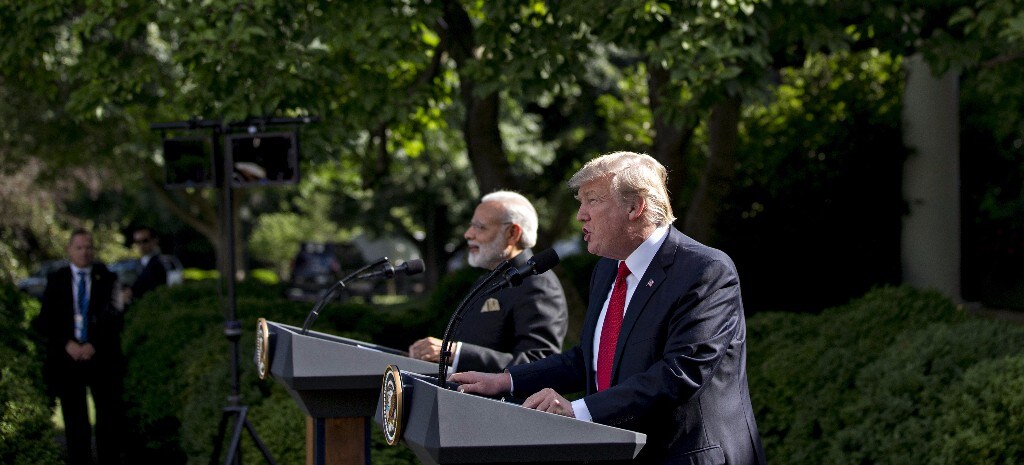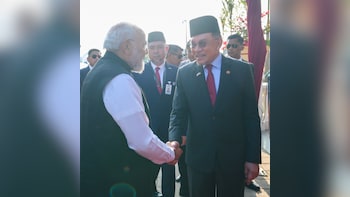
One may be forgiven for not realizing the Prime Minister of the world's largest free market democracy visited the President of the world's most powerful democracy. Media coverage in the United States, in the 24 hours prior to the tête-à-tête between Messrs Modi and Trump, was scant. On the big day itself, June 26, the American press was abuzz with the U.S. Supreme Court decision to uphold the Muslim travel ban.
One must be forgiven for being underwhelmed by the outcome of the June 26 meetings between the two Twitter fans. Indeed, with India's Goods and Services Tax (GST) effective July 1, one must query whether the Indian taxpayer got her money's worth from the trip.
To be sure, on June 24, Trump set the right tone with a tweet calling Modi a “true friend.” Thereafter, however, they didn't meditate on the definition of “true friendship,” nor on how its meaning translates into an itinerary. Rather, they parlayed, parsed a list of issues, and parted.
There is a difference between “true friendship” and a mutuality of interests.
Hard headed realists focus on the latter and produce agendas. They seek an identity of ends, and preferably means, too.
Confusing motion with progress, they oversell past deals as new news.
Ironically, they ignore at the peril of the nations they represent the reality that today's interest-based infatuation may be tomorrow's betrayal.
Holistic statesmen take the long view. They foresee as inevitable and acknowledge disagreements over ends, means, or both. They labor for breakthroughs to broaden and deepen an enduring relationship, to create a trust in perpetuity. Shared values are the assets in the trust, yielding a return in the form of friendship.
Five Days In November 1961: JFK and Panditji
President John F Kennedy and Prime Minister Jawaharlal Nehru understood the difference, as Ambassador's Journal (1969), the account by JFK's Ambassador on Delhi's Shantipath, the brilliant economist John Kenneth Galbraith, shows. JFK personally picked up Panditji on November 6 at the Newport, Rhode Island Naval Air Station, in the Presidential yacht, the Honey Fitz, and sailed him by the famed, gilded-age mansions, quipping “I want you to see how the average American lives.” During their five days together, November 6-10, 1961, they met not only in the Oval Office, but also at India's Embassy in Washington, D.C.
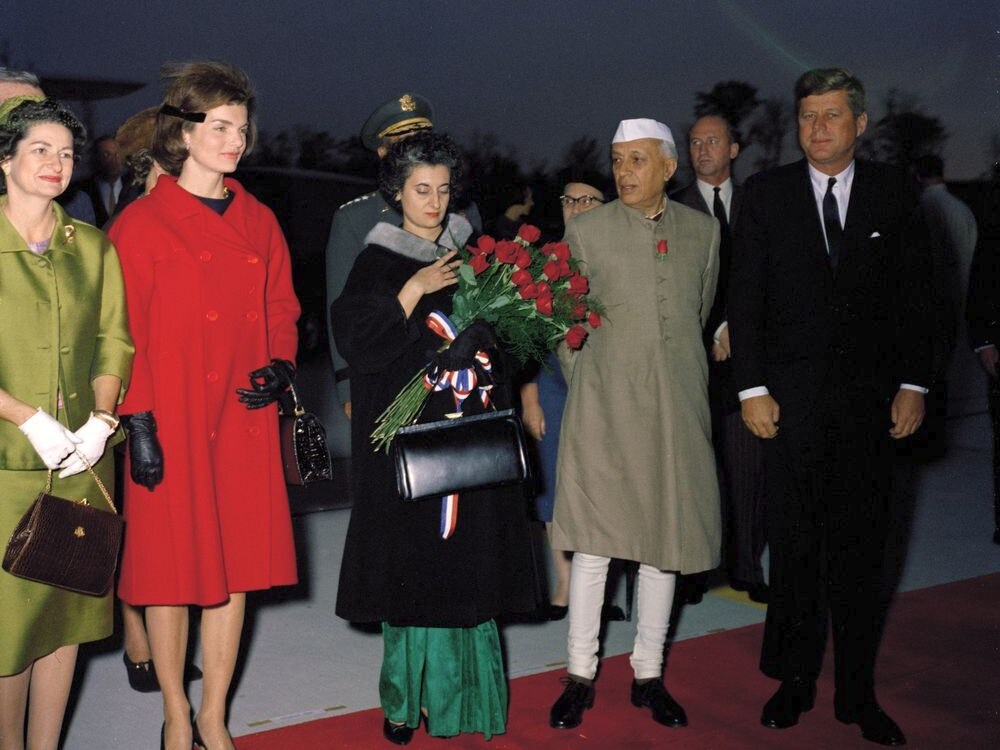
Guess what they and Ambassador Galbraith dealt with? The same underlying issues, albeit cast in different contexts, familiar to President Trump and Prime Minister Modi: defense and economics.
On Defense:
- ‘Communist terror' in Laos and Vietnam, and Panditji's counsel against sending American combat forces to Indochina.
- Pakistan, which (as Galbraith put it) was “unhappy over the allotment of time to India as opposed to Pakistan” that the First Lady, Jackie Kennedy, was planning on her March 1962 trip.
- ‘Communist China' and ‘the relation of innocence to isolationism.'
On Economics:
- Steel, particularly the possible use of American-made steel in the Bokaro mill.
- Food security, and the apparent diversion of PL-480 donations to Indian stores.
- Sugar, specifically, a decrease in the U.S. tariff rate quota (TRQ) for Indian imports.
- Britain's entry into the European Common Market in exchange for across-the-board tariff cuts, and the possible launch of the ‘Kennedy Round' of multilateral trade talks under the General Agreement on Tariffs and Trade (GATT).
Less than Five Hours in June 2017: DJT and Modiji
So, what happened during the 4 hours and 25 minutes (from 15:35 to 20:00 Eastern Time) that Messrs Modi and Trump shared? They conversed about interests, asserting an alignment on their top two agenda items, defense and economics.
On Defense:
India bought $19 billion worth of Sea Guardian MQ-9B Unmanned Aerial Systems (i.e., drones for surveillance of the Indian Ocean, across which Chinese ships traverse and under which Chinese subs lurk from their new base in Djibouti), Apache attack helicopters, and C-17 aircraft. America lobbied India to buy more ordnance, namely, F-16 and F/A-18 fighter jets.
The June 26 White House Fact Sheet, entitled “The United States and India – Prosperity Through Partnership,” proclaimed the deal would “support thousands of United States jobs.” Maybe the more accurate sub-title is ‘American Prosperity Through Indian Procurement.'
That's because the sales essentially were set before the trip. Indeed, the drone manufacturer announced the Trump Administration authorized them on the Friday before the Prime Minister arrived. That's also because the Fact Sheet noted...
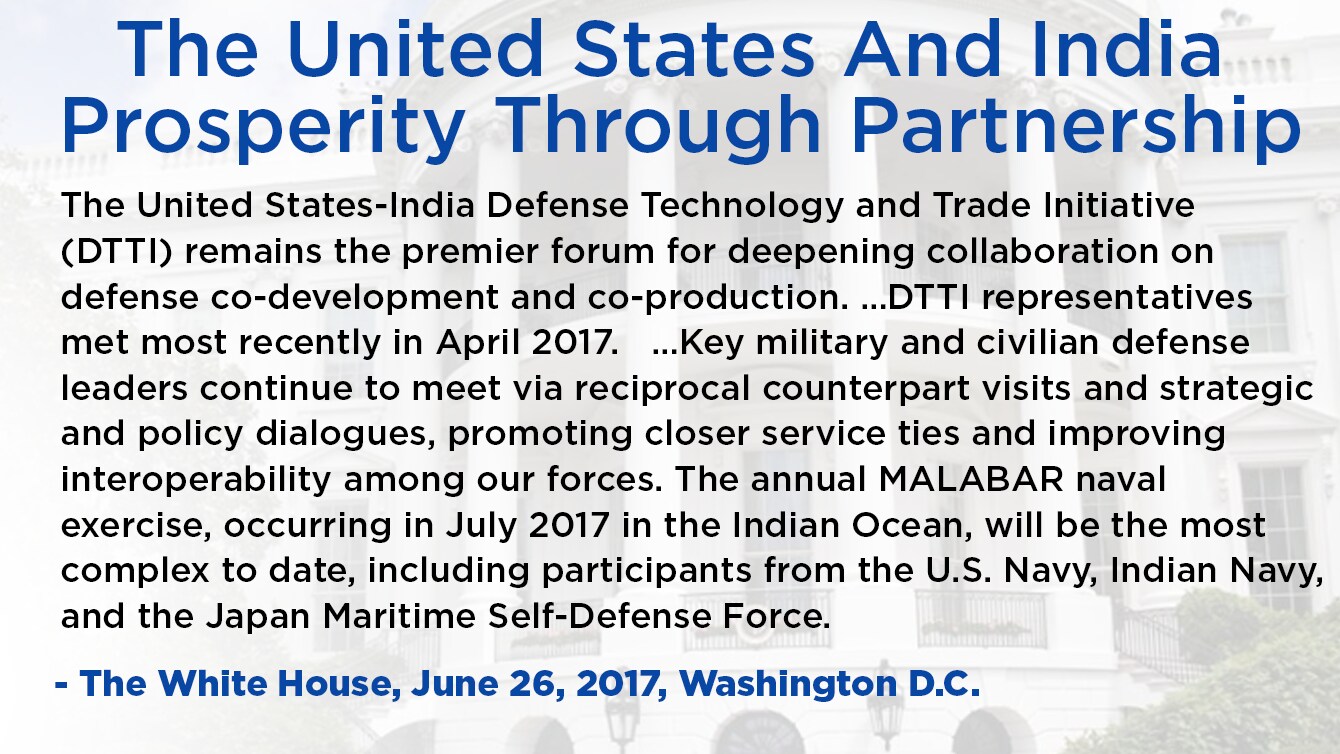
Exactly why is an institutional structure (the DTTI) that “remains” in place and met two months ago, and a pre-planned, “annual” naval exercise, new news?
Maybe an answer is Modi's appearance at the White House was what lawyers call a ‘condition precedent' for (something that must happen before) performance of the drone sales contract, more DTTI meetings, and the Malabar naval exercises can occur. Maybe another answer is his appearance had symbolic value.
Modi and Trump agreed to fight harder and closer against what Trump called ‘radical Islamic terrorism.'
That us-versus-them characterization works for the Alt-Right in both democracies.
How many times must it be said there is nothing ‘Islamic' about ‘terrorism'? Yet, how accurate is it to avoid saying candidly what is or should be known: though Pakistan has suffered grievously as a victim of terrorism, it is not on par with India in fighting violent extremist organizations through educational and military means, and thus is not yet a “true friend” of India?
On Economics:
The Fact Sheet declared a shared commitment to “free and fair trade.” Lawyers recognize the elasticity of that phrase.
‘Free' trade allows either side to demand the other drop its bound Most-Favored Nation tariffs to below its actually-applied duty rates. ‘Fair' trade permits either side to impose on the other anti-dumping and countervailing duties. Whole-hearted commitment to ‘free' trade would suggest a bilateral free trade agreement, which this columnist indeed will suggest. Serious attention to ‘fair' trade would address labor, environmental, and women's rights, as did the Trans Pacific Partnership, which India could join, as this columnist already has suggested.
So, what trade deals did the Fact Sheet announce? First, India's SpiceJet Ltd. agreed to buy 100 new Boeing 737MAX-8s, for a total of 205 planes valued at more than $20 billion.
Whoops! That SpiceJet deal was done earlier in 2017, but at least it supports 130,000 American jobs.
Second, the two countries signed the World Trade Organization's Trade Facilitation Agreement (TFA).
Whoops, that's not new news either! The TFA was completed in December 2013.
Yes, 2013, WTO Ministerial Conference in Bali, and took effect on 22 February 2017. Ditto for the ballyhooed gas deals.
Instead, India agreed to give Ivanka Trump a visa to lead the U.S. delegation to the Global Entrepreneurship Summit.
Thank you, Prime Minister Modi, for inviting me to lead the U.S. delegation to the Global Entrepreneurship Summit in India this fall. pic.twitter.com/ZNwmTTnGYD
This columnist would have picked Madhur Jaffrey. The Delhi-born actress and food and travel writer, who resides in New York and London, is a cultural bridge between millions of Americans and Indians – and, as a Shakespearean, Britishers, too. Besides, Ms Jaffrey didn't outsource her clothes to China; rather, in support of Gandhiji, she spun khadi.
Modi lauded the two great democracies as being engines of global growth, and their shared interest in increased productivity and employment. But, he seemed wilfully blind to the difference between ‘America First' and ‘Make in India.' Isolationism is the goal of ‘America First,' protectionism is the policy tool. ‘India First' is a news weekly in Odisha, and ‘IndiaFirst' is a life insurance company whose goal is to sell policies. “Make in India” is a goal the Prime Minister announced in September 2014 to encourage production in India. Its policy tools are liberalized FDI rules in 25 sectors.
Rewriting The Itinerary
So, what would have made the trip impressive? An itinerary crafted to engender a value-based friendship among leaders and their peoples.
The starting point should have been on Indian soil, that is, at the Embassy of India in Washington, D.C.
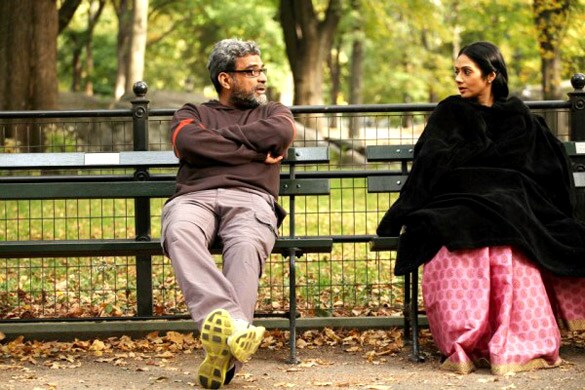
There, the Prime Minister should have hosted the President for a Bollywood movie. English Vinglish would have been a good pick. While munching bhujia, the President would have seen not every Indian who comes to the U.S. wants to stay in America.
Mother India is a pretty strong draw, not just for Sridevi, but also for many H-1B visa holders.Next, dinner in Chinatown would have been sensible.
That would have been an occasion to chat about how to bring 2010 Nobel Peace Prize Winner Liu Xiaobo out of China before he dies of liver cancer. His ‘crime' to the Chinese Communist Party is a badge of honor for Messrs Trump and Modi – a call for political reforms. Peking duck would have been accompanied by a discussion of currency manipulation, and maybe sanitary and phytosanitary (SPS) barriers to poultry trade. Fortune Cookies could have been opened while noting the good fortune of a rupee that trades freely and has appreciated against the dollar from 68.81 on November 23, 2016 to 64.43 on June 26, 2017.
After dinner, an Eid al-Fitr celebration hosted by the Embassy of Oman would have been in order.
What a pity Trump ended the White House iftar tradition, which dated back to President Thomas Jefferson's invitations in 1805. Why Oman? Strategically positioned at the Strait of Hormuz, it is doing a characteristically remarkable job of staying above the fray that engulfs the Gulf Cooperation Council (GCC). Ibāḍī Muslims, who predominate in Oman, are friends to all. Their leaders might have helped the Prime Minister and President strategize how to put the GCC back together so that normal air, sea, and land trade and travel for Americas, Indians, and everybody else can resume.
The next morning would have started with a walk, coupled with seva (service).
Not a walk around the Rose Garden, but around a dicey area of Washington, D.C. The two leaders would have jointly served masala chai and aloo paratha at a homeless shelter, like law students working together on a pro bono project. Seva would have been a costless way to demonstrate that economic growth unaccompanied by poverty alleviation exacerbates social tensions and vulnerability to extremist ideologies.
The capstone ought to have been a joint press conference at the Sackler Gallery.
That venue would have highlighted a shared love for the beautiful Asian art displayed around them. In that apolitical setting, they might have bantered humorously, as “true friends” do, with each other and the reporters, in the tradition of JFK and Panditji, who faced tough interviewers on NBC's ‘Meet the Press,' and lunched with Pulitzer-Prize winning journalist Walter Lippmann.
Instead, shielded behind White House podiums, DJT and Modiji read prepared texts, and took no questions.Yes, seriously, the leaders of the world's two greatest democracies retreated from the free press.
Fortunately, they have another chance to transcend a fleeting mutuality of selected interests. The President accepted the Prime Minister's invitation to visit India.
Hey guys, please script that trip differently.
Raj Bhala is Associate Dean for International and Comparative Law and Rice Distinguished Professor, The University of Kansas, School of Law. The views expressed here are his and do not necessarily represent the views of the State of Kansas or the University.
The views expressed here are those of the author's and do not necessarily represent the views of BloombergQuint or its editorial team.
Essential Business Intelligence, Continuous LIVE TV, Sharp Market Insights, Practical Personal Finance Advice and Latest Stories — On NDTV Profit.