His eureka moment came at 8, watching Hema Malini in the title song of Naseeb, shimmying in a black sequinned maxi and a pink boa. “That was it. A lightbulb went off in my head, I wanted to be her. I wanted to wear that feather boa and seduce men. I didn't want to be Amitabh. Eek! I wanted to be Hema.”
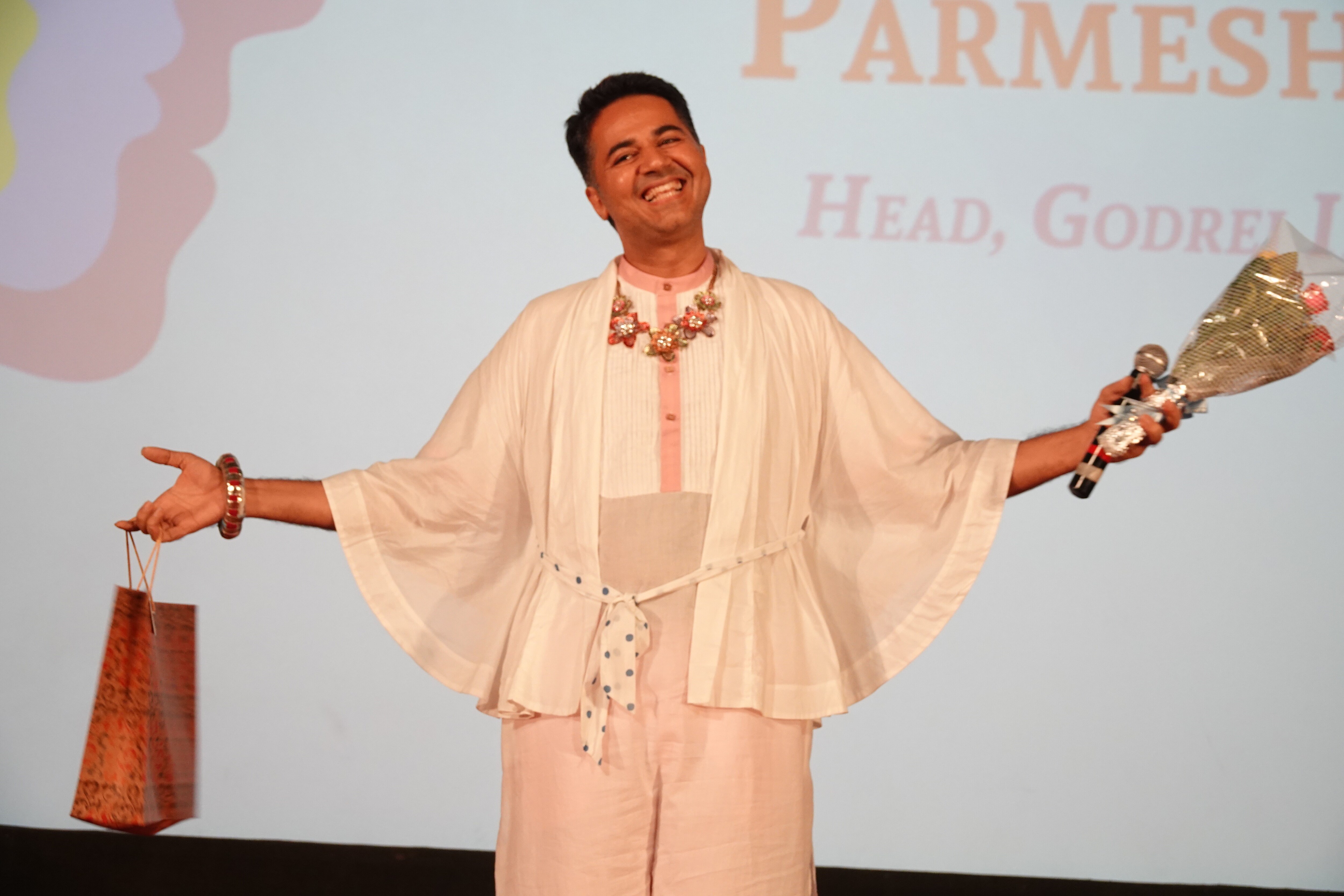
Parmesh Shahani's new book Queeristan is part glittery memoir, part cultural and legal history of the LGBTQ (lesbian, gay, bisexual, transgender and queer) movement, part five-step guide to an inclusive workplace and part hopeful vision of a kinder, more just India whose name is referenced in the title.

Shahani sets the book in corporate India, a world which he says he has “infiltrated”.
You may know him as the founder of Mumbai's cultural programming hub Godrej India Culture Lab, an oft-invited speaker/writer on LGBTQ issues, or simply as a flamboyant dresser who accessorises every outfit—whether pista green silk trench coat, African-print suit or his mother's repurposed petticoat—with a wide grin and a double scoop of optimism.
Shahani thinks of himself as someone who practises “jugaad resistance” – a “resourceful, solution-oriented opposition” located “within the establishment they wish to change”, working assiduously from the inside. As vice-president at the more than century-old Godrej Industries for a decade now, he's demonstrated enough times that this is a workable approach.
The conglomerate now has same-sex partner benefits and gender-neutral adoption leave. Last year it announced its Godrej Gender Affirmation Policy—offering reimbursements for non-cosmetic surgeries and hormone replacement therapy—and Project Rainbow, to attract LGBTQ talent. In addition to a detailed case study of how his workplace changed, Shahani looks at inclusion policies at other companies such as Tata Steel, the Lalit group of hotels, and IBM.
Everyone can and should do jugaad resistance from their sphere of influence, he believes.
Shahani also borrows the term “cultural acupressure” conjured by the Harry Potter Alliance of fans, where young activists use pop culture to frame their unique brand of resistance in the fight for a better world. Recently, the Hong Kong protests saw some of these experiments.

In an age when dissent is an increasingly fraught activity, Shahani's approach offers some cheer. “This is an India in which, at nationwide, student-led protests against the Citizenship Amendment Act, there is heart-warming solidarity across the anti-caste, feminist, queer and environmental protection movements,” he says, reminding you of the country you (hopefully) witnessed first-hand just a few months ago. It's something that has played out in other parts of the world too. LGBTQ organisations have stood alongside #BlackLivesMatter protestors and held #BlackTransLivesMatter marches.
“Sometimes history is made quietly, by simply updating a word document on a corporate server,” says Shahani, referring to the start of his journey as “corporate infiltrator” – when he asked a friend for his progressive tech company's anti-discrimination policy and used the template to create one at Godrej.
📍 Chicago
🗣️ @JoshuaKissi pic.twitter.com/ZeD3XvJUbX“Feel free to copy-paste it for your own organisations,” he says. Shahani's book is itself an experiment in inclusion, a fireside chat where he shares his bursting rolodex and his dreams with equal enthusiasm. First names are used, and all are invited to meet people whose ideas will contribute to building this New India – no, it's nothing like the one we currently reside in.
If you haven't previously encountered transgender activist Gauri Sawant, Mr Gay India 2014 Sushant Divgikar, head of diversity at KPMG India Zainab Patel, director of queer film festival Kashish Sridhar Rangayan (Shahani describes Kashish as India's Met Gala, only more authentic), the granddaughter of Baba Amte Sheetal Amte, Nelson Mandela's prison mate Ahmed Kathrada (Uncle Kathy), first blind solo pilot Divyanshu Ganatra, accepting grandmother Rani Sharma, writer of Bollywood's first commercial lesbian film Gazal Dhaliwal and many important legal, activist, and academic faces of this movement, you'll be happy to meet them here.
There's even a front-row account of the subversive Big Fat Indian wedding of hotelier Keshav Suri and cosmetics company founder Cyril Feuillebois in December 2018 where the sangeet party was repurposed as a drag ball, the traditional male pundit was replaced by trans rights activist Laxmi Narayan Tripathi and the couple were led by their sisters, not brothers, to the mandap.
When there is #PureLove, it triumphs over all odds. Here's wishing @keshav_suri and @kronokare a very happy and queer 1st wedding anniversary ❤️ You both inspire us to aspire.#LoveIsLove #PrideMonth #PrideAtTheLalit pic.twitter.com/j6ToMrpZg9
Shahani, whose book focuses on LGBTQ inclusion in the Indian workplace, says he cruises “from corporate boardrooms to college campuses to global conferences, waving my magic wand and sprinkling rainbow-coloured tinsel over all and sundry”. Inclusivity is good business, it fosters creativity and millennials love it, Shahani argues.
In 2020, Queeristan's alternate vision of a hopeful India seems almost surreal.Here, politicians across party lines will stand up for queer rights; the law will evolve to safeguard the interests of the LGBTQ community; the government will honour and empower its LGBTQ citizens; and parents will be easily accepting of their children's choices and sexual orientation. Before it happens, you have to imagine it, says the ever-optimistic Shahani.
As Shahani points out himself, this long-running, successful civil rights movement has become increasingly intersectional over the years, growing from LGBT to LGBTQIAA+ where the A+ stands for allies, irrespective of their sexual orientation (I and A are intersex and asexual respectively).
A+ is an idea every civil rights movement can do well to incorporate.The author references sociologist Jyoti Puri who wrote, “Undoing the injustices of sexual orientation are contingent on undoing the harms of caste and class inequalities, religious discrimination, nationalism, racialisms, gender hierarchies and intolerance of gender expression.”
This vein runs through the narrative even though it is primarily a business book about the workplace. Shahani explains why the office is his battleground of choice. “In most countries, one negotiates their identity at home and not at work,” he says. “In our country, where the home itself is a space of identity erasure, the negotiation starts at the workplace.”
For an LGBTQ employee, he says, the workplace must be “a space for reconciliation”.
He has a clear answer to that million-dollar question all companies grapple with. How do you retain young talent? “I would say by being so inclusive they never want to leave.”
Priya Ramani is a Bengaluru-based journalist and is on the editorial board of Article-14.com.
The views expressed here are those of the author and do not necessarily represent the views of BloombergQuint or its editorial team.
Essential Business Intelligence, Continuous LIVE TV, Sharp Market Insights, Practical Personal Finance Advice and Latest Stories — On NDTV Profit.