Latest media reportssuggest that the BJP top leadership has decided to replace Gujarat ChiefMinister Anandiben Patel who was earlier handpicked by Prime Minister NarendraModi to replace him in the state. If the BJP were to, in fact, move in that direction, it would be to salvage the situation in Gujaratarising out of the Patel agitation.
Clearly, the centralleadership doesn't want to take chances following the BJP's poor performance inthe panchayat elections and the inroads made by the Congress even in urbanareas. Any loss in the state at this juncture would be a huge setback for bothModi and party chief Amit Shah and will likely draw significant criticism fromelders in the BJP.
Patels account for 16 percent of the state's population and have been at odds with the BJP government, demanding reservation in government jobs. Historically, they have been the backbone of the BJP's voter base, with 60-70 percent of Patels having voted for the party for the past two decades.
This accounts for one-fifth ofthe BJP's vote share in Gujarat. The strong action against Hardik Patel, who hasnow been in jail for over 200 days, has not gone down well with the communityand a section of it appears determined to teach the BJP a lesson.
Anandiben's Woes
The Patidar agitation isrooted around the fact that rural Gujarat has had three (2012, 2014 and 2015) badyears, over the last four, due to poor rainfall. This was aggravated by the factthat only 41 percent of Gujarat's agricultural land is irrigated. Secondly, the gapbetween rural and urban Gujarat has rapidly increased during the last 10 years becauseof high growth in the manufacturing and services sectors. For example, between 2005and 2013, overall GDP (constant prices) may have grown 110 percent whileagricultural GDP grew only 53 percent.
Given that the 2014 and2015 monsoons failed, the gap is likely to have gone up even further. Of the23.9 million people above the age of 15 in rural Gujarat, 50.2 percent are eitherilliterate or had education below the primary level. The increasing income gap betweenrural and urban Gujarat, inconsistency in incomes (due to low irrigation andpoor monsoons), lack of basic education and skills and a government that hasbeen in power for a long time fanned the agitation. The belief amongst Patidarsis that reservations will open up several avenues for them, either injobs or education.
Will Patidars RemainLoyal?
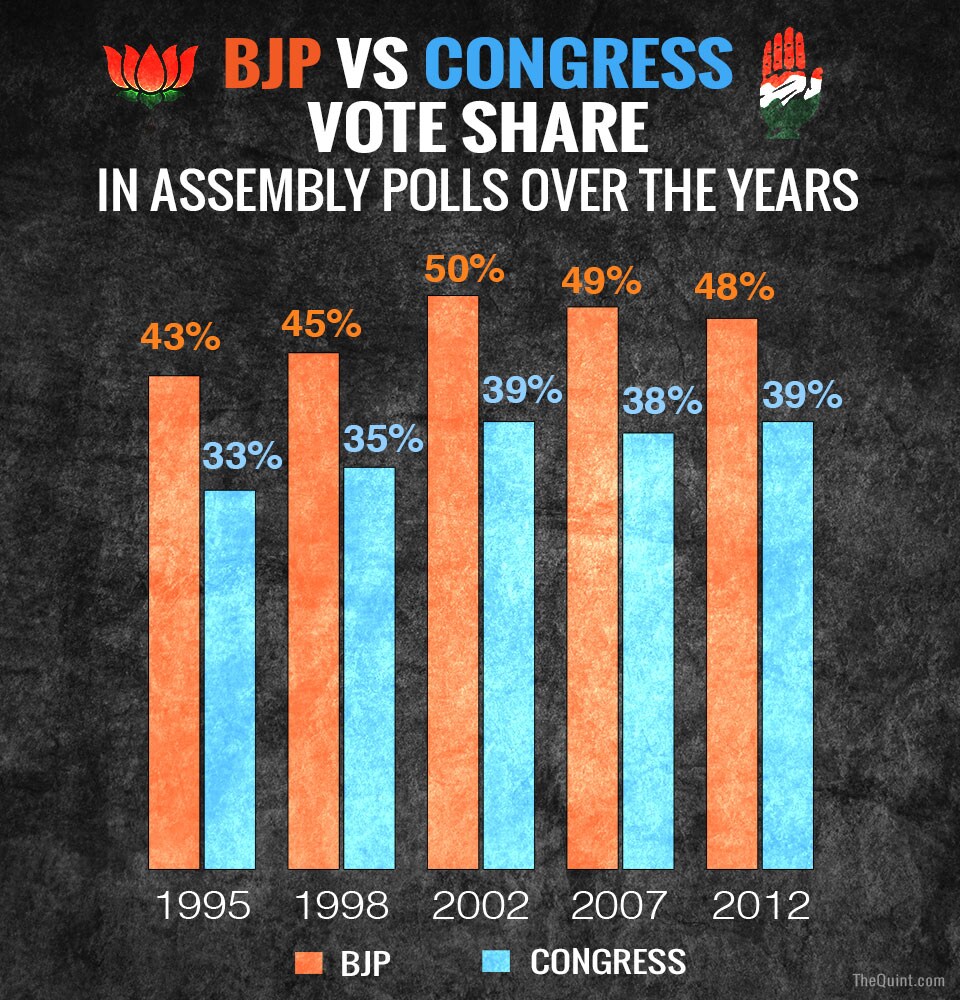
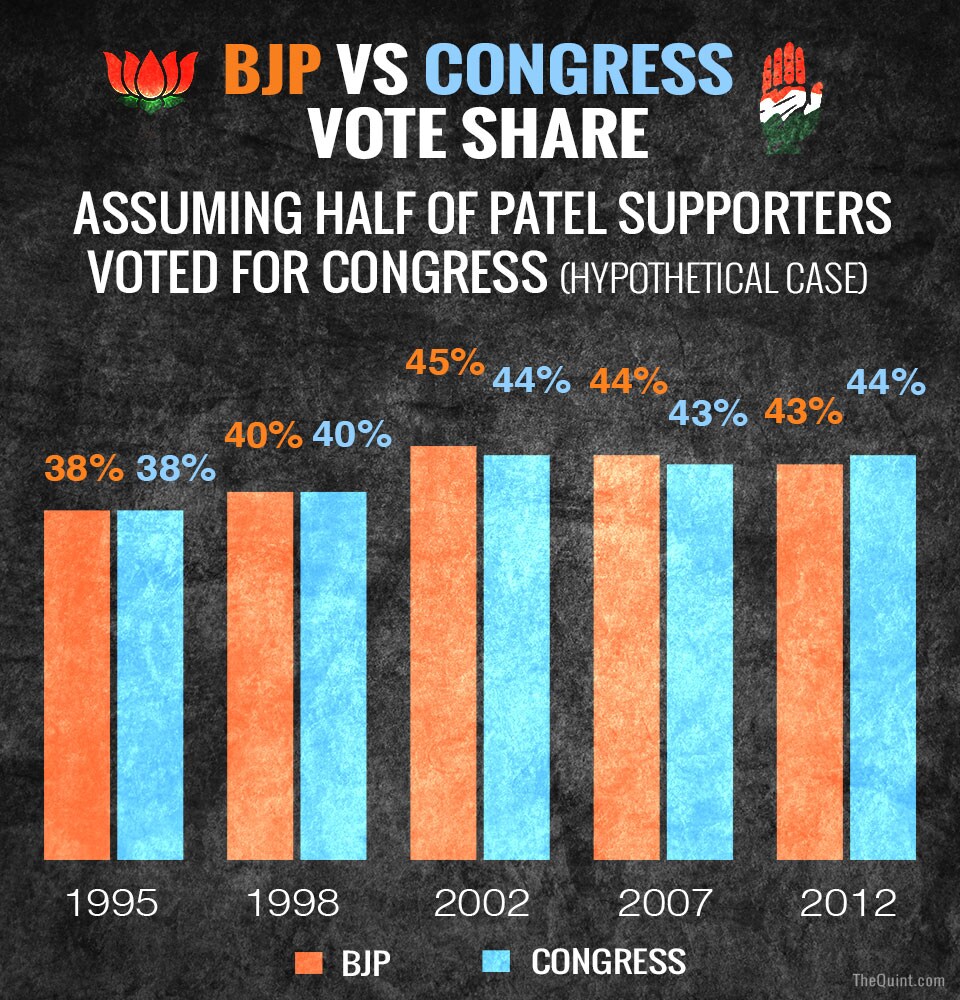
The BJP has maintained alead of about 10 percent in the last five elections. If 50 percent of the disgruntled Patelcommunity voters switch sides, the overall vote share of the BJP and the Congresswill be at levels shown in Graph 2. This is what is giving theBJP central leadership sleepless nights.
The strategyfollowed by Anandiben (a Patidar herself) to quell the movement ranged fromempty promises to strong action, before her government relented and declared 10 percentreservation for the economically backward section (earning less than Rs 6 lakhannually). With elections just a year-and-a-half away, this may be too littletoo late. That she was also seen getting close to Sanjay Joshi may have been theproverbial last straw for the BJP leadership.
Salvaging Pride in Gujarat
- A wake-up call for BJP camein December last year when it suffered one of its worst defeats in local bodyelections, especially in rural Gujarat.
- Agrarian crisis in the stateexplains the recent Patidar agitation; the community is a crucial vote bank accountingfor one-fifth of the BJP vote share.
- With elections due in Gujarat due in 2017, the 10 percent reservation for Patidars may be too little toolate.
- Loss of face in Gujarat can translateinto an erosion of 10-12 Lok Sabha seats in 2019.
Challenges Ahead
Twenty years is enough time for anti-incumbency to set in, despite good performance. And since the statehas witnessed bipolar contests for decades, any loss for the BJP is gain forthe Congress.
The implication of a BJPloss is massive. Not only would it be a loss of face for Modi-Shah, the kniveswould be out in the party to clip Shah's, if not Modi's wings. Shah's continuance as as BJP chief would depend on how well the party performs in UP. Themost significant fallout will be a confidence boost for anti-Modi forces. ThreeBJP-ruled states – Chhattisgarh and Madhya Pradesh (15 years) and Rajasthan –will be up for grabs in 2018 if the BJP loses Gujarat.
This could well mean anerosion of 10-12 Lok Sabha seats in 2019. There could also be some impact onfour Rajya Sabha seats in 2018.
What Lies in Store
The only saving grace forthe party is that the increasing likelihood of La Nina couldmean that Gujarat might get decent monsoons in 2016 and 2017. This could somewhat reduce the anti-incumbency effect. Besides, the Congress is yet to prove that it hasthe leadership and the cadre to convert sentiment to votes.
Gujarat is strategicand central to the BJP's consolidation in national politics. The PM and theparty chief are from the state. But Modi and Shah should not take the state'svoters for granted especially when winning elections will not be as easy asbefore. Playing the Gujarati asmitacard may not work all the time.
(This article has been co-authored by Amitabh Tiwari and Subhash Chandra. They are independent political commentators and can be reached at @politicalbaaba and @schandra_100 respectively.)
Also Read:
Is Gujarat Chief Minister Anandiben Patel On Her Way Out?
Has Anandiben Been Politically Done in by a Deal From the Past?
Essential Business Intelligence, Continuous LIVE TV, Sharp Market Insights, Practical Personal Finance Advice and Latest Stories — On NDTV Profit.