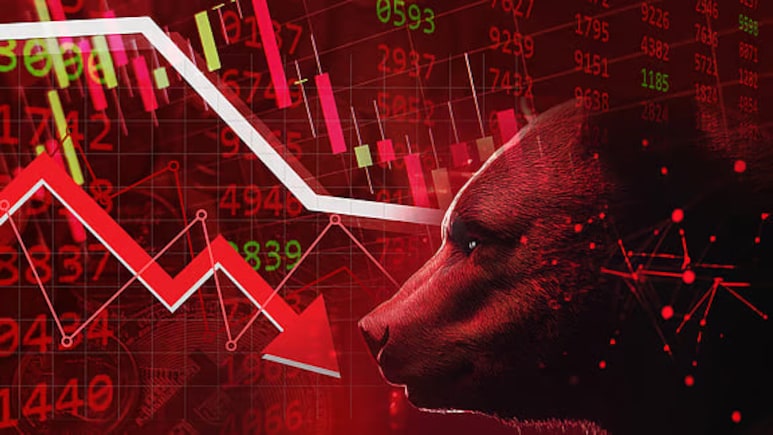
Indian benchmark indices ended lower on Wednesday, recording their sharpest decline in 10 trading sessions, as rising crude oil prices, renewed geopolitical tensions involving Iran and fresh tariff announcements from the United States triggered selling across the market.
The sell-off wiped out about Rs 4.2 lakh crore from investors' wealth, according to BSE data.
The Nifty 50 settled at 23,996.25, down 191.45 points, or 0.79%, while the Sensex closed at 76,755.05, losing 715.06 points, or 0.92%. Both the benchmarks extended declines for third consecutive trading session.
The decline followed a jump in global oil prices after another night of U.S. military strikes on Iran. Investor sentiment also weakened after U.S. President Donald Trump outlined a phased tariff plan for imported generic medicines. The developments added to concerns over the continuing conflict involving Iran.
Crude Oil
Crude prices advanced nearly 4% on Wednesday after the United States carried out its 11th straight night of military strikes against Iran.
Brent crude, the global benchmark, rose 3.5% to $94.20 a barrel after giving up some early gains. U.S. West Texas Intermediate crude futures climbed 3.8% to $87.56.
Speaking at the ASEAN Foreign Ministers' meeting in the Philippines, U.S. Secretary of State Marco Rubio said the United States remained open to diplomacy but accused Iran of failing to honour the understanding reached between the two sides over the Strait of Hormuz.
"Our concern is that Iran has not shown it is genuinely committed to negotiations," Rubio said. "If Tehran is prepared to engage seriously, so are we. If not, we will take the steps needed to protect our interests and those of our allies."
The U.S. Central Command said its latest operation targeted Iranian military command facilities, maritime assets, aircraft shelters, drone storage sites and logistics infrastructure.
According to the command, the strikes were intended to "further reduce Iran's capacity to threaten commercial shipping through the Strait of Hormuz."
Rubio also said the Strait of Hormuz remained a major obstacle in discussions with Tehran, alleging that Iran wanted control over the strategic waterway. He said granting such control would create "a very dangerous precedent" globally.
Tariff Plan
Markets also came under pressure after Trump announced a phased increase in tariffs on generic medicines imported into the United States.
"From August 1, 2026, imported generic drugs will continue to face a zero tariff for two years. After that, they will be subject to a 100% tariff for one year, followed by a 200% tariff thereafter," Trump said.
Essential Business Intelligence, Sharp Market Insights, Practical Personal Finance Advice, Daily Fuel, Gold and Silver Prices and Latest Stories — On NDTV Profit.