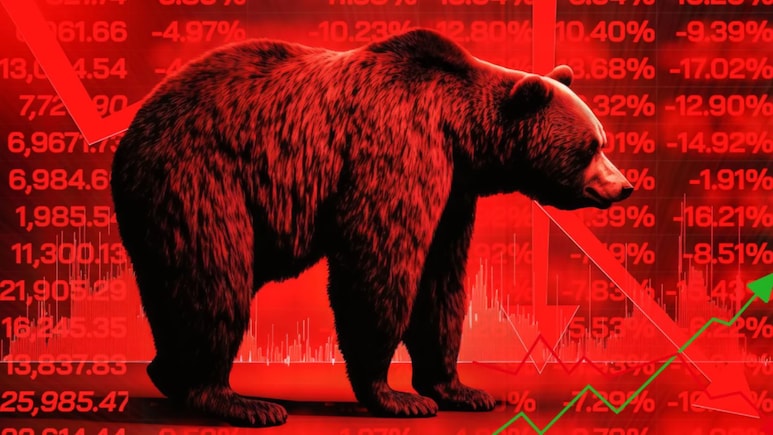
- US tech stocks fell sharply, with Nasdaq down 3.35% amid chip and AI selloff
- Nasdaq is about 17% below its record high, nearing a bear market threshold
- Fed’s preferred inflation gauge rose 0.3% in October, boosting hike odds
US stocks sank sharply on Wednesday, with technology shares leading the decline as investors dumped chipmakers and AI-linked names for a second straight session.
The Nasdaq Composite was down 795.53 points, or 3.35%, at 22,938.00 at around 10:14 am ET. Earlier in the session it fell as low as 22,632.40, a drop of 1,101.13 points, or 4.64%, from Tuesday's close.
The tech-heavy index is now about 17% below its record high hit last month, putting it within roughly 3% of a bear market, typically defined as a 20% fall from a recent peak
Also Read | Layoffs Are Rising In Tech, But These Skills Are Helping People Unlock Better Pay
The S&P 500 was trading 159.76 points, or 2.22%, lower at 7,041.33, after touching an intraday low of 6,970.11. At that point it was down 230.98 points, or 3.21%.
The Dow Jones Industrial Average fell 674.61 points, or 1.35%, to 49,344.09. The blue-chip index hit a low of 48,913.74, down 1,104.96 points, or 2.21%.
Wall Street's fear gauge, the Cboe Volatility Index, climbed above 30, a level that signals high stress in the market.
Here are three factors behind the selloff.
1. AI Trade Unravels Again
The relief that followed Jensen Huang's reinstatement as Nvidia CEO has faded fast. Nvidia shares jumped more than 30% on Monday, but fell about 6% on Tuesday and were down around 7% on Wednesday.
The selling spread across the chip sector. AMD fell about 6.5%, Micron lost 6% and Marvell Technology shed 5.7%. Hyperscalers such as Amazon, Alphabet and Microsoft also traded lower.
Anthropic, which listed last week in what was billed as the largest IPO ever, extended its slide below its $83 offer price.
Nvidia also faces fresh uncertainty, with Huang set to appear before congressional committees next week. Separately, President Donald Trump told the New York Post that a pardon for Huang was always an option, though he added he didn't think one would be needed.
Daniela Hathorn, senior market analyst at Capital.com, told Reuters that markets would still need "evidence that AI shares can sustain a recovery" beyond a short-lived bounce.
ALSO READ: From 30% Rally To Rout In 48 Hours: Nvidia, AMD, Micron Sink Up To 10% As AI Fears Return
2. Inflation Is Running Hot, And A Fed Hike Looks Locked In
Wednesday's data did little to calm nerves. The Personal Consumption Expenditures (PCE) price index, the Federal Reserve's preferred inflation gauge, rose 0.3% in October from the previous month, and 3.8% from a year earlier. The annual figure was reportedly the highest since 2023.
Core PCE, which excludes food and energy, rose 3.3% year-on-year, a notch above the 3.2% economists had expected.
The reading reinforced bets that the Fed will raise rates in December. Traders are now pricing in a roughly 98% chance of a 25-basis-point hike next month, according to CME Group data.
3. A Fresh Round Of Tariffs
Adding to the pressure, the Trump administration proposed new tariffs on 14 major trading partners on Wednesday. The proposal follows an eight-month probe into excess industrial capacity.
China faces the steepest proposed rate of 20%, while other rates include 17% for India and 15% for Japan and Taiwan. The duties won't take effect until after public hearings and a comment period, which a US official said would likely push implementation to January at the earliest.
The tariff proposal comes as oil prices stay elevated due to the unresolved US-Iran war, further complicating the inflation outlook. It also adds uncertainty ahead of the expiry of the US-China trade truce on Jan. 10.
ALSO READ: India 17%, China 20%, Japan 15%: Who's Winning And Losing Under Trump's Proposed Tariffs?
Essential Business Intelligence, Sharp Market Insights, Practical Personal Finance Advice, Daily Fuel, Gold and Silver Prices, Watch Business News Live and Latest Stories — On NDTV Profit.