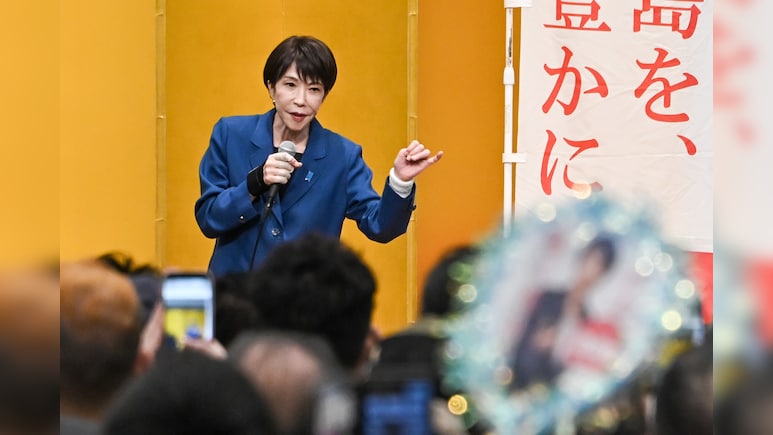
Stocks in Japan climbed to record territory following Prime Minister Sanae Takaichi's emphatic election win, as markets welcomed her agenda for renewed economic strength and stability. Japan's ruling Liberal Democratic Party clinched a supermajority in the 465-seat lower house, according to public broadcaster NHK.
Japan's Nikkei 225 jumped by up to 5% on Monday, pushing past 57,000 for the first time, as markets reacted to Prime Minister Sanae Takaichi's election win a day earlier, as per Financial Times (FT).
Japan's currency strengthened, with the yen trading at 156.88 against the dollar, as government bond yields moved higher. The 10-year JGB yield rose close to four basis points to 2.274%, while the 20-year yield increased by roughly three basis points to 3.158%, reported CNBC.
Also Read | Layoffs Are Rising In Tech, But These Skills Are Helping People Unlock Better Pay
Investors said the revival of the so-called “Takaichi trade” on Monday reflected expectations that the Prime Minister's historic majority would give her the political room to roll out stimulus measures and push companies to invest in priority technology industries, the FT report added.
According to The Japan Times, PM Sanae Takaichi is widely seen as favouring loose fiscal and monetary policy, and her rise to power late last year sparked a rally in equities alongside a weaker yen and falling bond prices, a market pattern that came to be dubbed the “Takaichi trade”.
As per Nikkei Asia, the election result is expected to embolden Takaichi to press ahead with her ambitious fiscal and national security plans, including sweeping tax reductions and a sharp rise in defence outlays. But with those proposals having rattled global markets before the vote, investors are now focused on her post-election comments for clues on how forcefully she intends to pursue what she calls a “responsible and proactive” fiscal approach.
Analysts expect the so-called “Takaichi trade” to gather further momentum, with equities advancing, bond yields climbing and the yen coming under renewed pressure, Nikkei Asia reported.
Stefan Angrick, head of Japan and frontier markets economics at Moody's Analytics, regards Takaichi trade as "a little bit puzzling."
"Japan's government deficit has narrowed to the smallest within the G-7," he was quoted as saying by Nikkei Asia. "Japan's fiscal position is stronger than at any point in the past 15 years."
In a note published before the vote, Shigeto Nagai, who leads Japan economics at Oxford Economics, said he believed Takaichi would aim to balance an active fiscal stance with budgetary restraint.
"Although we think she's determined to make the best use of the fiscal space generated by inflation-boosted tax revenue, we also believe she seriously worries about a further rise in JGB yields," he said as per Nikkei Asia.
According to Nagai, the Bank of Japan is likely to deliver rate increases every six months, in June and December, with a further hike anticipated in June 2027. He said expansionary fiscal measures under Takaichi would boost consumption-led demand and weaken the currency, adding to the case for continued policy normalisation.
As per a Reuters report, expectations of increased government expenditure have added to market anxiety over Japan's swollen debt, the largest in the developed world. That unease intensified on Jan. 20, when yields on Japanese government bonds jumped sharply across maturities following Takaichi's decision to call an early election and support a pause in food-related sales taxes.
Essential Business Intelligence, Sharp Market Insights, Practical Personal Finance Advice, Daily Fuel, Gold and Silver Prices and Latest Stories — On NDTV Profit.