- Nomura cut Nifty 50 target to 24,000 by March 2027 from 24,900 in Dec 2026
- Nifty faces key support between 21,743 and 22,182 from past reaction lows
- Two correction phases in 2026 show shift from oil to tech and regulatory concerns
Global brokerage Nomura has downgraded its headline valuation multiple and tempered its expectations for Indian equities, assigning a March 2027 target of 24,000 for the benchmark Nifty 50, down from its earlier projection of 24,900 slated for December 2026. In an equity strategy report authored by analyst Saion Mukherjee, the brokerage lowered its one-year forward target multiple to 17.0x from 18.5x. The recalibration reflects a hardening interest rate environment in developed markets, sharp foreign institutional outflows, and emerging concerns over India's relative growth profile against global peers.
Nomura cautioned investors against "chasing narratives" in an increasingly expensive broader market, urging market participants to adopt a disciplined, bottom-up approach anchored to fundamental value. Indian market analysts believe the Nifty 50 benchmark is now in the close vicinity of a horizontal support region that is formed by 21,743 and 22,182, the reaction lows of 2025 as well as 2026 respectively, both seen in April months.
Based on technical charts, this support region having helped reverse major downtrends in the last two occasions. Alternatively, the break of this region would mark the end of the uptrend that has been on since the Covid-19 pandemic and could expose 19,000 and 16,700 for the NSE 50 benchmark index, along with the 38 and 50% retracements respectively from Covid low, according to analysts. Nifty valuations have reset sharply from 2024 levels.
Also Read | Layoffs Are Rising In Tech, But These Skills Are Helping People Unlock Better Pay
A Tale of Two Corrections: Beyond Crude Oil Pressures
The benchmark Nifty has weathered persistent volatility since crude oil surged past $100 per barrel in early August 2026. However, Nomura highlighted that the nature of market weakness has shifted fundamentally across two distinct sell-off phases:
- Phase 1 (February-March 2026): The Nifty retreated 14% in US dollar terms following geopolitical friction involving the US and Iran. The decline was heavily concentrated in domestic cyclical and fuel-sensitive pockets-oil marketing companies (OMCs), banks, real estate, and automotive manufacturers-while export-oriented and defensive names provided stability.
- Phase 2 (August-September 2026): The index declined 9% in US dollar terms, but the market dynamics reversed. IT services logged the sharpest contraction, with Non-Banking Financial Companies (NBFCs) and consumer staples lagging despite resilient first-quarter earnings (Q1 FY27). In contrast, OMCs proved relatively defensive despite elevated crude prices.
According to Nomura, the sectoral composition of the second correction indicates that investor concerns have expanded beyond temporary oil price shocks. Markets are pricing in structural anxieties surrounding technological disruptions, geopolitical shifts, and domestic regulatory interventions across sensitive pockets such as insurance and healthcare. The domestic triggers also impact sector-specfic stock calls for investors in the near-term cycle.
Shrinking Yield Spreads and Capital Outflows
A central catalyst for the multiple contraction is the sharp escalation in US Treasury yields. The US 10-year and 30-year yields have climbed 74 basis points and 65 basis points over the past three months, crossing 5%. The shift has compressed the India-US 10-year sovereign bond yield spread to just 190 basis points-its lowest level in 22 years. With developed-market assets offering attractive risk-free returns, emerging-market allocations have faced pressure.
Foreign investors accelerated divestments through September 2026, pulling net outflows to $12.5 billion for the fiscal year to date, with healthcare representing the sole major sector insulated from the liquidation. Nomura projects 50 basis points of policy rate increases across both India and the US across 2026 and 2027, reversing earlier expectations of a pause.
Valuation Disparities: Small Caps at Peak Premium
The headline Nifty 50 currently trades at 16.9x 1-year forward earnings, placing it marginally below its historical pre-pandemic average and beneath its 17x-22x post-pandemic trading band. However, valuation resets across market-cap segments remain uneven. The equity risk premium has also tightened relative to the US. However, analysts believe that the high valuation of Indian market is a reason behind consistent foreign outflows.
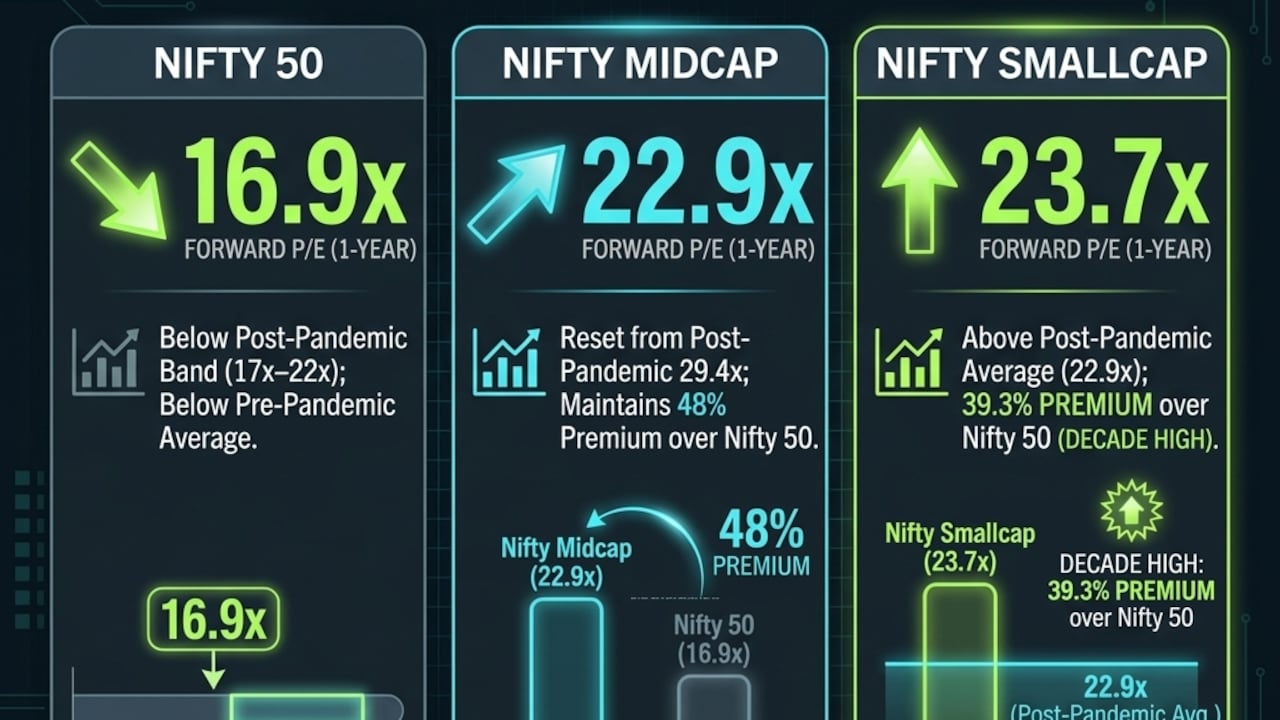
Nifty 50 Valuation
Photo Credit: Nomura/Echion
With the S&P 500 benchmark supported by massive artificial intelligence capital expenditure and a projected two-year earnings compound annual growth rate (CAGR) of 25%-versus 13% for India's BSE 200-the relative growth premium traditionally commanded by Indian equities has compressed. The Nifty's premium over the FTSE Emerging Markets Index has receded to 22%, roughly half its long-term average of 50%, according to Nomura's analysis.
Macro Activity Holds Up, But Earnings Face Headwinds
High-frequency indicators reveal a split domestic economic landscape:
- Urban vs. Rural Divide: Economic output remains supported by urban, credit-financed consumption (passenger vehicles and consumer durables) and firm power demand. Conversely, mass-market rural consumption remains subdued, with a deficient monsoon posing further headwinds to agricultural disposable income.
- Margin Squeeze Ahead: A widening spread between the Wholesale Price Index (WPI) and Consumer Price Index (CPI), coupled with elevated industrial input costs (copper, aluminium, zinc, and pig iron), points to gross margin compression for capital goods and consumer goods manufacturers heading into the second half of FY27.
- FY28 Consensus Risk: Market consensus currently projects high-teens earnings growth for FY28. Nomura characterized this estimate as overly optimistic, noting it relies on swift geopolitical de-escalation, falling crude prices, and steady corporate earnings-to-GDP ratios at cyclical peaks. The brokerage warned that mid-single-digit downward earnings revisions remain a distinct risk.
Sector Allocation: Where Nomura Sees Value
Faced with elevated borrowing costs and selective domestic demand, Nomura outlined a bottom-up sectoral blueprint focused on valuation cushions, structural buildouts, and tangible export capabilities:
- Positive on Financials and IT Services: Both heavyweights have de-rated below pre-pandemic valuation multiples. While IT margins may see foreign-exchange benefits partially offset by AI reinvestment and client renewals, current entry levels offer an asymmetric risk-reward profile.
- Constructive on Exporters and Infrastructure Plays: The brokerage favors auto ancillaries, engineering/manufacturing, and pharmaceuticals with established global operations. Domestic capital deployment into data center capacity, power equipment, and defense manufacturing continues to provide structural earnings visibility.
- Cautious on Discretionary Consumption: High inventory input costs, sluggish volume traction in non-durables, and limited fiscal room for government-sponsored consumer stimulus present near-term hurdles for mass consumer companies.
Essential Business Intelligence, Sharp Market Insights, Practical Personal Finance Advice, Daily Fuel, Gold and Silver Prices and Latest Stories — On NDTV Profit.