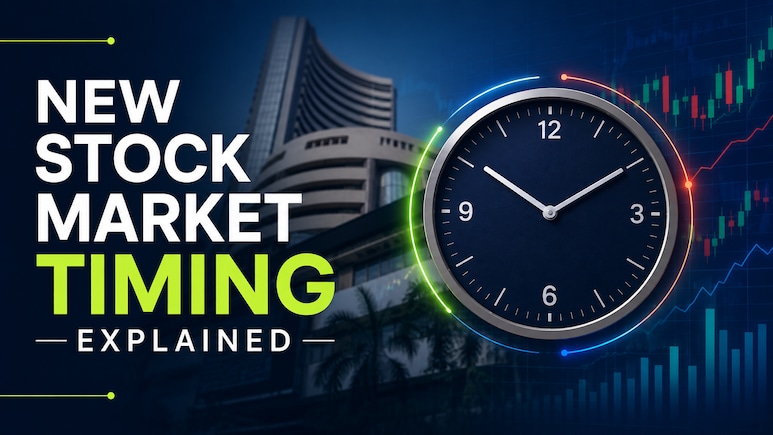
India's stock market will follow different closing schedules for shares and equity derivatives from Monday, August 3, as a new closing auction for F&O-eligible stocks takes effect and derivatives trading gets an additional 10 minutes.
The change does not mean the entire stock market will close later or that cash trading will end at the same time for every stock. Non-F&O shares will continue regular trading until 3:30 p.m. F&O-eligible shares will stop continuous trading at 3:15 p.m. and enter a Closing Auction Session, or CAS. Stock and index derivatives, meanwhile, will trade until 3:40 p.m.
The Securities and Exchange Board of India introduced the auction framework for F&O-eligible stocks to change how their official closing prices are discovered. The National Stock Exchange has also extended equity derivatives trading to accommodate the new closing process.
Also Read | Layoffs Are Rising In Tech, But These Skills Are Helping People Unlock Better Pay
The changes create three end-of-day schedules and alter the closing price mechanism for F&O stocks. Here are five things investors and traders need to know.
1. Three Closing Times
The first distinction investors need to make is between non-F&O shares, F&O-eligible shares in the cash market and equity derivatives.
Stocks outside the F&O segment will continue regular cash-market trading until 3:30 p.m., with no change to their closing time.
For F&O-eligible stocks in the cash market, continuous trading will end at 3:15 p.m. Those shares will then move through the closing auction process until 3:35 p.m.
Stock and index F&O contracts will trade until 3:40 p.m., 10 minutes beyond the previous 3:30 p.m. close.
The post-close session will run from 3:50 p.m. to 4 p.m.
In effect, 3:30 p.m. will no longer serve as the common reference point for the end of regular activity across these market segments.
2. F&O Trades Longer
Equity derivatives will remain open for an additional 10 minutes, with trading ending at 3:40 p.m. instead of 3:30 p.m.
The extension aligns derivatives trading with the auction-based closing process for F&O-eligible shares in the cash market.
It also gives derivatives traders time after the cash-market auction to adjust positions, hedge exposures or respond to the closing price established through the auction.
The VWAP calculation window used for derivatives will consequently run from 3:10 p.m. to 3:40 p.m., instead of the previous 30-minute window ending at 3:30 p.m.
3. F&O Stocks Enter Auction
The bigger change for F&O-eligible shares is not simply when they stop trading, but how their closing price will be determined.
Continuous cash-market trading in these stocks will end at 3:15 p.m. A five-minute transition period will follow until 3:20 p.m., during which the reference price for the auction will be calculated.
The first order-entry window will run from 3:20 p.m. to 3:25 p.m., when investors can place market and limit orders.
A second order-entry period will run from 3:25 p.m. to 3:30 p.m. During this phase, only limit orders can be placed, while market orders cannot be modified or cancelled.
Order entry will close at a random point between 3:28 p.m. and 3:30 p.m.
Orders will then be matched between 3:30 p.m. and 3:35 p.m., when the auction price will be determined.
4. Closing Price Changes
F&O-eligible stocks will also get a different closing-price mechanism under the new framework.
Instead of relying on the existing Volume Weighted Average Price-based process during the final part of continuous trading, buy and sell orders in the Closing Auction Session will be pooled and matched.
The resulting equilibrium price will become the official closing price for the eligible stock.
SEBI said the auction mechanism is intended to improve closing-price discovery by bringing demand and supply from market participants together at a single point. The regulator also expects the framework to improve execution efficiency, provide equal access to investors and reduce tracking errors for passive funds.
The change applies to eligible F&O stocks rather than every share traded in the cash market.
5. Pre-Open Also Changes
The closing session is not the only timing change taking effect.
SEBI has also revised the pre-open market schedule. The order-entry period will run from 9 a.m. to 9:07 a.m., followed by order matching between 9:07 a.m. and 9:15 a.m.
Regular trading will continue to begin at 9:15 a.m.
For investors, the key distinction from August 3 is therefore straightforward: non-F&O shares continue trading normally until 3:30 p.m.; F&O-eligible shares stop continuous trading at 3:15 p.m. before entering the closing auction; and stock and index derivatives remain open until 3:40 p.m.
Essential Business Intelligence, Sharp Market Insights, Practical Personal Finance Advice, Daily Fuel, Gold and Silver Prices and Latest Stories — On NDTV Profit.