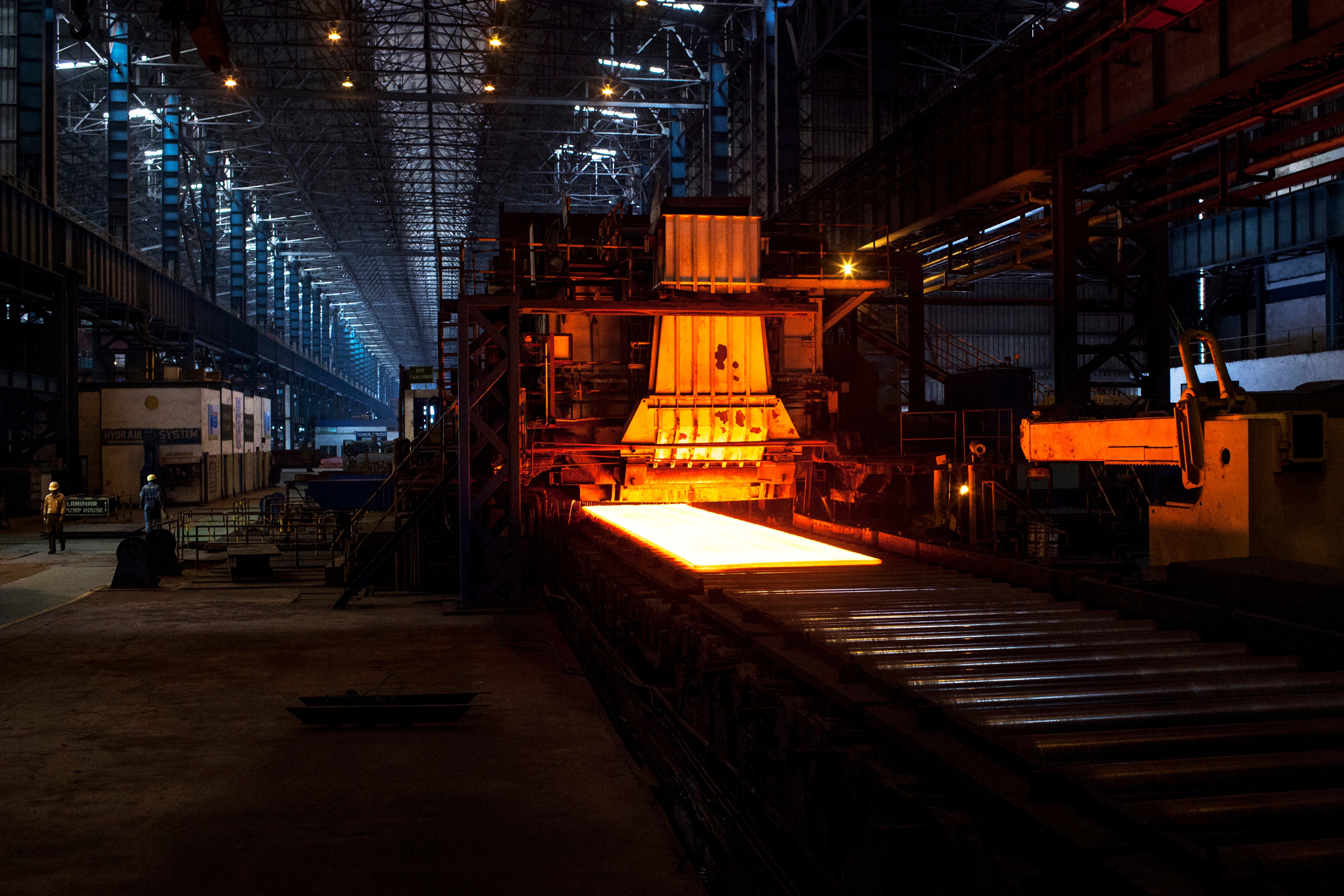
India's largest steelmaker JSW Steel said that it will achieve its full year production target despite a slowdown in the first quarter due to a water shortage.
The production loss of around 2 lakh tonne this quarter will be made up for in the following three quarters, Seshagiri Rao, chief financial officer and joint managing director of JSW Steel, told BloombergQuint in an interview. “We don't find it a difficulty,” he said.
JSW Steel produced 3.9 million tonnes of steel in the April-June quarter, 1 percent higher over the year-ago period, according to its financial statements released earlier on Tuesday. Production was lower than what JSW Steel had forecast. The company targets 16.5-million-tonne production this year.
Also Read: JSW Steel Net Profit Declines 43% But Beats Estimates
The “moderate” production was “majorly due to water shortage”, especially in South Indian regions of Selam and Vijayanagar, he said. One of the blast furnaces in Salem too was shut, he said.
However, production is improving now that monsoons are on track, he said.
In case GST was not there in the quarter, what would thesales figure had been?
We have achieved 3.9 million tonnes of production, which is only a 1 percent growth year-on-year. We have given a guidance of 5 percent, 16.5million tones. Therefore production is lower than the guidance we had given forQ1. It is majorly due to water shortage. If you look at south particularly,both in Vizianagaram and Salem in Tamil Nadu, there is water shortage. So the production moderated because of that. Now luckily, the monsoon is good, so we will be able to make up for what we lost.
We have achieved 3.5 million tonnes of sales. So there is 5 percent growth year-on-year, that is what we have been guiding for. Volume-wise, we were expecting more. We could have done more then 3.5 million tonnes. Destocking in June impacted our sales. If that wasn't there, we could have done better in terms of sales volumes. That is why overall there was 3 lakh tonne increase in inventories in the quarter. We will be able to partially take it out in the next three quarters.
With regards to EBIDTA per tonne, it's Rs 6,265 per tonne for Q1. Globally, hot rolled coil prices corrected 13 percent in the quarter. Accordingly, Indian hot rolled coil prices have also come down. Coking coal prices also fell but that we have been buying globally, so there is no problem. There is iron ore which we buy locally. Iron ore prices have not corrected, so that is still at a higher level. Correction of Rs 200 per tonne has happened on July 1 by NMDC. So iron ore prices being at the same level when steel prices came down, margins were under pressure.
For the entire year FY18, what would the average EBIDTA pertonne be?
We are in the range of Rs 6000-9000 per tonne. In onequarter, we could be at the lower end, in another quarter we could be at higherend.
Are you comfortable with the 1.9 times debt toequity ratio?
We have given a guidance and we maintain that. The debt-to-EBIDTA is at 3.75, Debt-to-equity is at 1.75. In March 31, 2017, we were at 1.85. We have given the guidance that we want to bring it down to 1.75. So, if you look at year as a whole, we are reasonably confident that we will be able to bring it down to this level.
You have expressed interest in acquiring distressed assets, especially companies that have been referred to NCLT. What kind of a haircut are you looking at when you acquire the debt of these companies?
There are opportunities for inorganic growth in India. Five out of these 12 companies which are getting referred, have already been referred to the NCLT. Once we have the information, we will be able to study and take a call.
Which one looks more attractive - Monet Ispat or Bhushan Steel?
Today we have 18 million tonnes of steel capacity. Whereas our gross block is Rs 60,000 crore. That means it's in the range of Rs 3000 - 3500 crore per million tonne. So that is the kind of range where the sustainability of any company, in the medium term to long term will come. When steel prices and raw material prices are so volatile, if any investor has to look at the long-term sustainability of operations, allocation of capital in the right way is very important. How much one will invest per million tonne. Based on that, the haircut gets decided. As far as JSW is concerned, our range is between Rs 3000 crore - 3500 crore.
Essential Business Intelligence, Sharp Market Insights, Practical Personal Finance Advice, Daily Fuel, Gold and Silver Prices and Latest Stories — On NDTV Profit.