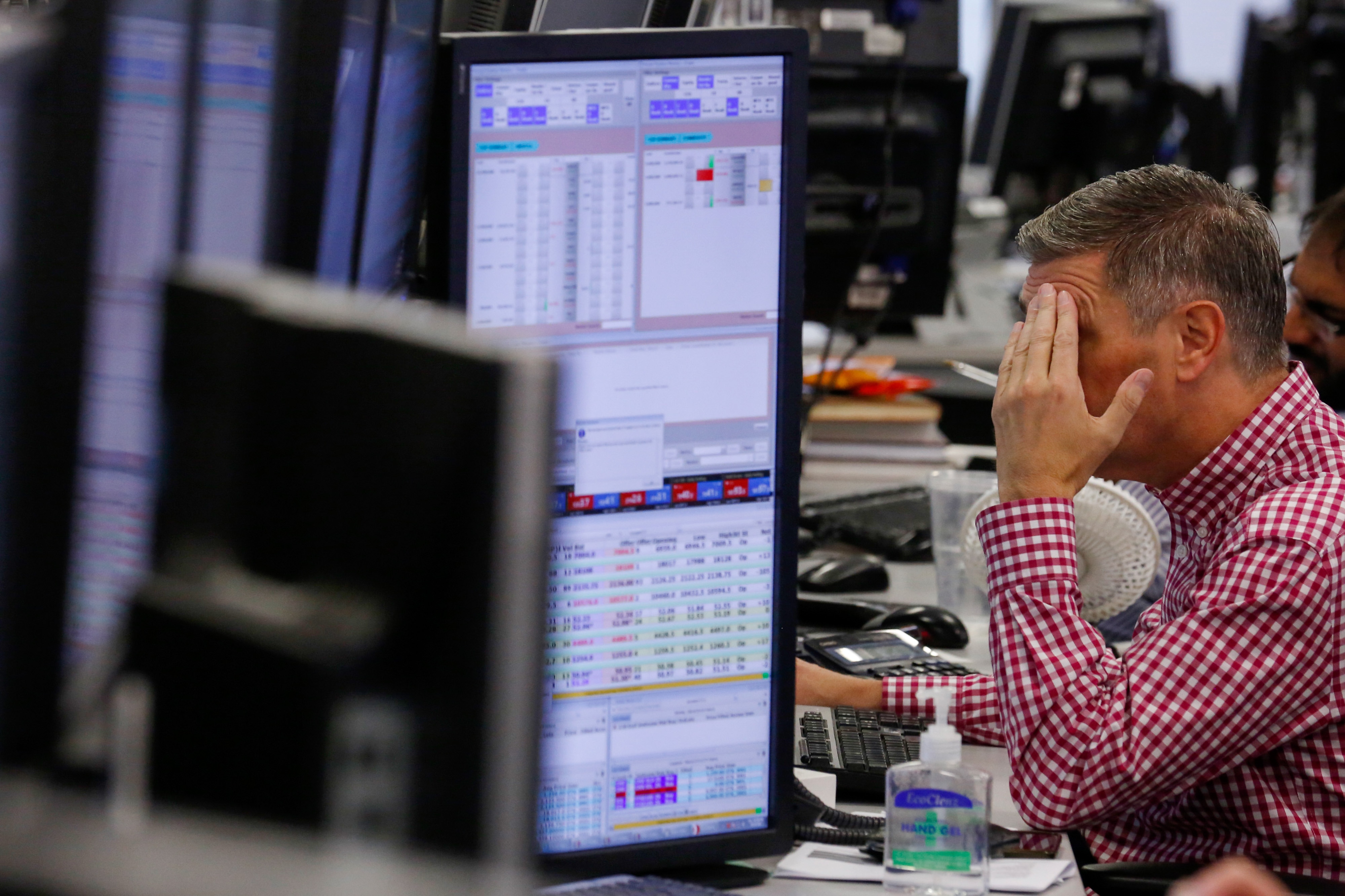
Selling pressure continued across Indian markets, from currencies to equities and bonds, as the perception of risk increased and traders speculated on the consequences of a sharply weaker Indian rupee.
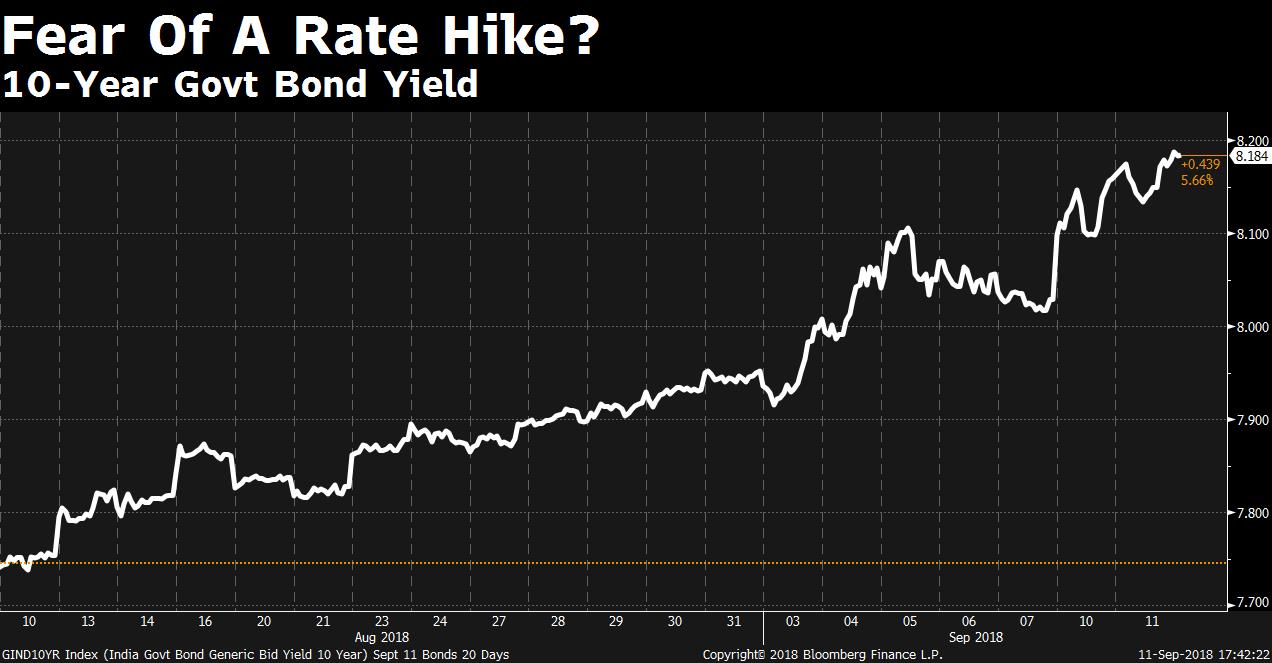
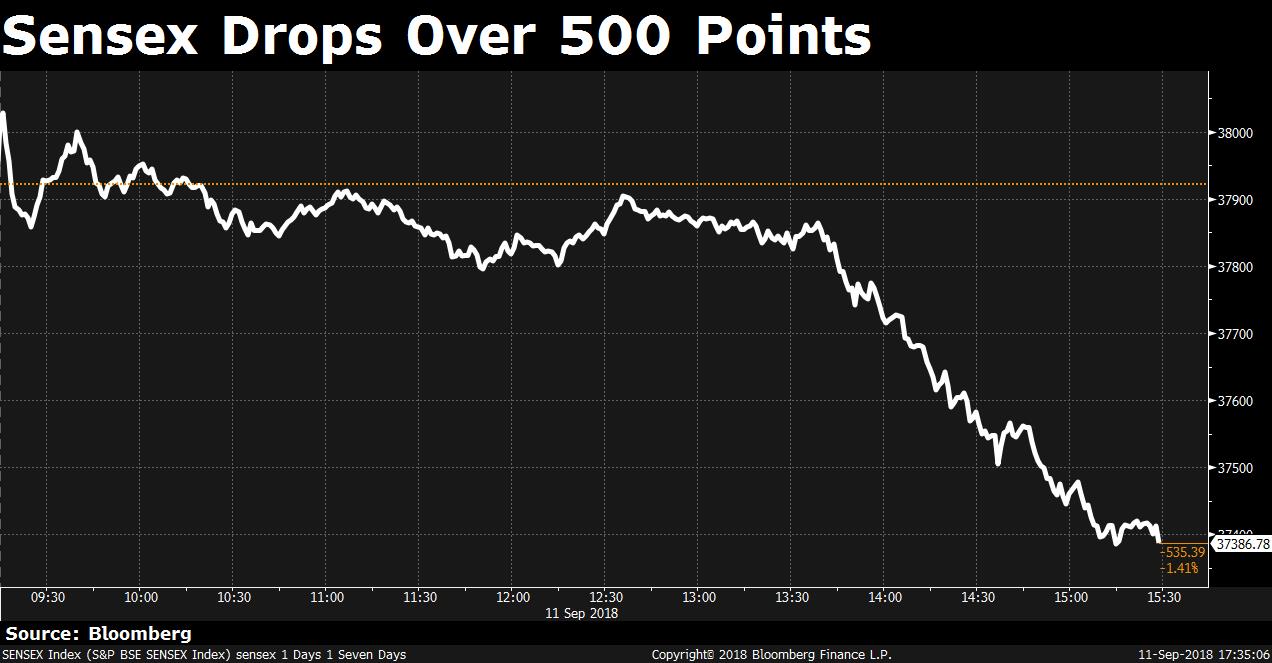
On Tuesday, the rupee fell to another record low of 72.74 against the U.S. dollar, closing marginally above that level at 72.69. The persistent weakness in the rupee took down equities and bonds with it. The BSE Sensex fell 509 points or 1.34 percent to close at 37,413. In the bond markets, the benchmark 10-year bond yield spiked to 8.17 percent as bond prices fell.
Rupee Fall Quickens...
Trouble is stemming from the currency markets, where the now steep fall in the rupee is raising concerns about inflation, interest rate hikes and foreign portfolio outflows.
The rupee has fallen by more than 5 percent in the last month alone, taking the year-to-date depreciation to over 12 percent. The fundamental factors behind the rupee fall remain the higher oil prices, the wider current account deficit and portfolio outflows. The current account deficit widened to 2.4 percent of GDP in the April-June quarter, while capital flows fell, leading to a negative balance of payments.
However, market expectations on the trading range for the currency have also changed due to the perception that the Reserve Bank of India allowing the nominal exchange rate to depreciate in order to correct an overvaluation in the real effective exchange rate. The RBI bulletin released on Tuesday showed that the 36-country REER is now at 114, closer to the long run average of 110.
While the initial fall in the rupee was welcomed by some stakeholders, markets can often overshoot and that is what appears to be happening now.
There is a school of thought for policy authorities to hold back on “intervening” in the markets, allowing the rupee to find its own level. We do not agree. Unfortunately, financial markets, particularly forex markets, are prone to overshooting, and sharp moves can create multiple problems for companies, particularly liquidity.Saugata Bhattacharya, Chief Economist, Axis Bank
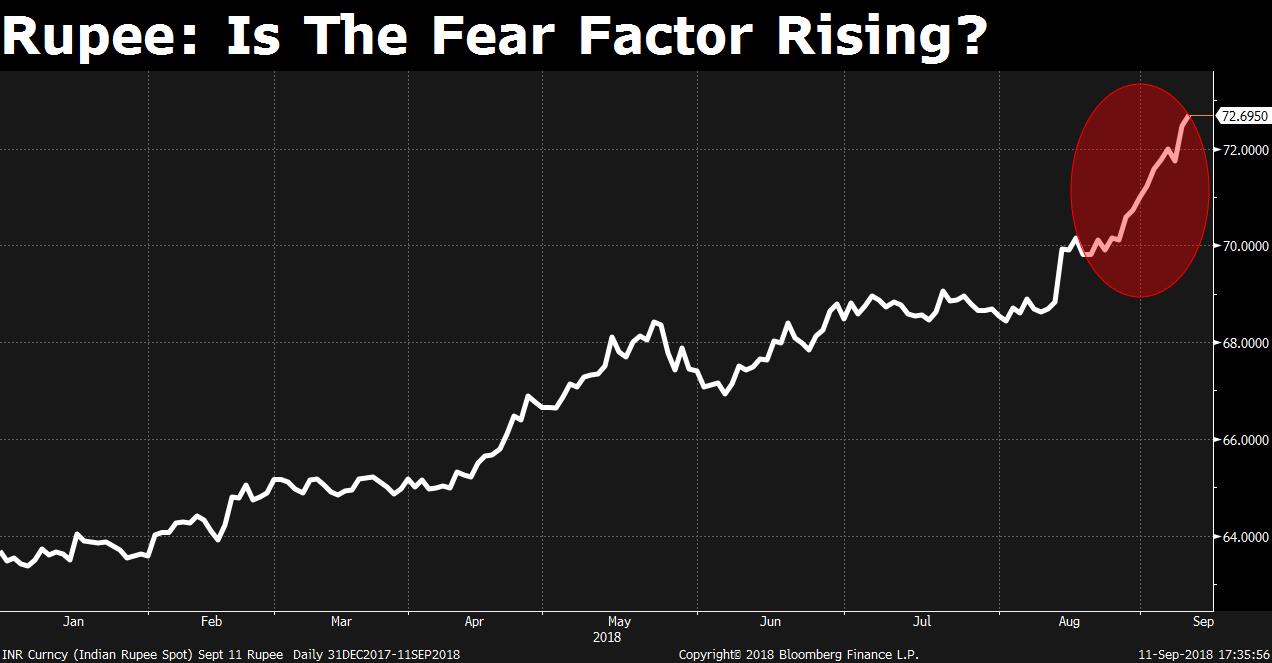
#BQMoney | The rupee gives up morning gains to touch a new low. Is fear seeping into the markets? @dugalira explains.
Read: https://t.co/wvs6FeQHWF pic.twitter.com/nRmtyHigDjBond Market Fret About Rate Hikes...
The 12 percent fall in the rupee has altered expectations for inflation and interest rates. The swap markets are now pricing in another 75 basis points in rate hikes, said B Prassana, head of global markets at ICICI Bank. This would follow the two rate hikes of 25 basis points each already announced by the Monetary Policy Committee so far this year.
According to the RBI's own analysis, every 5 percent fall in the rupee can add 20 basis points to headline inflation. At present, the RBI sees CPI inflation at about 4.8 percent by the financial year end. The MPC's mandate is one of flexible inflation targeting, with the target set at 4(+/- 2 percent).
There was some speculation of an emergency rate hike among traders. However, that is unlikely. RBI Governor Urjit Patel articulated his position a few months back, stating that monetary policy is driven by the domestic inflation target and not the exchange rate. Also the RBI has more targeted options available to stem the fall in the rupee, such as providing dollars directly to oil companies.
If you look at the swap markets, it is pricing in a 25 bps rate hike in October, 25bps in December and another 25bps sometime in June....From the bond market it is tough to judge the expectations because a number of other factors like demand-supply get factored in. But at 8.15% levels for the 10-year bond, one can argue that rate hikes are priced in to the bond market. Having said that, if there are rate hikes going forward, then yields will go up even more.B Prasanna, Head, Global Markets, ICICI BankEquity Markets Join The Fall....
The fall in the rupee and the specter of higher interest rates spooked equity markets too. The BSE Sensex fell 500 points or 1.34 percent on Tuesday. The NSE Nifty fell 1.45 percent.
That equity markets have corrected should not surprise anyone. Even in isolation, at 19-20 times, the price-to-earnings multiples were stretched. This, together with macro headwinds, such as the fall in the rupee and the rise in crude prices, meant that it was a matter of time before the correction happened.
The correction has been different than the previous falls of 2018, in that the stronger and more stable stocks have seen a fall. The top losers in September have been the likes of Hindustan Unilever Ltd., Bajaj Finance Ltd., Titan Company Ltd. and ITC Ltd. None of these companies have sounded bearish about business prospects in the recent quarter. Their stock prices have corrected nonetheless.What does that tell you about the mood of the market? That it is now in ‘PE contraction' mode. And there is no saying where this stops.
There are multiple factors making foreign investors an unhappy lot right now. The fall in the rupee, steep valuations, the possibility of an escalating trade war, the busy year-end election calendar in India and the U.S., the Fed taper. With that list, you have all the possible ingredients for nervousness in the markets. And that may well be the reason why select smart money managers are taking the chips off the table.
#BQStocks | Indian equities are at a one-month low, and its not just the Indian currency. @_nirajshah explains the factors at play.
Read: https://t.co/UeSHKDVyAn pic.twitter.com/Pwkq1pc4xTEssential Business Intelligence, Continuous LIVE TV, Sharp Market Insights, Practical Personal Finance Advice and Latest Stories — On NDTV Profit.