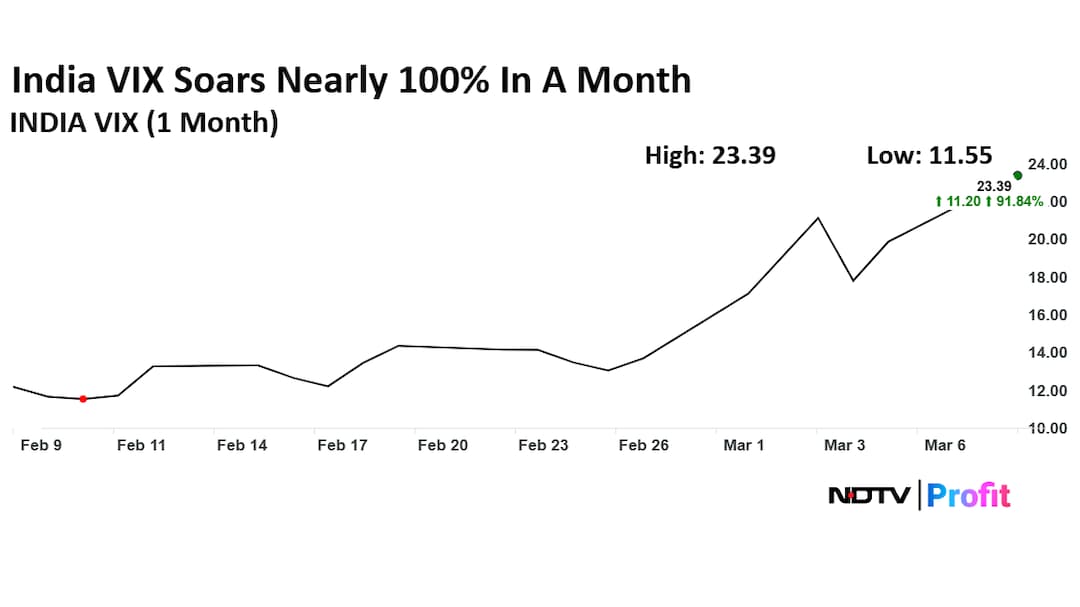
Volatility in Indian equity markets has surged sharply over the past month, with the India VIX nearly doubling amid escalating geopolitical tensions and heightened global uncertainty that have triggered aggressive selling in equities.
India VIX, which is often called as the market's “fear gauge”, jumped 91.63% over the last month, reflecting growing nervousness among investors. The index has risen 70% in the past week alone and is up 146.41% year-to-date.
The spike in volatility has coincided with a sharp correction in the broader market. The Nifty 50 has declined 7.11% over the past month, fallen 3.37% in the past week and is down 8.04% so far this year.
Also Read | Layoffs Are Rising In Tech, But These Skills Are Helping People Unlock Better Pay
The escalation of tensions involving the United States, Israel and Iran has intensified market anxiety in recent days, pushing crude oil prices sharply higher and triggering a global risk-off sentiment.
The heightened uncertainty translated into a steep sell-off on Monday. The Sensex plunged as much as 2,994 points, or 3.2%, to an intraday low of 76,424.55, while the Nifty fell as much as 3.1% to 23,597 before recovering some losses.
At one point during the session, both benchmark indices slipped into correction territory. The Nifty had fallen more than 10% from its record high, while the Sensex declined around 11% from its peak.
ALSO READ: Nifty, Sensex End Off Day's Low After Crude Oil Pullback Following Historic Rally
However, markets trimmed part of their losses after crude oil prices retreated sharply from earlier highs, easing some pressure on global equities. By the close, the Nifty 50 ended 1.74% lower near the 24,000 mark, while the Sensex settled nearly 1,400 points lower around 77,500 after a volatile trading session.
On Monday, oil prices had surged dramatically in what marked the largest intraday jump on record. Brent crude had climbed as much as 29.92% to $119.50 per barrel, while US crude rose as much as 31.44% to $119.48 before reversing.
What Spike In Volatility Means?
According to Axis Securities, the sharp rise in India VIX suggests that markets are pricing in a significant risk premium.
“This spike suggests a significant ‘fear premium' is now embedded, signalling a cautious outlook as the market grapples with escalating geopolitical hostilities and energy supply shocks,” the brokerage said.
Hariprasad K founder of Livelong Wealth, added that unless there is a positive development in the Middle East conflict that pushes crude prices lower, Indian markets could continue to witness elevated volatility.
According to market analysts, in such an environment, traders should avoid excessive leverage and overtrading, and focus on disciplined risk management as volatility is likely to remain elevated.
ALSO READ: Market Crash: 'Buy The Dip' Isn't A Sure Thing — Nifty's Past Corrections Prove It
Ponmudi R, chief executive officer of Enrich Money, echoing a similar opinon said markets could remain volatile in the near term. Technically, he noted that the Nifty is hovering near the 24,000 level after a sharp decline, signalling persistent bearish sentiment with a pattern of lower highs and lower lows.
Immediate support for the index lies around the 23,700–23,600 zone, and a decisive breakdown below this level could extend the decline towards 23,400–23,300, he said. On the upside, resistance is seen around 24,300, followed by a stronger hurdle near 24,600, which would need to be reclaimed to signal any meaningful recovery.
Bajaj Broking Research sees the benchmark index's immediate support at 23,700, and expects a decline beneath this level to push the Nifty to 23,400-23,200.
Momentum indicators also remain weak. The Relative Strength Index (RSI) is hovering around 28–30, indicating oversold conditions but without a confirmed reversal signal, while the MACD remains deeply negative with an expanding bearish histogram.
Essential Business Intelligence, Sharp Market Insights, Practical Personal Finance Advice, Daily Fuel, Gold and Silver Prices and Latest Stories — On NDTV Profit.