Walking forward confidently on the path of reforms for a Viksit Bharat, Finance Minister Nirmala Sitharaman announced her ninth consecutive Union Budget.
Like every industry, the Indian mutual fund industry, represented by the AMFI, had a long wish list for the finance minister.
However, the Union Budget 2026-27 did not provide direct benefits to mutual funds, whether it was the reintroduction of the long-term indexation benefit for debt schemes, or introducing a debt-linked savings scheme with a five-year lock-in (intended at expanding the Indian bond market), changing the definition of equity-oriented funds to include fund of funds, or changing the basic exemption for long-term capital gain tax, or any other proposal that could encourage investor participation.
What the Union Budget 2026-27 did was offer an indirect benefit to mutual funds investor who invest thoughtfully. The budget increased the capex allocation to certain sectors to sustain and accelerate economic growth.
The total allocation to capex has been increased to Rs 12.22 lakh crore from the revised estimate (RE) of Rs 10.96 lakh crore (the budgeted estimate was Rs 11.21 lakh crore) for the current fiscal, an increase of 11.5%. For road transport and highways, the capex allocation is Rs 2.94 lakh crore for FY27.
For railways, it is Rs 2.78 lakh crore, and with the internal and extra budgetary resources of Rs 15,000 crore, the total capex of railways for FY27 stands at Rs 2.93 lakh crore, the second highest. The cumulative outlay for road transport and highways plus railways is estimated at 64.4% of the total capex.
Against the backdrop of rising geopolitical tensions and military conflicts in many parts of the world, the defence capex is third, estimated at Rs 2.19 lakh crore in FY27, up from Rs 1.86 lakh crore in FY26 (a 17.7% year-on-year growth). Similarly, the government has increased its capex for telecom to Rs 73,990 crore (an increase of 39.6% over last year) for capital infusion into state-run BSNL.
Also, for housing & urban affairs, the allocation has been increased to Rs 85,522 crore in FY27 from FY26 RE of Rs 57,204 crore, an increase of 49.5% but lower than the BE of Rs 96,777 crore for FY26. In the last six years, the government's capex has increased manifold. This is expected to have a multiplier effect on the economy, particularly when wisely spent on infrastructure.
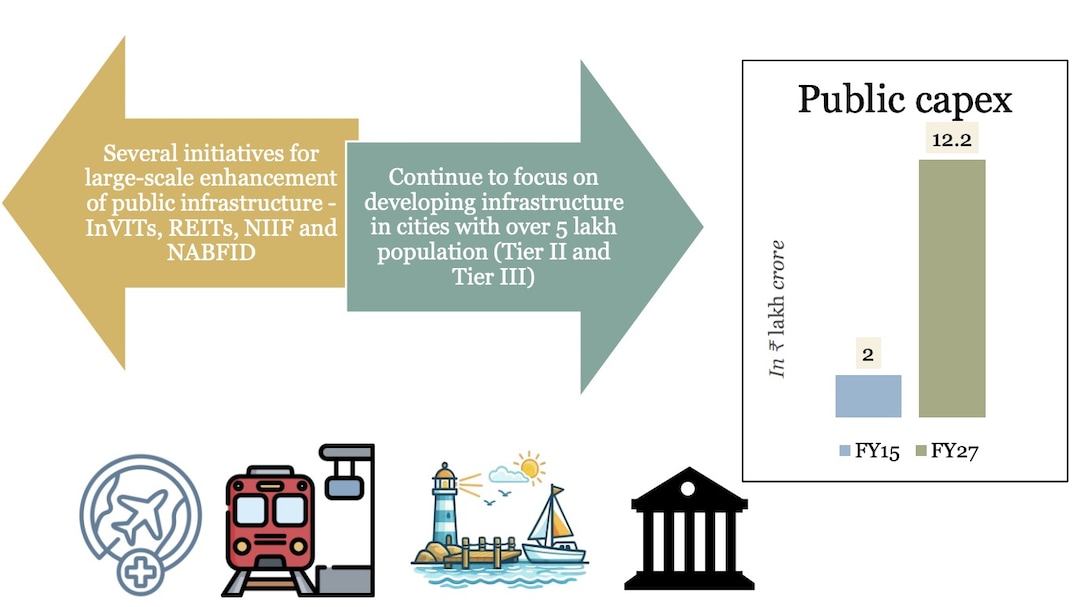
According to the Economic Survey for 2025-26, for every rupee spent on creating infrastructure, GDP increases by Rs 2.5 to Rs 3.5. At present, with capex at 3.1% of GDP, it is indicative of the government's dream of Viksit Bharat and achieving higher economic growth.
The budget has also focused on scaling up manufacturing by rejuvenating legacy industrial sectors and creating ‘champion MSMEs'. For the latter, a dedicated Rs 10,000 crore SME Growth Fund is proposed, and the Self-Reliant India Fund (set up in 2021) will be topped up with Rs 2,000 crore to continue support to micro enterprises and maintain their access to risk capital.
This comes at a time when the private sector seems cautious about stepping up investments.
Other than that, the Union Budget 2026-27 has its focus on ensuring long-term energy security and stability and developing ‘City Economic Regions', recognising that cities are the engines of growth, innovation, and opportunities.
Sectors That Will Benefit From Budget Proposals
Well, here are the following:
Infrastructure, Logistics and Real Estate: An infrastructure risk guarantee fund has been set up to provide prudently calibrated partial credit guarantees to lenders.
Plus, the recycling of real estate assets of CPSEs through the setting up of dedicated REITs. Also, it is decided to establish dedicated freight corridors, operationalise 20 new national waterways (connecting mineral-rich areas, industrial centres and ports), and set up a ship repair ecosystem.
In addition, the government would launch a Coastal Cargo Promotion Scheme to increase the share of inland waterways and coastal shipping from 6% to 12% by 2047, a Seaplane VGF Scheme to indigenise manufacturing, and develop an integrated east coast industrial corridor.
A new scheme has also been proposed to encourage container manufacturing with an allocation of Rs 10,000 crore spread over five years. Seven high-speed rail corridors are also proposed as growth connectors for the economy.
For developing ‘City Economic Regions' with a focus on tier 1 and tier 2 cities plus temple towns, an allocation of Rs 5,000 crore is made.
Semiconductors: The government will launch the India Semiconductor Mission 2.0 (ISM 2.0) to produce equipment and materials, design full-stack Indian IP, and fortify supply chains. It will also focus on industry-led research and training centres to develop technology and a skilled workforce.
Mining and Rare Earth Magnets: A Scheme for Rare Earth Permanent Magnets was launched in November 2025. Now, to support the mineral-rich states of Odisha, Kerala, Andhra Pradesh and Tamil Nadu, it is proposed to establish dedicated Rare Earth Corridors to promote mining, processing, research and manufacturing.
Chemicals: To enhance domestic chemical production and reduce import-dependency, the government is launching a scheme to support states in establishing three dedicated chemical parks through a challenge route on a cluster-based plug-and-play model.
Biopharma: A total outlay of Rs 10,000 crore under the Biopharma SHAKTI (Strategy for Healthcare Advancement through Knowledge, Technology and Innovation) is proposed in the coming five years to build the entire ecosystem for domestic production of biologics and biosimilars.
Besides, three new National Institutes of Pharmaceutical Education and Research will be set up along with seven existing ones being upgraded.
Also, 1,000 accredited clinical trial sites will be built, and the Central Drug Standard Control Organisation will be strengthened.
The other sectors that are likely to benefit from the Union Budget 2026-27 are:
- Electronics (with an outlay of Rs 40,000 crore for the Electronics Components Manufacturing Scheme)
- IT and ITeS (with an outlay of Rs 25 crore has been proposed for building AI missions
- The Animation, Visual Effects, Gaming and Comics with content creator labs across 15,000 secondary schools and colleges
- Textiles
- Energy
- Agriculture
- Fisheries
Overall, it's a progressive budget.
While spending, the government has also been conscious of walking tight on the path to fiscal consolidation. The fiscal deficit target has been pegged at 4.3% of GDP for FY27 compared to 4.4% in FY26. India's debt-to-GDP ratio is estimated to be 55.6% in FY27 versus 56.1% in FY26.
Which Type of Equity Mutual Funds to Consider and Strategy to Follow
Given an all-pervasive budget, by and large, diversified equity funds that have exposure to the aforementioned sectors or industries would be apt. They would help mitigate the risk exposure to a specific sector or theme.
In the core holdings (around 65-70% of your total equity portfolio), you could consider some of the best large cap funds and flexi-cap funds with an investment horizon of around five years or more.
Large cap funds shall help add stability to your portfolio amid volatile times, and the flexi-cap funds potentially aid in delivering better returns if the mid and small caps fare well. In the satellite portfolio, which can be around 30-35% of your total equity portfolio, some of the best mid-cap funds and/or small-cap funds, depending on your risk appetite.
If your risk profile is very high, some of the best sector and thematic funds, such as pharma and healthcare funds, infrastructure funds, transport and logistics funds, defence funds, energy funds, metals and mining funds, and banking and financial services funds, may also be considered. The fortune of these funds will hinge on how the respective sectors and themes actually fare. Given the concentration risk, ideally, ensure sector and thematic funds comprise only a small portion of your overall equity mutual fund portfolio. Avoid going gung-ho.
The core and satellite approach is an investment strategy followed by some of the most successful equity investors around the world. The core portion shall add stability, while the satellite portion shall potentially push up the overall returns of the portfolio.
The overall returns on the equity mutual portfolio you clock would depend on how much you allocate to each type of fund.
Make sure your portfolio is well-diversified and follow the asset allocation best suited for you.
Happy investing!
Disclaimer: The views expressed in this article are solely those of the author and do not necessarily reflect the opinion of NDTV Profit or its affiliates. Readers are advised to conduct their own research or consult a qualified professional before making any investment or business decisions. NDTV Profit does not guarantee the accuracy, completeness, or reliability of the information presented in this article.
Comprehensive Budget 2026 coverage, LIVE TV analysis, Stock Market and Industry reactions, Income Tax changes and Latest News on NDTV Profit.