- Gold remains a key wealth preservation tool despite rising real yields and Fed tightening
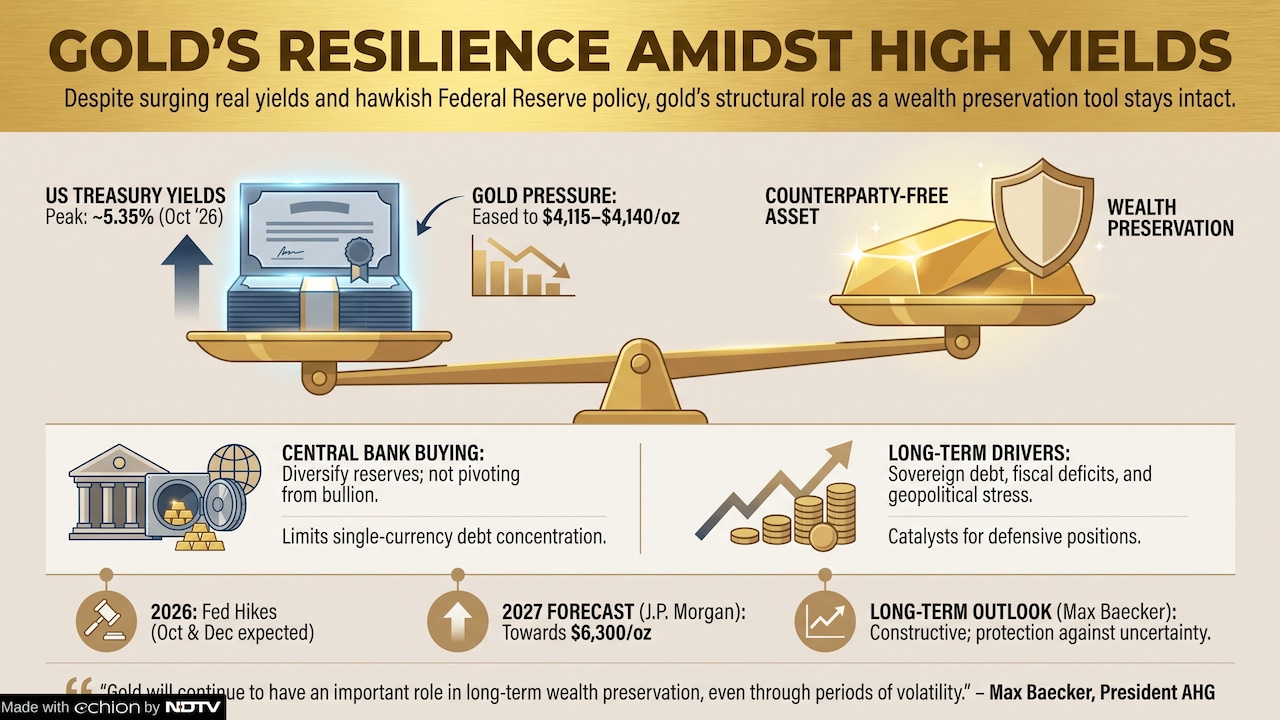
- US 10-year Treasury yields hit 5.35%, pressuring gold prices but no major crash occurred
- Central banks continue buying gold to diversify reserves and limit single-currency risk
Gold's structural role as a wealth preservation tool and counterparty-free asset stays intact, despite surging real yields and a hawkish Federal Reserve policy that may increase the opportunity cost of holding non-yielding bullion, according to Max Baecker, President of American Hartford Gold (AHG).
In an emailed interaction with NDTV Profit, Baecker noted that while guaranteed high real returns on US Treasuries make sovereign debt competitive, gold's value in institutional and retail portfolios rests on risks that interest rate policy cannot eliminate. The bullion is bound to gain traction on expanding sovereign debt, geopolitical stress, and systemic uncertainty, he argued.
Baecker's remarks came in the backdrop of US 10-year Treasury yields peaking at nearly 5.35%, reaching their highest level since 2002. Gold prices have since come under pressure, though a dramatic crash has not been recorded. The bullion eased from a high of $4,225 an ounce last week to around $4,115–$4,140. On India's Multi Commodity Exchange, gold futures continue to stay under pressure, trading below Rs 1.5 lakh per 10 gram.
Also Read | Layoffs Are Rising In Tech, But These Skills Are Helping People Unlock Better Pay
Bullion watchers expect gold to come under increased pressure during the remainder of 2026, as the US Federal Reserve is expected to hike rates twice—in October and December.
While aggressive Fed tightening can trigger sharp short-term paper liquidations in futures and exchange-traded funds, long-term physical buying continues to establish durable price floors, Baecker said.
Justifying his views, the AHG president pointed out that foreign central banks are not pivoting away from bullion into high-yielding Treasuries. This is because, he said, reserve management is executed over multi-year horizons, and holding gold limits single-currency debt concentration.
Higher Treasury yields are attractive, but central banks also have to consider how much of their reserves they want tied to one country's currency and debt. Gold helps diversify that exposure and carries no issuer default risk. Reserve decisions are made over years, so a higher Treasury yield does not automatically change the reasons for holding gold. There is no single yield where central banks collectively walk away, and their purchases should not be treated as a guaranteed floor under prices.
What is also supporting the demand for physical bullion is mounting fiscal deficit in several economies. The concerns surrounding government debt burdens and the viability of a macroeconomic "soft landing" serve as natural catalysts prompting allocators to build defensive positions, he explained.
The institutional bid for gold extends beyond interest-rate cycles, focusing instead on capital preservation during credit squeezes and debt overhangs, according to Baecker.
ALSO READ: Gold Steadies As Stronger Dollar And Yields Weigh On Rate Path
Constructive Outlook For 2027
Looking ahead, Baecker keeps his constructive macro view on gold intact for 2027. While sticky real yields and strengthening US dollar could trigger periodic pullbacks, persistent central bank accumulation and sovereign debt expansion will continue to drive gold's purchasing power over the longer horizon.
My outlook for gold in 2027 is constructive, although I wouldn't attach a precise price target to it. Continued central-bank buying and concerns about government debt could support demand, with additional strength possible if real yields decline. Persistently high real yields and a stronger dollar would create headwinds and could bring meaningful pullbacks. I believe gold will continue to have an important role in long-term wealth preservation, even through periods of volatility.
Even if the Fed embarks on its hawkish blueprint, and thereby compel other major central banks to tighten the rates as well, the case for holding gold will remain intact, Baecker believes. "Further rate hikes could put more pressure on borrowers and increase the risk of an economic slowdown, which can strengthen the case for holding gold. People buy gold because they know they can't predict every risk, and they want some protection against that uncertainty."
"Gold can help diversify a portfolio, although its price can also come under pressure during a selloff. The goal is to be prepared for a range of outcomes, including the possibility that the Fed has a harder time achieving a soft landing," he said.
While Baecker refrained from attaching a price target to gold, institutional desks have given bullish forecasts for the bullion in the medium-to-longer run.
J.P. Morgan Global Research, in a note published in June, projected gold to rise towards $6,300 an ounce by the end of 2027. However, the investor interest that was seen in the precious metal in 2025 has "declined", Greg Shearer, head of Base & Precious Metals at J.P. Morgan, had acknowledged. "Amid this sideways plod, and with growing worries that the Fed might have to respond to energy-driven inflation with hikes, gold is on the back burner for most investors at the moment,” Shearer had stated.
ALSO READ: Check 24K, 22K Gold Prices In Mumbai, Delhi, Chennai, Kolkata, Bengaluru On October 6
Essential Business Intelligence, Sharp Market Insights, Practical Personal Finance Advice, Daily Fuel, Gold and Silver Prices and Latest Stories — On NDTV Profit.