- Gold reached a record high of $5,500 per ounce amid continued rally
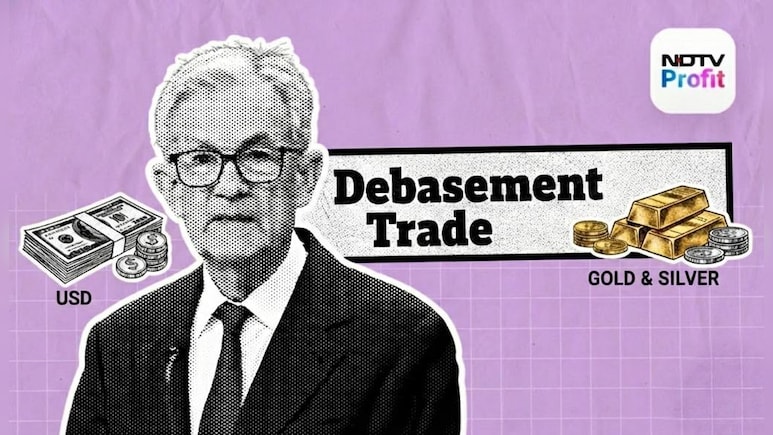
- Debasement trade refers to betting against fiat currencies losing value
- Fiat currencies lose value due to excessive money printing and debt
The gold rally continued on Wednesday, with the precious metal reaching a new record high of $5,500 per ounce. While the US dollar weakness and investors shifted further to safe havens were once again key reasons behind the sustained rally, Bloomberg reports the debasement trade is also playing a key role, of late.
The debasement trade, in fact, is the latest buzzword on Wall Street, especially amid heightened tension between the US government and the US Federal Reserve. But what is it exactly?
Debasement Trade: All You Need To Know
Debasement trade refers to the investment strategy centred on the belief that fiat currencies (such as the US dollar or the Indian rupee) are losing their value or 'reputation' as a reliable means of capital or wealth. This is due to excessive money printing and government spending, which has already shot up the national debt of most countries since the pandemic.
What are fiat currencies? You may ask. These are essentially money issued by governments that have value because people trust it, not necessarily because it has any true underlying value. They are simply 'paper' currencies, which can lose their value overnight if the government announces it no longer holds any value.
This is unlikely to be gold or silver, which are not fiat currencies but rather hard assets that have an underlying value on account of their exclusivity and usage. Interestingly, Bitcoin is not a fiat currency either, but a digital asset, which is not controlled by a government and the supply is controlled by computer code.
Debasement Trade: The Rationale
Traders who belong to the Debasement Trade camp believe that traditional 'safe' assets such as government bonds are no longer safe because they pay back in devalued currency.
Instead, these traders flock towards hard assets like gold, which is considered the standard, given its finite amount and a 5,000-year track record as a store of value.
Similarly, commodities such as silver and copper are seen as hard assets that have industrial value and typically rise in prices when the currency weakens.
Debasement Trade: The Recent Trigger
What has particularly aided the shift towards debasement trade is the recent tension between the US government, led by Donald Trump and the Federal Reserve, led by Chairman Jerome Powell.
Trump has constantly put pressure on Powell, invariably trying to influence fiscal policy. While Powell has remained resilient, the tension between the two parties peaked when the US Chair confirmed he is being probed by the US Department of Justice.
This has led many to fear that the Fed is becoming a captured institution that will prioritise the government's spending needs over fighting inflation. This has been accentuated by the fact that the US national debt is over $38 trillion.
Keeping these factors in mind, it is perhaps fair to acknowledge that gold and silver are no longer just 'commodities' in the current market dynamics, but are fast-emerging as alternative financial assets for the world.
ALSO READ: US Fed Rate Decision: What Does It Mean For Indian Markets?
Essential Business Intelligence, Sharp Market Insights, Practical Personal Finance Advice, Daily Fuel, Gold and Silver Prices and Latest Stories — On NDTV Profit.