- Only four of 11 automakers reported positive returns since GST rate cut implementation
- TVS Motor, Bajaj Auto, Eicher Motors, and Ashok Leyland stocks gained significantly
- Hero MotoCorp, Maruti Suzuki, Mahindra & Mahindra, and Tata Motors PV saw declines
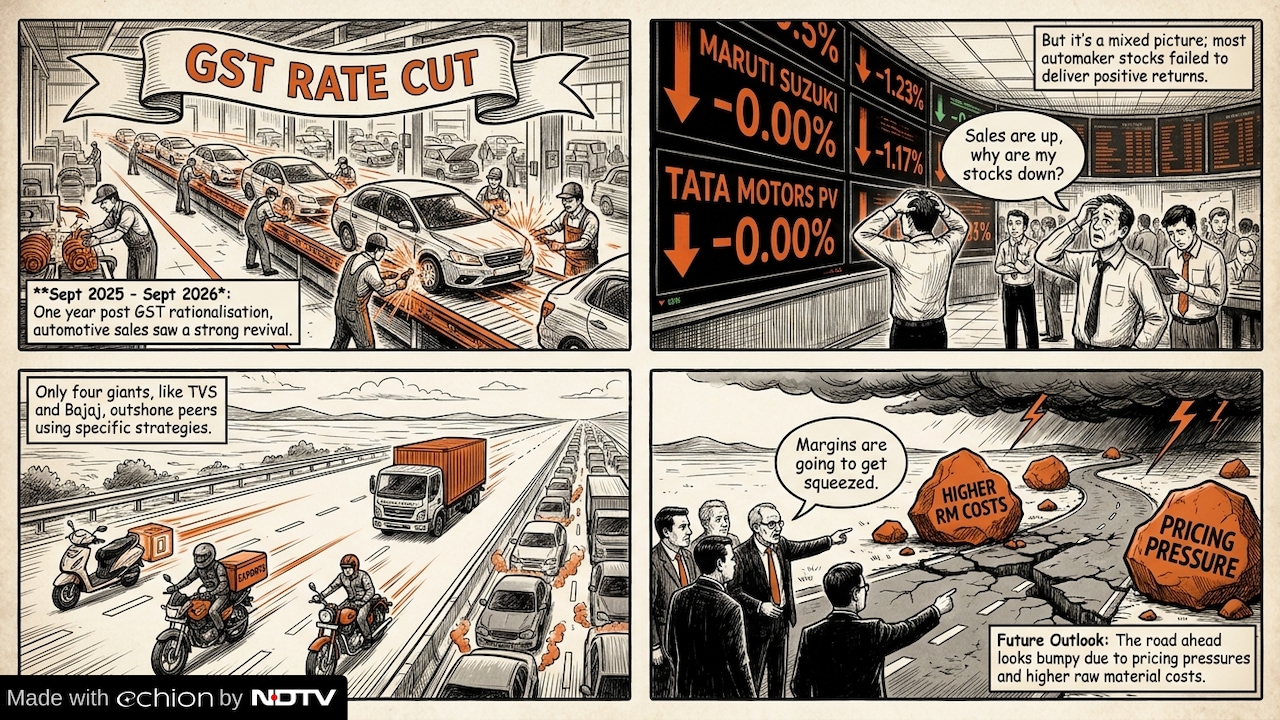
One year post GST rationalisation, the picture looks mixed for automotive manufacturers. On the one hand, sales have risen; on the other, most of the stocks have failed to deliver positive returns.
Only four out of 11 automakers have reported positive returns year-on-year since the GST rate cut implementation, despite seeing a strong revival in sales because of the rationalisation.
Between Sept. 22, 2025 and Sept. 22, 2026, stocks of auto giants like TVS Motor Company Ltd., Bajaj Auto Ltd., Eicher Motors Ltd., and Ashok Leyland Ltd. have outshone their peers.
Also Read | Layoffs Are Rising In Tech, But These Skills Are Helping People Unlock Better Pay
In the stipulated duration, TVS Motor has gained 18.3% to Rs 4,171 from Rs 3,525, followed by Bajaj Auto, which is up 26.1% to Rs 11,414 from Rs 9,055. Eicher Motors has risen 8.2% to Rs 7,516 from Rs 6,946, while Ashok Leyland has gained 17.3% to Rs 163 from Rs 139.
Among the laggards, Hero MotoCorp has declined 2.7% to Rs 5,285 from Rs 5,429, while Maruti Suzuki is down 23.5% to Rs 12,103 from Rs 15,816. Mahindra & Mahindra has fallen 14.8% to Rs 3,052 from Rs 3,584, while Tata Motors PV has declined 28.0% to Rs 303 from Rs 421.
Hyundai Motor has fallen 18.9% to Rs 2,208 from Rs 2,721. Escorts is down 23.5% to Rs 2,798 from Rs 3,656, while Tata Motors Ltd has risen 34.3% to Rs 442 from Rs 329 since its November 2025 listing.
What Worked For The Winners?
These four players were able to buck what seems like a broad-based trend; the reason behind each one is unique. For instance, in TVS Motors' case, strong EV & ICE Scooter sales boosted returns.
Bajaj Auto's export sales continued to offset domestic weakness; the launch of Royal Enfield's entry-level Hunter model was a key driver for first-time buyer share.
Finally, in Ashok Leyland's case, demand for Medium and Heavy Commercial Vehicles (MHCV) showed resilience despite fuel price volatility.
What To Expect?
The road ahead for automakers looks rather bumpy as pricing pressure is clearly visible in car sales and passenger vehicle makers.
Two-wheeler and truck makers have already hiked prices. A higher second-half base for tractors looms and could restrict growth after a breakthrough fiscal 2026.
Most importantly, higher raw material costs could be a drag on margins, ultimately resulting in further pressure on stock prices.
Essential Business Intelligence, Sharp Market Insights, Practical Personal Finance Advice, Daily Fuel, Gold and Silver Prices and Latest Stories — On NDTV Profit.