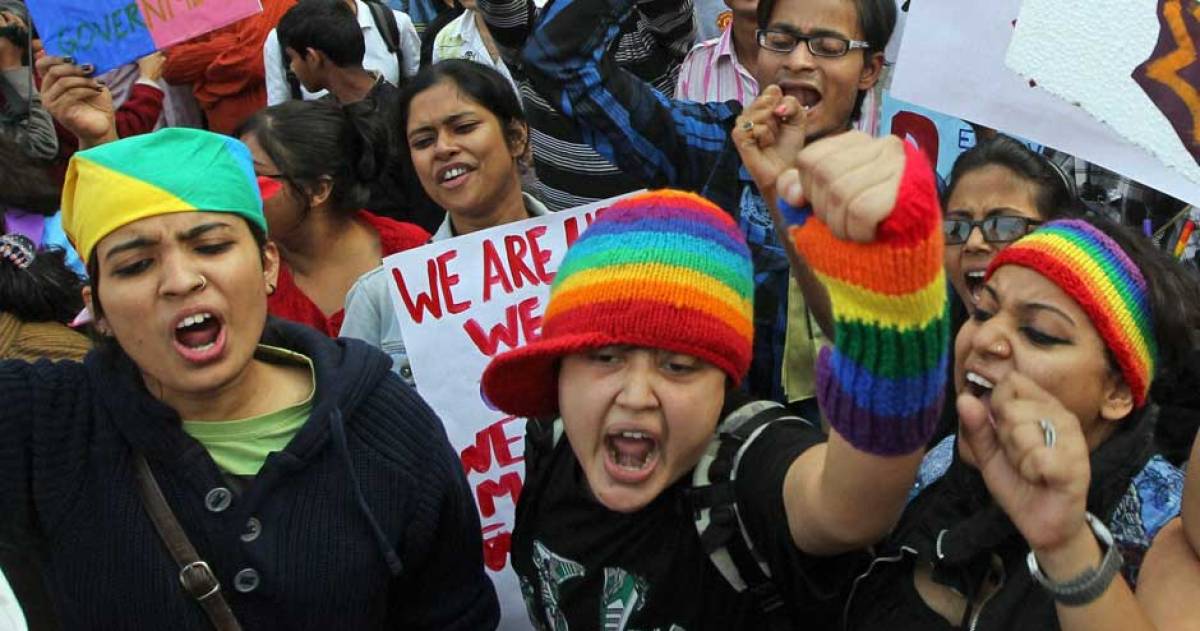
Former Attorney General of India and Senior Advocate Mukul Rohatgi, who started arguing for petitioners, said the 2013 Supreme Court judgment that upheld Section 377 was bad in law and has to be struck down. Rohatgi said sexual orientation is not a matter of choice but is innate, and something that is natural cannot be criminalised.
Justice Malhotra, during the arguments, observed that homosexual behaviour is found not just in humans, but animals as well.
Senior Advocate Arvind Datar said that central government had not challenged the 2009 Delhi High Court decision that struck down Section 377. He also cited the recent nine-judge verdict that held privacy to be a fundamental right. In that judgment, he said, the apex court noted that “right to privacy includes decisional privacy which is an ability to make intimate decisions primarily consisting one’s sexual or procreative nature and decisions in respect of intimate relations”.
Continuing arguments for petitioners, Advocate Menaka Guruswamy called Section 377 “arbitrary” and one that is based on ideas of Victorian morality. Citing Article 15 that bars discrimination on the basis of sex, she argued Section 377 discriminates on basis of sex of a person’s sexual partner; and, hence, hits the bar placed by Article 15, making it unconstitutional.
Guruswamy also cited the recent case of Hadiya, the Kerala medical student who had embraced Islam and wanted to marry a Muslim man. The top court, in that case, had held that the right to choose a partner a fundamental right. Section 377 criminalises choosing a same-sex partner and hence violates the principle enunciated in the Hadiya case, she argued.
Senior Advocate Anand Grover also highlighted arbitrary application of Section 377 due to its poorly defined scope. He cited the example of a man who was held for distributing condoms to gay men and didn’t find a lawyer to represent him.
The petitioners also argued on the impact on the mental health of the members of the LGBTQ community. Justice Chandrachud agreed that society has developed in a manner which has led to disdain for the community, impacting their mental health.