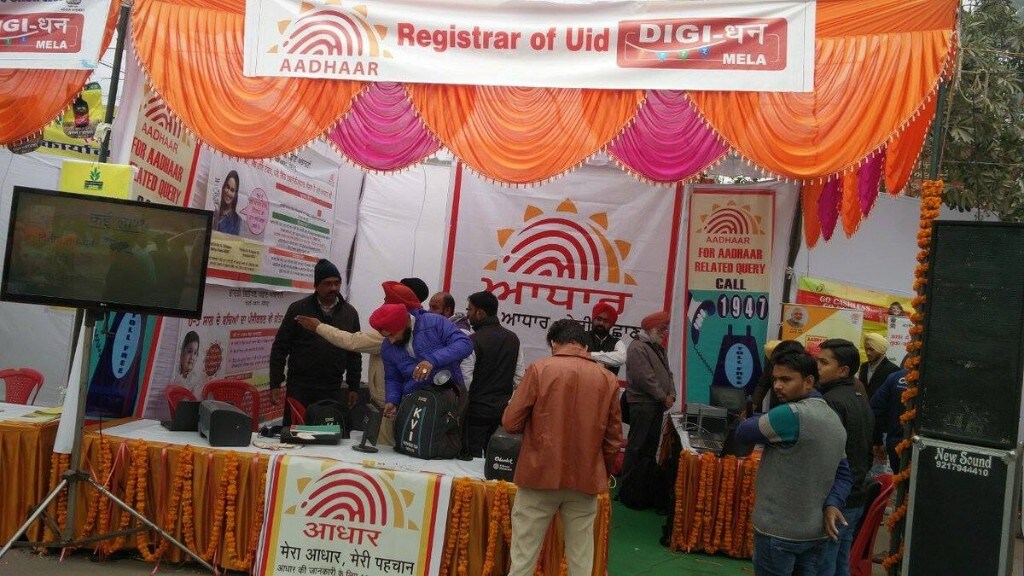
Aadhaar Seva kendra. (Source: Aadhaar Official Account/Facebook)
8 years ago
Jan 18, 2018
The Supreme Court is hearing petitions challenging the validity of Aadhaar starting today. Get live updates on hearings related to Aadhaar's validity on BloombergQuint.
Divan emphasised that in the privacy judgement the apex court had noted that public welfare can only be sustained when individual liberties and freedoms are respected.
Shyam Divan, the lawyer arguing for the petitioners, made the following arguments.
Aadhaar is completely invasive and nothing about the process is voluntary
There is no contractual relation between the UIDAI and the agency collecting private information of citizens
We are being forced to part with private information with someone who we dont know and have no contractual relation with
The machines used at the time of authentication process is are of poor quality which makes it difficult for senior citizens and manual labourers to enroll
Everything about this programme is unconstitutional
Senior advocates, P. Chidambaram and Arvind Datar, who were representing two of the petitioners separately, explained how the Aadhaar Act 2016 didn't fulfill the criteria for a money bill. CJI Dipak Misra had asked them to explain.
They cited two landmark Supreme Court cases (Kihoto Hollohan and Rajam Ram Pal) and said that the apex court has the power to review laws passed by the Parliament on the basis of an irregularity.
Shyam Divan, appearing for petitioners, said that current Aadhaar architecture goes beyond verification to 'tracking of a person'. It allows the creation of a complete profile of an individual's actions.
When asked by Justice Sikri how Aadhaar is different from giving biometrics to a foreign country when visiting on a visa, Divan said in such a case, biometrics are only matched when a person enters the foreign country. After that, the foreign government does not require fingerprints or any data tied to a person's fingerprints, through the rest of the stay.
Highlighting the difference between a pervasive and non-pervasive system, Divan said Aadhaar is a pervasive system because the government can build an electronic trail of the person's activities through cross-linking of databases. It doesn't matter whether anyone is actually tracking in individual, but that such an architecture is possible, he argued.
While Divan discussed the functions of the Unique Identification Authority of India, Justice Chandrachud makes the first observation of the proceedings. Ne noted that very few posts have been filled in the organization.
Divan pointed out how this demonstrates the lack of governmental oversight in the organization.
A declaration from the court safeguarding the physical autonomy of individuals against the State
If this is not granted, a right to opt out of the Aadhaar program and for their data to be destroyed
If the Aadhaar Act is held to be constitutional, the court must pass an order guaranteeing that no citizens will be deprived of any rights or benefits because they haven’t enrolled for Aadhaar.
The Supreme Court bench hearing the argument consisted of Chief Justice of India Dipak Misra, and Justices AK Sikri, DY Chandrachud, AM Khanwilkar and Ashok Bhushan.
The hearing follows a Supreme Court Constitutional Bench’s unanimous ruling in August last year that privacy is a fundamental right.
During the last five years, the top court has dealt with subsequent challenges like the one against linking the ID with the Permanent Account Number used for filing taxes. The government has already extended the deadline to link Aadhaar to bank accounts and mobile subscriptions till March-end. And it has rejected privacy concerns saying the biometric database has never been breached.