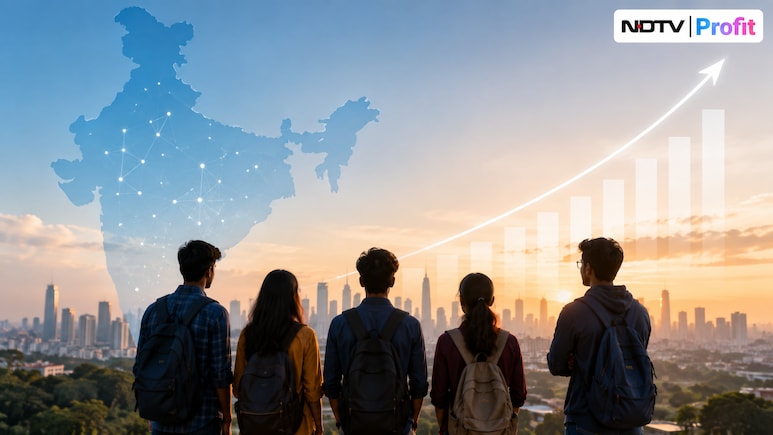
For nearly two decades, India's economic story has rested on three enduring strengths. We have celebrated ourselves as one of the world's youngest major economies. We have taken confidence from the resilience of domestic consumption. We have reassured ourselves that demographics would continue supporting growth long after many advanced economies had begun ageing.
These are usually discussed as independent advantages. Increasingly, they deserve to be understood as parts of the same economic story. The recent student protests offer an unexpected opportunity to revisit that story. They have naturally attracted political debate, as every public protest inevitably does.
Yet politics alone risks reducing a much larger national conversation into a contest of immediate positions. Beneath the slogans lies a generation expressing something that deserves the attention not only of governments, but also of corporate boardrooms, investors and business leaders.
The young Indians occupying our universities today will soon become the country's largest workforce, its fastest-growing consumer segment, its future entrepreneurs, homebuyers, borrowers, systematic investors and taxpayers. Looking at them only through the prism of protest underestimates their significance. They are, in many ways, the earliest visible signal of India's next economic cycle.
ALSO READ | The Invisible Contract Between Promoters And Their Children
Corporate India has become exceptionally good at reading technological change. Artificial intelligence occupies board agendas with understandable urgency. Geopolitics is redrawing supply chains that took decades to establish. Climate transition is influencing capital allocation across industries.
Every serious organisation is attempting to prepare for a future that appears increasingly uncertain. Yet another transition is unfolding quietly alongside these developments. It rarely appears on strategy presentations because it cannot yet be measured through financial statements or quarterly earnings. It is unfolding through human behaviour.
Markets have always changed after people did.
The internet did not transform commerce the day it was invented. It transformed commerce after people began trusting digital transactions. Smartphones did not reshape industries because they became smaller or faster. They reshaped industries because they altered habits, expectations and everyday decisions.
Digital payments became an economic story only after millions changed their relationship with money itself. Technology undoubtedly accelerates change, but behaviour determines whether that change becomes economically meaningful.
The same principle now applies to India's demographic dividend.
ALSO READ | The Best Successor Isn't You
For years, economists have measured that dividend through workforce participation, median age and consumption potential. Businesses have viewed it through the lens of market size and future demand. Those measures remain valid, but they no longer appear sufficient. Demographics influence economies through confidence long before they influence them through statistics.
Young people spend when they feel secure about tomorrow. They borrow when they believe future incomes will justify today's commitments. They invest systematically when they trust that long-term wealth creation remains possible. They become entrepreneurs when the rewards of risk appear greater than the costs of failure. Confidence quietly connects aspirations to economic activity.
Talking to students over the past several months, one observation has become increasingly difficult to ignore. The anxiety many express extends well beyond finding employment. It is about the durability of livelihoods themselves. Artificial intelligence is beginning to redefine professions before many careers have properly begun. Skills depreciate faster than ever before.
Housing continues to move further beyond the reach of many young professionals. Stable employment often coexists with unstable expectations. Social mobility, once taken for granted by many families, now appears less predictable than it did even a decade ago. Every generation has lived through uncertainty. Few have entered adulthood confronting so many uncertainties simultaneously.
It is against this backdrop that the communication of younger Indians also deserves to be understood. Public debate has spent considerable time discussing the language, tone and methods adopted by this generation. That discussion, while understandable, often overlooks a more fundamental question. Behaviour does not emerge in isolation. It emerges from lived experience.
A generation uncertain about livelihoods, careers and future opportunity is unlikely to communicate with the measured patience of one that inherited greater economic certainty. Before institutions judge the manner in which young people express themselves, they may first need to understand the conditions that have shaped that expression.
Behaviour Changes Before Markets Do
The country's growth model rests disproportionately on domestic demand. Consumption has remained one of the economy's most dependable strengths precisely because Indian households have continued to display confidence in their economic future. That confidence has encouraged spending, borrowing, investing and entrepreneurship even through periods of uncertainty.
When confidence weakens, behaviour changes long before economic statistics acknowledge it. Young families postpone buying homes. Discretionary spending becomes more cautious. Entrepreneurial risk is deferred. Long-term financial commitments are reconsidered. None of these shifts appears immediately in quarterly earnings. Yet each gradually reshapes demand, investment and economic momentum.
This is why the future of work can no longer be examined independently of the future of workers. Artificial intelligence will undoubtedly redefine productivity, automate tasks and reshape organisational structures. Equally significant is the psychological adjustment accompanying that transition.
Previous generations entered workplaces assuming that careers would evolve predictably with experience. Today's young professionals begin their working lives knowing that entire professions may be transformed before they reach mid-career. That awareness inevitably influences decisions about learning, mobility, financial planning and risk-taking.
It also influences expectations from employers. Continuous learning is no longer a developmental aspiration. It has become an economic necessity. Stability is valued differently when change itself has become permanent.
ALSO READ | 'Lack Of Communication' Is Business Families' Most Expensive Risk
Older generations occasionally respond to these expectations with impatience. They question the language, urgency and informality with which younger employees engage institutions. Yet every generation develops its own vocabulary for expressing uncertainty.
The industrial economy produced one kind of workplace. Liberalisation produced another. The digital economy has produced yet another. Judging a generation's communication without understanding the economic circumstances shaping it offers only a partial reading of the problem. Institutions naturally prefer order. Periods of structural transition rarely arrive in orderly ways.
For boards, this demands a broader understanding of risk. Financial capital, technology and market share will remain central to strategy, but they are no longer sufficient to explain competitive advantage. Organisations also need the ability to interpret behavioural changes in demographic layers before it becomes market change.
That capability may prove as valuable as technological sophistication. Companies that understand how young Indians think about work, consumption, trust, institutions and opportunity are not simply improving talent management. They are developing an earlier understanding of the economy they will be operating in over the next two decades.
India's demographic dividend has always been measured through numbers. The next decade will determine whether it should instead be measured through confidence.
The generation entering India's workplaces today will determine far more than the future of work. It will determine the future of India's consumption economy, capital markets and long-term growth. That makes preserving confidence in opportunity one of the country's most important economic priorities-and one of Corporate India's most consequential strategic responsibilities.
Disclaimer: The views expressed in this article are solely those of the author and do not necessarily reflect the opinion of NDTV Profit or its affiliates. Readers are advised to conduct their own research or consult a qualified professional before making any investment or business decisions. NDTV Profit does not guarantee the accuracy, completeness, or reliability of the information presented in this article.
Essential Business Intelligence, Sharp Market Insights, Practical Personal Finance Advice, Daily Fuel, Gold and Silver Prices and Latest Stories — On NDTV Profit.