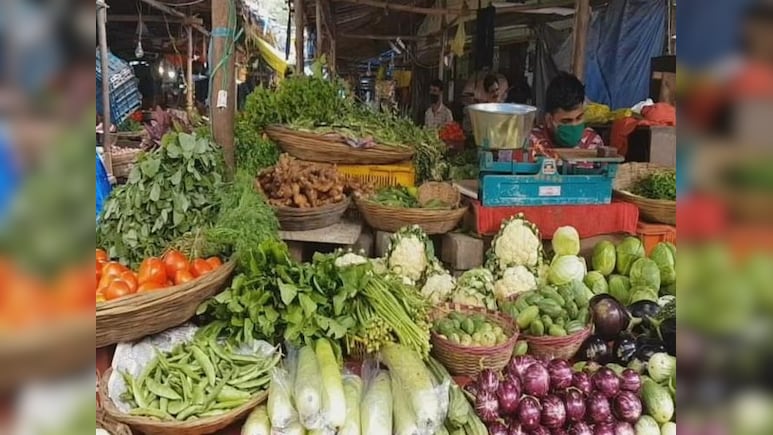
India's consumer price index (CPI)-based inflation for January 2026 rose to 2.75% on higher food and precious metal prices, as part of the first compiled data under the new CPI series. The base year for the CPI has been moved to 2024 from 2012 earlier. In the consumption basket, the number of weighted items has increased from 299 to 358 in CPI 2024. Goods items has increased from 259 to 308, and services items has risen from 40 to 50. The new series will ensure that inflation accurately reflects the average household's current consumption patterns, while adding rural house rent for the first time.
The corresponding inflation rates for rural and urban areas stood at 2.73% and 2.77%, respectively. Housing inflation stood at 2.05%. Statistics ministry data released on Thursday, Feb. 12, also showed that food inflation under the revised series rose to 2.13% year-on-year, though its overall impact on headline inflation is expected to be lower than in previous series because of the reduced weighting. The corresponding food inflation rates for rural and urban stood at 1.96% and 2.44% respectively.
ALSO READ: New CPI Series To Improve Basis For Formulating Monetary, Fiscal Policies: CEA Nageswaran
Also Read | Layoffs Are Rising In Tech, But These Skills Are Helping People Unlock Better Pay
India's CPI inflation print in January 2026
The government did not release comparable annual data for key components under the new series but data showed a sequential decline in food prices, with the cost of a broader basket of goods remaining broadly stable. ''The print indicates a firming in price momentum compared with the unusually soft readings seen toward the end of 2025, when food prices had kept headline inflation subdued,'' said Sujan Hajra, Chief Economist & Executive Director, Anand Rathi Group.
According to the new CPI series, Telangana had the highest inflation at 4.92%, followed by Kerala and Tamil Nadu. The top five items with low inflation in January were garlic, onion, potato, arhar, tur dal, and peas. On the other hand, high inflation was in silver jewellery, tomato, coconut-copra, gold, diamond, platinum jewellery, and coconut oil. Personal care inflation, which includes gold and silver jewellery, was a high 19.02%, as silver jewellery inflation was 160%, while gold inflation was 47%.
Division wise inflation based on Consumer Price Index for the month of January 2026 with revised base year 2024=100.#KnowYourStats #DataForDevelopment #CPI #Retailinflation@PMOIndia @_saurabhgarg @PIB_India @PibMospi@Rao_InderjitS @mygovindia @NITIAayog pic.twitter.com/wyybMN5gGD
— Ministry of Statistics & Programme Implementation (@GoIStats) February 12, 2026
Will RBI cut rates after new CPI print?
The Reserve Bank of India decides on monetary policy based on the CPI data. It aims to keep retail inflation contained in a band of 2% to 6%. Despite the increase in January 2026 from December 2025, the CPI print returned to the central bank's target band for the first time since August. Benign inflation and high economic growth have prompted the Reserve Bank of India (RBI) to cut interest rates steeply over the last year, even though it held rates earlier in February.
"We do not expect the new inflation series to materially influence policy in the near term. An extended rate pause looks likely, underpinned by a cyclical upturn in both growth and inflation and improving confidence following the conclusion of the US-India trade negotiations," said Madhavi Arora, chief economist at Emkay Global Financial Services.
According to Sanjay Kumar, MD & CEO, Rassense Pvt Ltd, the spike in retail inflation during January was majorly due the rise in food prices along with alterations in components with 2023-24 as the base. Technically, it is a good sign that in-spite of the changes, inflationary trend has remained well-within the comfort band of the RBI, according to Kumar.
This will help sustain household purchasing power and confidence, supporting continued spending on essential and discretionary good alike, keeping the pricing dynamics balanced. ''While this can be taken positively, it is critical to be watchful of how the situation takes shape in 2026, especially in the wake of economic volatilities due to global headwinds,'' he said.
Upasna Bhardwaj, Chief Economist, Kotak Mahindra Bank believes the core inflation was significantly lower than expectations. ''While inflation trajectory remains fairly benign, we believe RBI's rate cutting cycle has come to an end, with the RBI likely to continue to hold rates on pause for an extended period through CY26 at least,'' said Bhardwaj.
ALSO READ: January Inflation Data To Be Based On New CPI Series With Base Year 2024
New CPI series with revised consumption basket: What's new?
The government is updating the base year for CPI data after more than a decade. As part of methodology upgrades, the ministry has begun collecting prices from e-commerce and digital platforms, including Amazon and Swiggy, across 12 cities with populations above 2.5 million. The pices for airline tickets and OTT streaming services such as Netflix are also being added. The retail inflation, under the old series with base year 2012, was 4.26% in January 2025 and 1.33% in December.
The new additions in the 2024 series are rural housing, online media service providers/streaming services, value-added dairy products, barley and its products, pen-drive and external hard disk, attendant, babysitter, and exercise equipment. The new series has removed VCR/VCD/DVD players, hiring charges, radio, tape recorder, clothing second-hand, CD/DVD audio/video cassettes and coir/rope. Share of food and beverages has declined in the new series to 36.75% from 45.86% in the CPI 2012. However, it remains the largest component of the CPI basket.
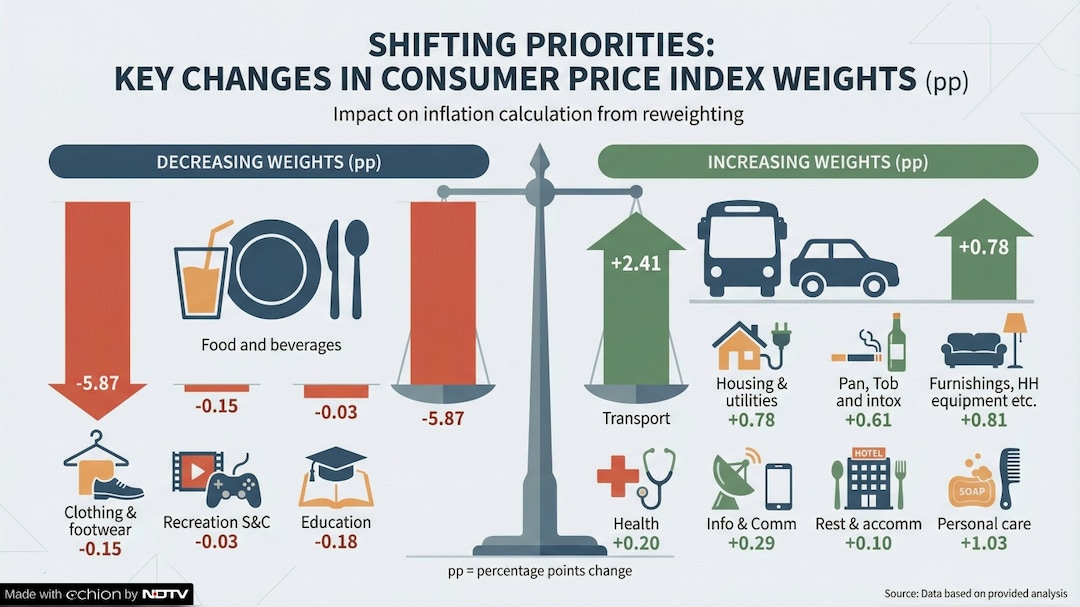
CPI for January 2026 with revised base year 2024=100
Photo Credit: MoSPI
Saurabh Garg, secretary at the Ministry of Statistics and Programme Implementation (MoSPI), told NDTV Profit earlier today that the revision in CPI that measures retail inflation will not only reflect new consumption trends but also play a key role in government decision making and serve as a critical indicator for businesses. MoSPI plans to revise the GDP base year every five years and conduct the next household consumption survey after a three-year gap, according to Garg.
Deepti Srivastava, Deputy Director General, MoSPI said that there is a 40% increase in towns covered for the new CPI series with a 25% increase in services items. According to Chief Economic Advisor V. Anantha Nageswaran, the new CPI series is first of the many milestones from the MoSPI. ''It aligns us with the best practices in the world. The economy has undergone a significant change in the last decade. The new CPI series represents the evolving composition of consumption,'' said CEA Nageswaran.
There is a progressive diversification of expenditure, in line with a growing economy, according to the CEA. The revised basket highlights the role of services items. Services account for rising share of economic activity. He added that the digital channels for price formation are increasing. The policy implications include better inflation signals to prevailing economic conditions. With the new CPI print, policymakers have more updated information to assess purchasing power and other trends. Inflation will become more driven by core, rather than food and will make inflation data less volatile, according to CEA Nageswaran. It could also see better Budget predictability. ''The CPI now captures housing costs more accurately as urban bias reduced in new data. India inflation data can be better compared globally now,'' added CEA Nageswaran.
ALSO READ: CPI Revision Will Make Better Government Policy, Help Businesses, Says MoSPI Secretary
Essential Business Intelligence, Sharp Market Insights, Practical Personal Finance Advice, Daily Fuel, Gold and Silver Prices and Latest Stories — On NDTV Profit.